Corn marigold
Glebionis segetum. Family Asteraceae. Annual.
Also called Corn chrysanthemum, Chrysanthemum segetum.
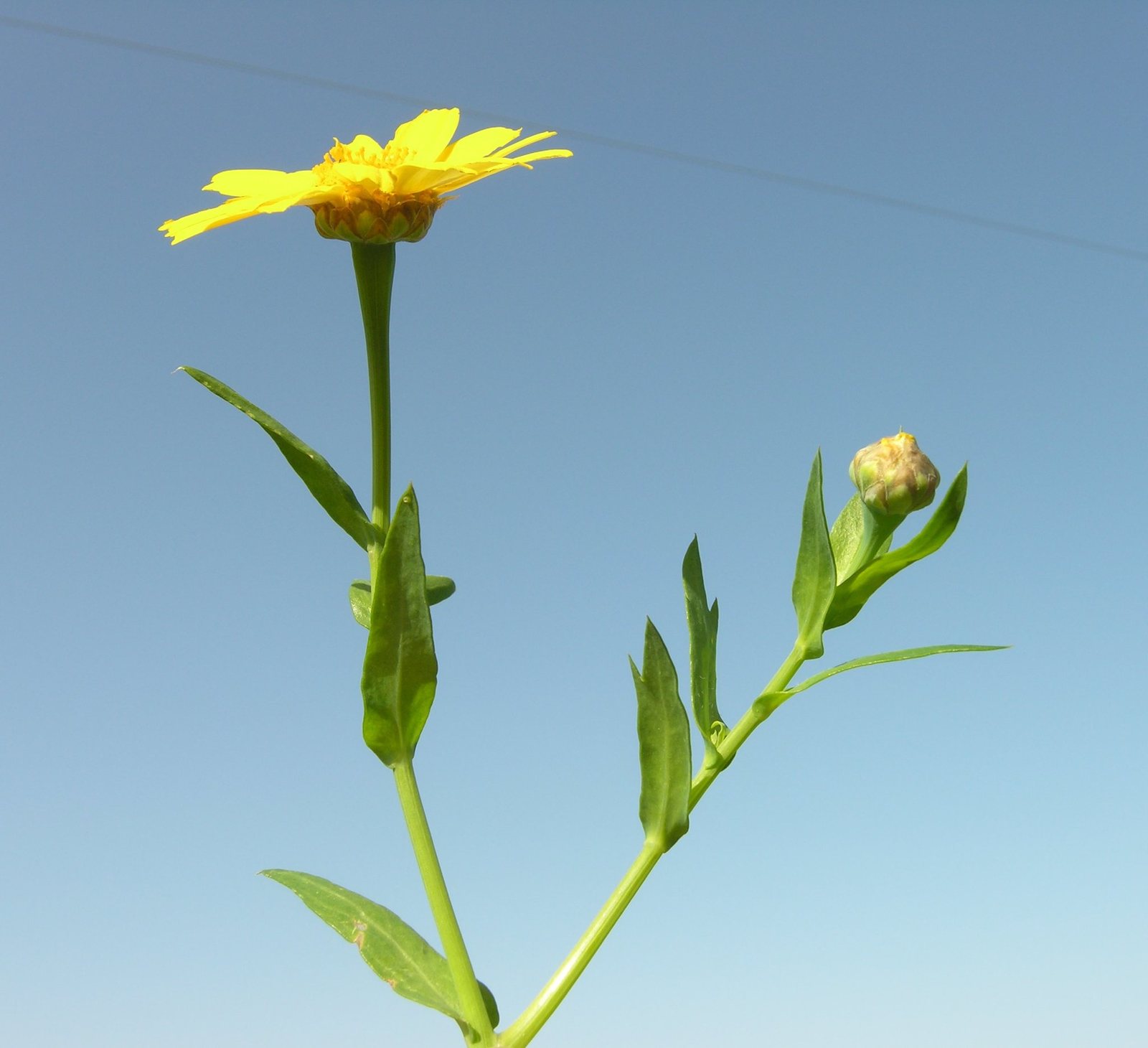
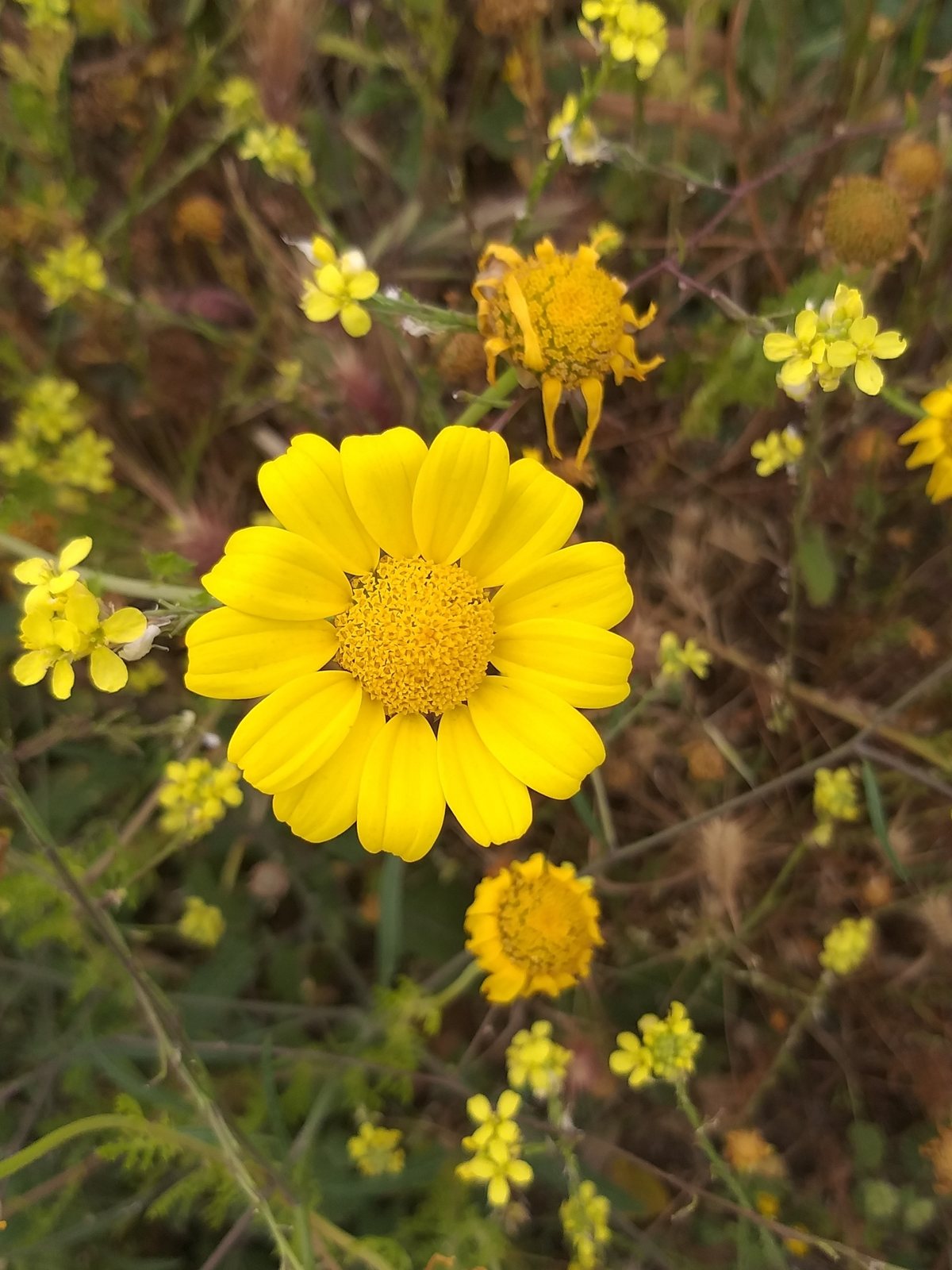
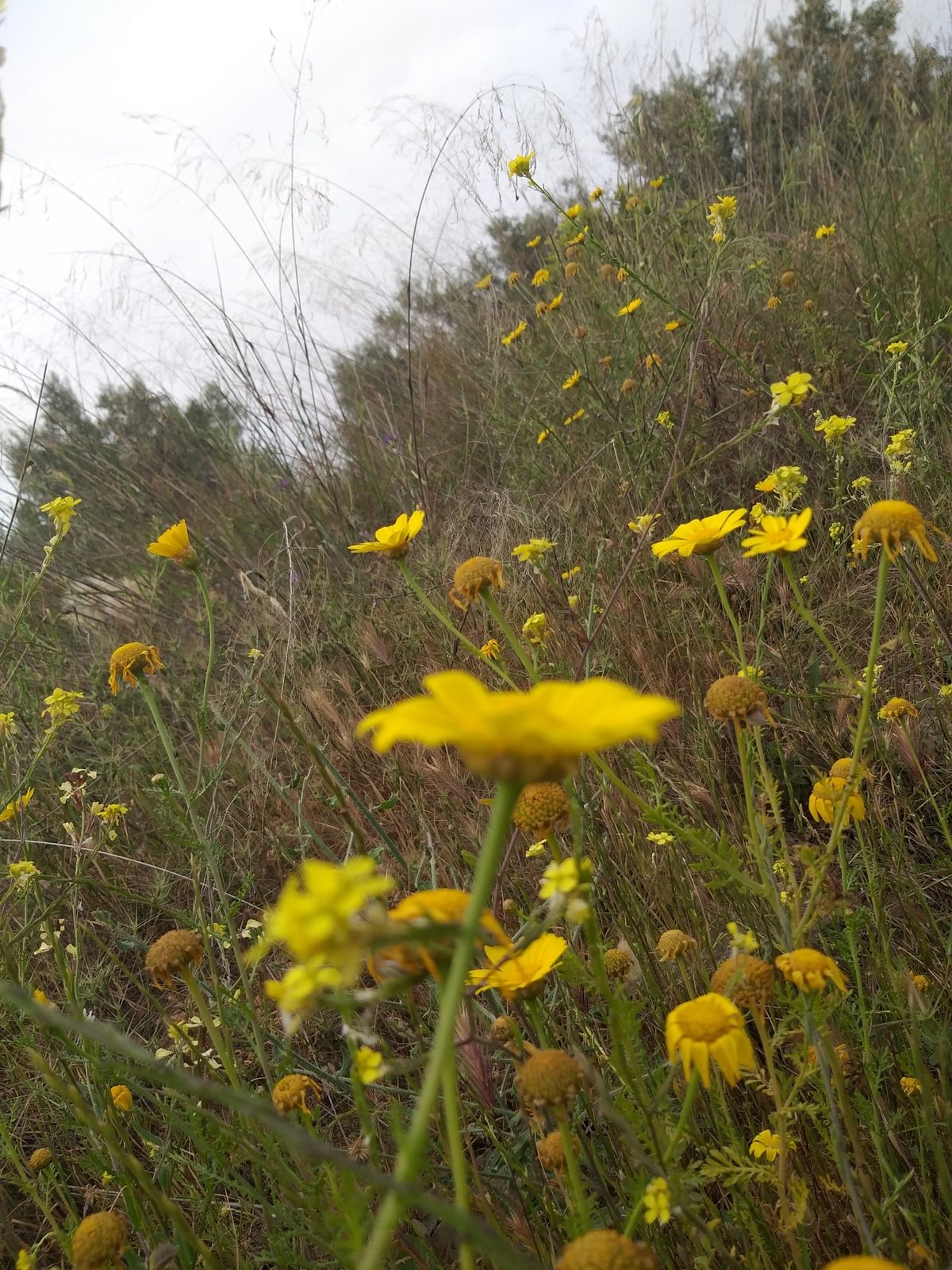
Corn marigold is grown as an annual for its bright yellow daisies above blue-green foliage. Traditionally associated with cultivated fields, it brings summer colour to annual wildflower patches and informal borders, especially on open, recently disturbed soil.
At a glance
- Sun
- Full sun.
- Water
- Water regularly during germination and establishment; established plants tolerate short dry spells but flower better with occasional watering in prolonged drought.
- Soil
- Well-drained, moderately fertile soil, preferably slightly acidic to neutral. Avoid waterlogged ground and heavily enriched soil.
- Height
- 1-2.5 ft (0.3-0.75 m)
- Spread
- 0.5-1.5 ft (0.15-0.45 m)
- Flowers
- Golden-yellow daisies with yellow centres, from late spring or early summer into autumn, depending on sowing time and climate.
- Foliage
- Blue-green, slightly fleshy leaves with irregular teeth or shallow lobes; upper leaves clasp the stems.
- Growth
- Fast; flowers in its first growing season.
- Care needed
- Low
The year at a glance
- Pollinators
- Low allergen
| J | F | M | A | M | J | J | A | S | O | N | D | |
|---|---|---|---|---|---|---|---|---|---|---|---|---|
| Flowers | ||||||||||||
| Fruit | ||||||||||||
| Plant |
Northern hemisphere months. In Australia, shift them by six.
- Difficulty
- Easy
- Toughness
- Fairly tough
Will it suit your garden?
Pick your zone, country, light and whether you have pets.
Full sun is 6 or more hours of direct sun a day, part shade 3 to 6 hours, shade under 3.
How it grows
Planting day
0.5 ft (0.15 m)
After 1 year
1.7 ft (0.53 m)
full size
Full size in one season.
From a typical nursery size, at an average rate for this kind of plant. A rule of thumb, not a forecast.
Good to know
- Cats and dogs
- Mildly toxic: may upset a stomach
- Invasive in
- Australia
- In the garden
- Spreads vigorously: plan to contain it.
- Growth rate
- Fast
Care
Jobs through the year
- WaterMar–May, Sep–Oct, every 14 days
- Water established plants only if soil is dry; keep newly sown seedbeds consistently moist.
- WaterJun–Aug, every 10 days
- Water established plants during prolonged dry weather; skip after substantial rain.
- DeadheadMay–Oct, every 7 days
- Remove faded flowers to prolong bloom; leave a few heads if seed is wanted.
- ProtectMar–May, Sep
- Protect emerging seedlings from slugs and snails.
- PruneSep–Oct
- Pull up finished plants before seed ripens where self-sowing is unwanted.
- Sow directly into weed-free, lightly raked soil and cover the seed lightly.
- Keep the seedbed moist until seedlings are established, then water during extended dry weather.
- Thin seedlings to about 8-12 in (20-30 cm) apart for sturdy, branching plants.
- Avoid routine feeding and rich manure, which encourage leafy growth and flopping.
- Keep heavy mulch away from areas where you want seedlings to emerge.
Pruning. Remove faded flowers through summer to prolong flowering, leaving a few heads only if you want seed. Pull up plants after they finish flowering, before seed ripens where spreading is unwanted.
Through the year
- Early spring
- Prepare an open, weed-free seedbed; avoid adding rich compost or fertiliser.
- Spring
- Direct-sow when the soil is workable, then keep the surface moist during germination.
- Late spring
- Thin crowded seedlings and remove competing weeds.
- Summer
- Deadhead regularly and water during prolonged drought.
- Early autumn
- Collect ripe seed from dry, brown flower heads, or remove plants before they shed seed.
- Autumn
- In mild-winter areas, sow a small batch outdoors for earlier flowering the following year; use spring sowing where winters are severe.
In the garden
- Sow in annual wildflower patches with cornflowers and field poppies for a traditional arable-field display.
- Use in loose drifts near the front or middle of sunny cottage borders.
- Fill temporary gaps between young shrubs or perennials while their canopies remain open.
- Combine with airy annuals and fine grasses for a light, informal summer planting.
Garden styles it suits: Cottage garden, Wildflower, English country, Pollinator garden, Farmhouse and Modern rustic.
Plant it with: Cornflower, Field poppy, Corn chamomile, Love-in-a-mist, California poppy and Quaking grass.
Wildlife: The open flower heads provide pollen and nectar for bees, hoverflies and other visiting insects. It is an introduced species in many regions, so include locally native flowers as well.
Problems to watch for
- Slugs and snails can destroy seedlings; inspect at dusk and use barriers or locally approved controls where needed.
- Aphids may gather on young shoots; wash off small colonies and encourage natural predators.
- Rich soil, shade or crowding can cause tall, floppy growth; grow in full sun, thin seedlings and avoid extra feeding.
- Seedlings struggle in dense grass or heavy mulch; provide patches of bare soil rather than sowing into an established lawn.
Safety
Reliable species-specific toxicity information is limited for people, cats, dogs and horses; it should not be assumed safe to eat or graze. Keep foliage, flowers and seed out of animal feed. Contact may irritate the skin of people sensitive to plants in the daisy family.
Where it spreads. Can self-seed freely on disturbed ground and become an agricultural weed. It is an introduced weed in parts of southern and western Australia; check local weed guidance before sowing, especially near farmland or natural areas.
Easily confused with
Crown daisy (Glebionis coronaria)
Usually taller, with deeply divided leaves; flowers may be entirely yellow or have white outer rays. Corn marigold has broader, toothed or shallowly lobed leaves.
Pot marigold (Calendula officinalis)
Has softly hairy, often sticky green leaves and large, curved seeds. Corn marigold has smooth blue-green foliage and smaller, straighter seed-like fruits.
Golden marguerite (Cota tinctoria)
Has finely divided, feathery foliage and is usually a short-lived perennial, rather than an annual with broad, shallowly lobed leaves.
The name
The epithet segetum means 'of cornfields', matching the common name's reference to its traditional habitat among cereal crops.
Propagation. Grow from seed, preferably sown directly where it is to flower in spring. Autumn sowing is suitable in mild-winter climates. It may self-seed where bare soil remains available, but is usually crowded out by dense perennial vegetation.
Checked against open data
- Accepted botanical name
- Glebionis segetum
- In the US and Canada
- Introduced in Alaska, Canada and the lower 48 states.
- Native range
- Albania, Algeria, Cyprus, East Aegean Is., Greece, Italy, Kriti, Lebanon-Syria, Libya, Morocco, Palestine and Tunisia.
- Measured
- Soil pH 5 to 5.5. Average height 39 cm.
Sources: GBIF (CC BY 4.0), USDA PLANTS and Trefle (CC BY 4.0). The care and design notes are LandscapeGPT's own.
See it in your own yard.
Upload a photo of your yard and see it redesigned with plants that suit your climate, each checked against your zone.