Quaking grass
Briza media. Family Poaceae. Ornamental grass.
Also called Common quaking grass, Perennial quaking grass.
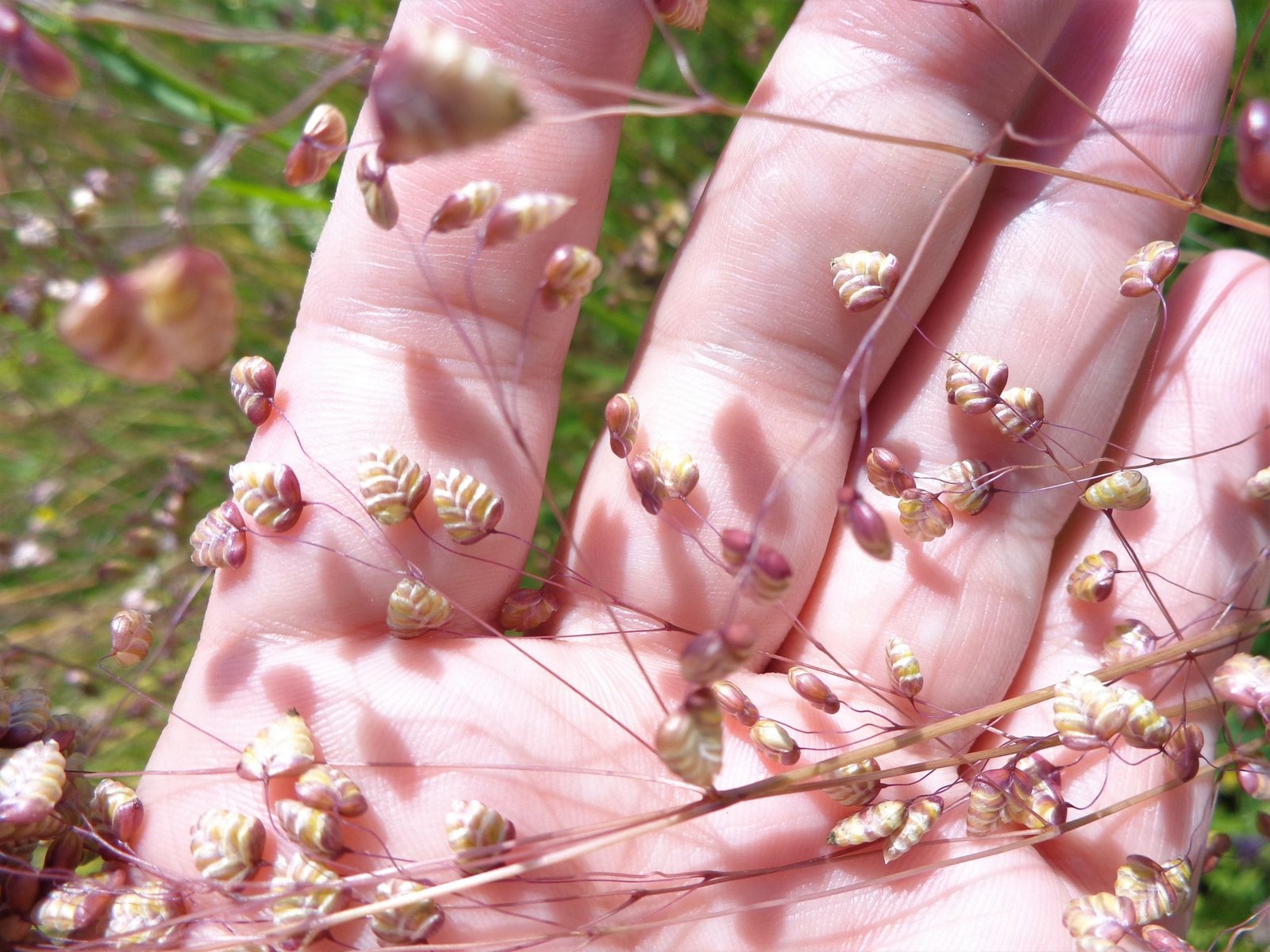
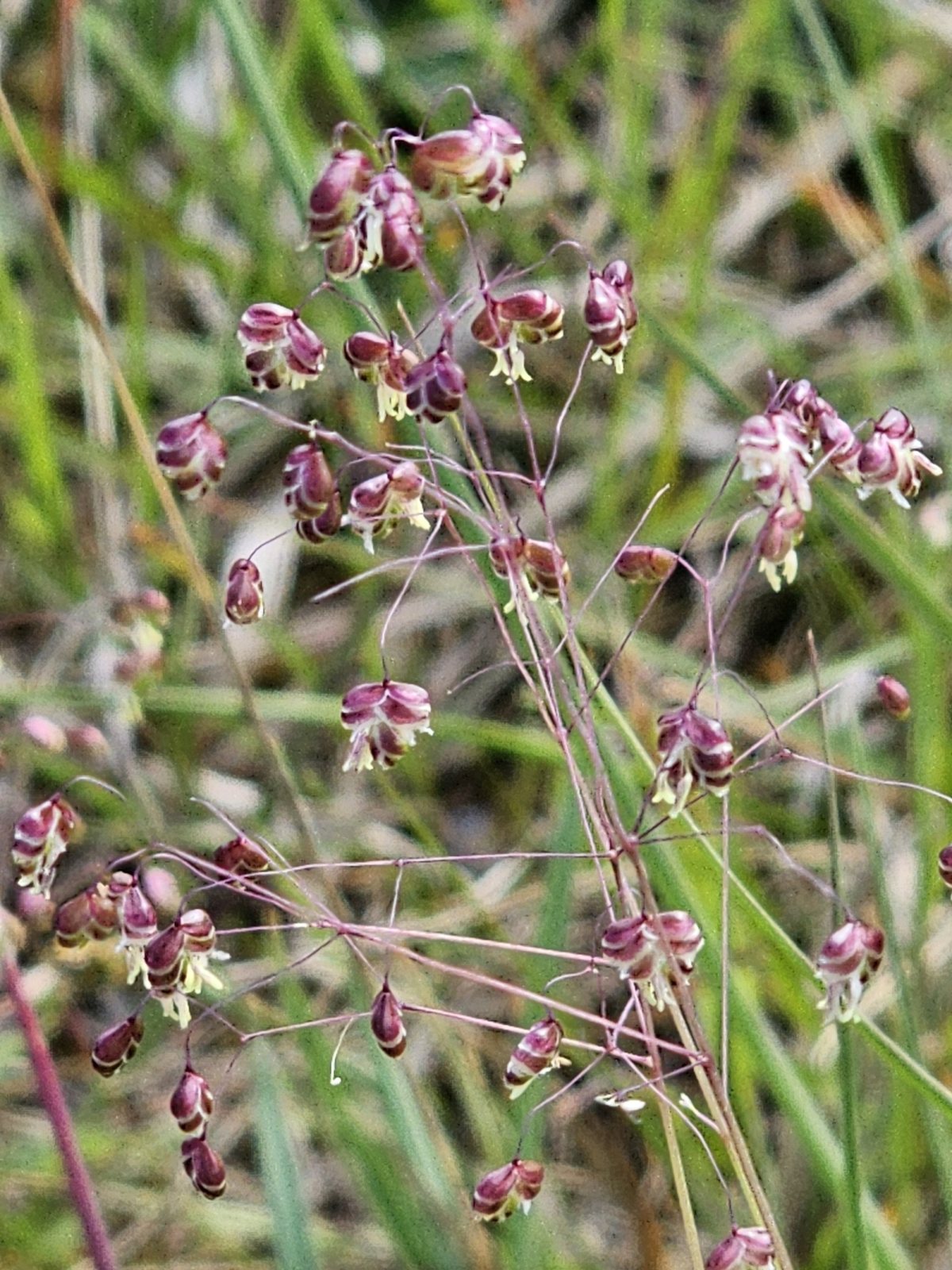
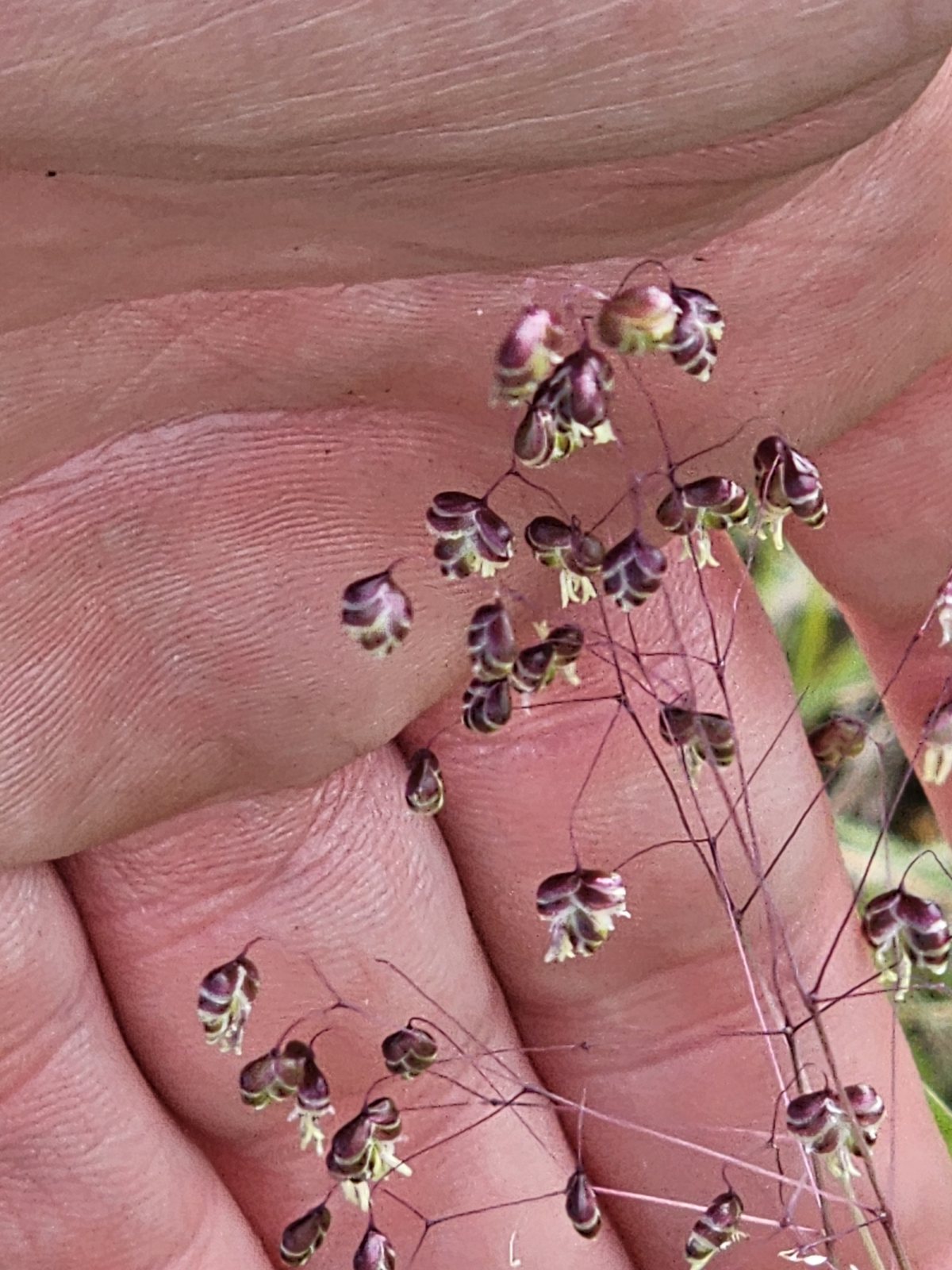
Quaking grass is a small, clump-forming perennial grass grown for its dangling, heart-shaped flower heads, which tremble in the slightest breeze. It brings light movement to meadow planting, gravel gardens and sunny borders, and its stems dry well for indoor arrangements.
At a glance
- Sun
- Full sun; tolerates light partial shade, but flowers less freely.
- Water
- Water regularly while establishing. Established plants tolerate short dry spells; avoid persistently wet soil.
- Soil
- Well-drained, poor to moderately fertile soil, including chalky, sandy or loamy ground. Avoid heavy, waterlogged soil and rich feeding.
- Height
- 1.5-2.5 ft (0.45-0.75 m), including flowering stems
- Spread
- 1-1.5 ft (0.3-0.45 m)
- Flowers
- Late spring to midsummer; dangling green spikelets, often flushed purple, mature to pale straw-brown.
- Foliage
- Narrow, flat, blue-green to mid-green leaves form a low tuft. Foliage may remain green in mild winters but dies back in colder climates.
- Growth
- Moderate
- Care needed
- Low
The year at a glance
- Deer resistant
- Drought tolerant
- Cold hardy
- Wildlife
| J | F | M | A | M | J | J | A | S | O | N | D | |
|---|---|---|---|---|---|---|---|---|---|---|---|---|
| Flowers | ||||||||||||
| Fruit | ||||||||||||
| Plant |
Northern hemisphere months. In Australia, shift them by six.
- Difficulty
- Easy
- Toughness
- Very tough
Will it suit your garden?
Pick your zone, country, light and whether you have pets.
Full sun is 6 or more hours of direct sun a day, part shade 3 to 6 hours, shade under 3.
How it grows
Planting day
1.1 ft (0.35 m)
After 1 year
1.5 ft (0.45 m)
After 2 years
1.8 ft (0.55 m)
After 3 years
2 ft (0.6 m)
full size
About 3 years to full size.
From a typical nursery size, at an average rate for this kind of plant. A rule of thumb, not a forecast.
Good to know
- Cats and dogs
- Safe
- Native to
- the UK
- Growth rate
- Moderate
Care
Jobs through the year
- WaterApr–May, Sep–Oct, every 21 days
- Water established clumps only during prolonged dry spells; water new plants more frequently.
- WaterJun–Aug, every 14 days
- During prolonged drought, water established clumps deeply if soil is dry; skip after sufficient rain.
- PruneFeb–Mar
- Remove dead stems and comb out dead leaves, preserving any fresh green growth.
- DivideMar–Apr
- Divide congested clumps when their centres begin to thin.
- DeadheadJun–Jul
- Optionally remove fading flower stems before seed falls to prevent unwanted seedlings.
- ProtectJan–Feb, Oct–Dec
- Clear collapsed stems and wet leaves from crowns and prevent winter waterlogging.
- Plant in well-drained soil with room for air to move between clumps.
- Water during dry spells in the first growing season; once established, water only during prolonged drought.
- Avoid routine fertiliser, which encourages soft growth and floppy flower stems.
- Keep mulch clear of the crown, especially where winters are wet.
- Divide congested clumps in spring when the centre begins to thin.
Pruning. Remove spent flower stems after flowering if you want to limit seedlings, or leave them for their dry seed heads. In late winter or early spring, cut dead stems close to the base and comb out dead leaves without cutting away fresh green growth.
Through the year
- Early spring
- Remove dead stems and leaves before new growth becomes well established.
- Spring
- Plant or divide clumps, then water until roots establish.
- Late spring
- Check for seedlings and remove any growing where they are not wanted.
- Summer
- Cut selected flower stems for drying, or remove fading heads before seed falls.
- Autumn
- Leave remaining dry stems for structure, but clear any that collapse onto the crown.
- Winter
- Check that water is not pooling around plants; improve drainage if the crown stays wet.
In the garden
- Thread through meadow-style planting with oxeye daisies and field scabious for fine texture and movement.
- Plant in small repeated groups near the front of a sunny border, where the hanging flower heads are easy to see.
- Combine with low-growing perennials in gravel gardens without obscuring their flowers.
- Place beside a path or seating area where breezes set the flower heads moving.
Garden styles it suits: Cottage garden, Wildflower, New perennial (prairie), Dry gravel garden, Sensory garden and Low-maintenance.
Plant it with: Oxeye daisy, Field scabious, Lady's mantle, Meadow cranesbill, Salad burnet and Yarrow.
Wildlife: Provides cover for small invertebrates, and its seeds may be eaten by birds. The flowers are wind-pollinated rather than a nectar source for bees.
Problems to watch for
- Crown or root rot in waterlogged soil: improve drainage or move the plant to a raised, freely draining position.
- Floppy stems in rich soil or shade: stop feeding and move to a sunnier site if necessary.
- Unwanted seedlings: remove flower heads before seed ripens and pull young seedlings while small.
- Rust or leaf spotting: remove badly affected foliage, avoid wetting leaves when watering and improve airflow.
Safety
Not known to be toxic to people, cats, dogs or horses; no part is recognised as poisonous. Like other grasses, its leaves can cause minor irritation, and eating a large amount may upset a pet's stomach.
Easily confused with
Greater quaking grass (Briza maxima)
An annual with much larger, conspicuous hanging spikelets, usually fewer on each flowering stem.
Lesser quaking grass (Briza minor)
An annual with many much smaller, usually pale green, triangular spikelets; it does not form a persistent perennial tuft.
Northern sea oats (Chasmanthium latifolium)
Has much broader leaves and larger, flattened seed heads on a taller, more substantial plant.
The name
The common name refers to the flower heads trembling on their fine stalks, while the Latin media means intermediate, referring to their size between those of greater and lesser quaking grass.
Propagation. Divide established clumps in spring. Sow seed in pots in spring or autumn, covering it only lightly; plants may also self-seed into open ground.
Checked against open data
- Accepted botanical name
- Briza media
- In the US and Canada
- Introduced in the lower 48 states.
- Native range
- Albania, Assam, Austria, Azores, Baltic States, Belarus, Belgium, Bulgaria, Canary Is., Central European Rus, China South-Central and Corse.
- Measured
- Soil pH 7 to 7.5. Average height 15 cm.
Sources: GBIF (CC BY 4.0), USDA PLANTS and Trefle (CC BY 4.0). The care and design notes are LandscapeGPT's own.
See it in your own yard.
Upload a photo of your yard and see it redesigned with plants that suit your climate, each checked against your zone.