Crimson flag lily
Hesperantha coccinea. Family Iridaceae. Perennial.
Also called Crimson flag, River lily, Schizostylis coccinea.
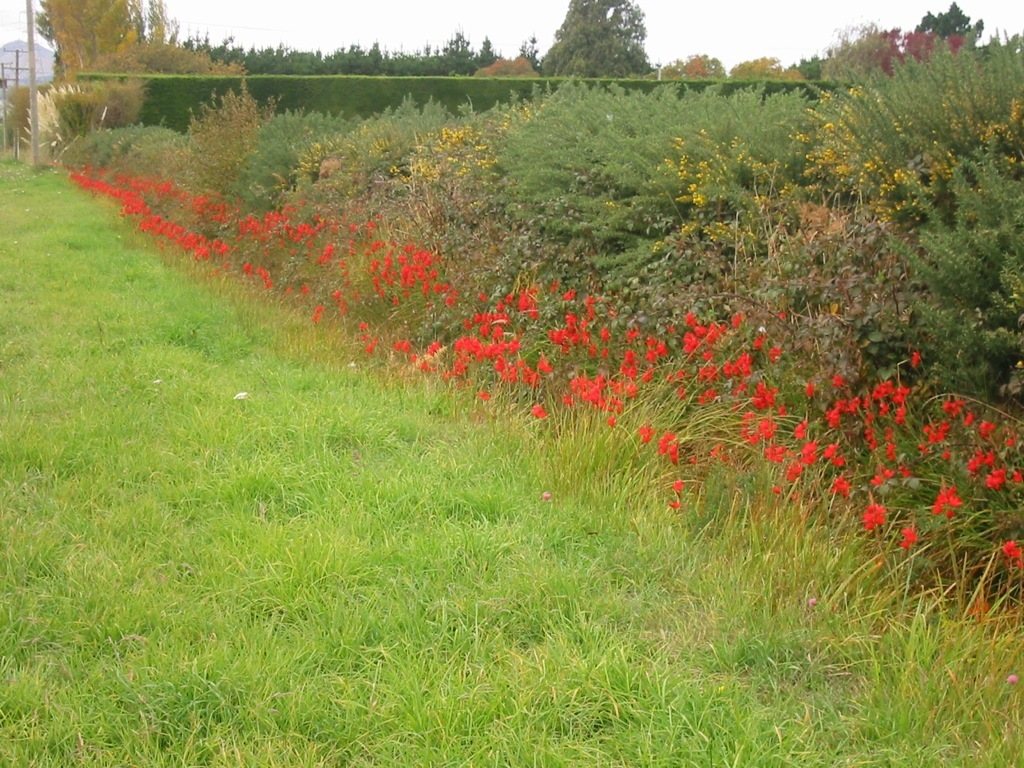
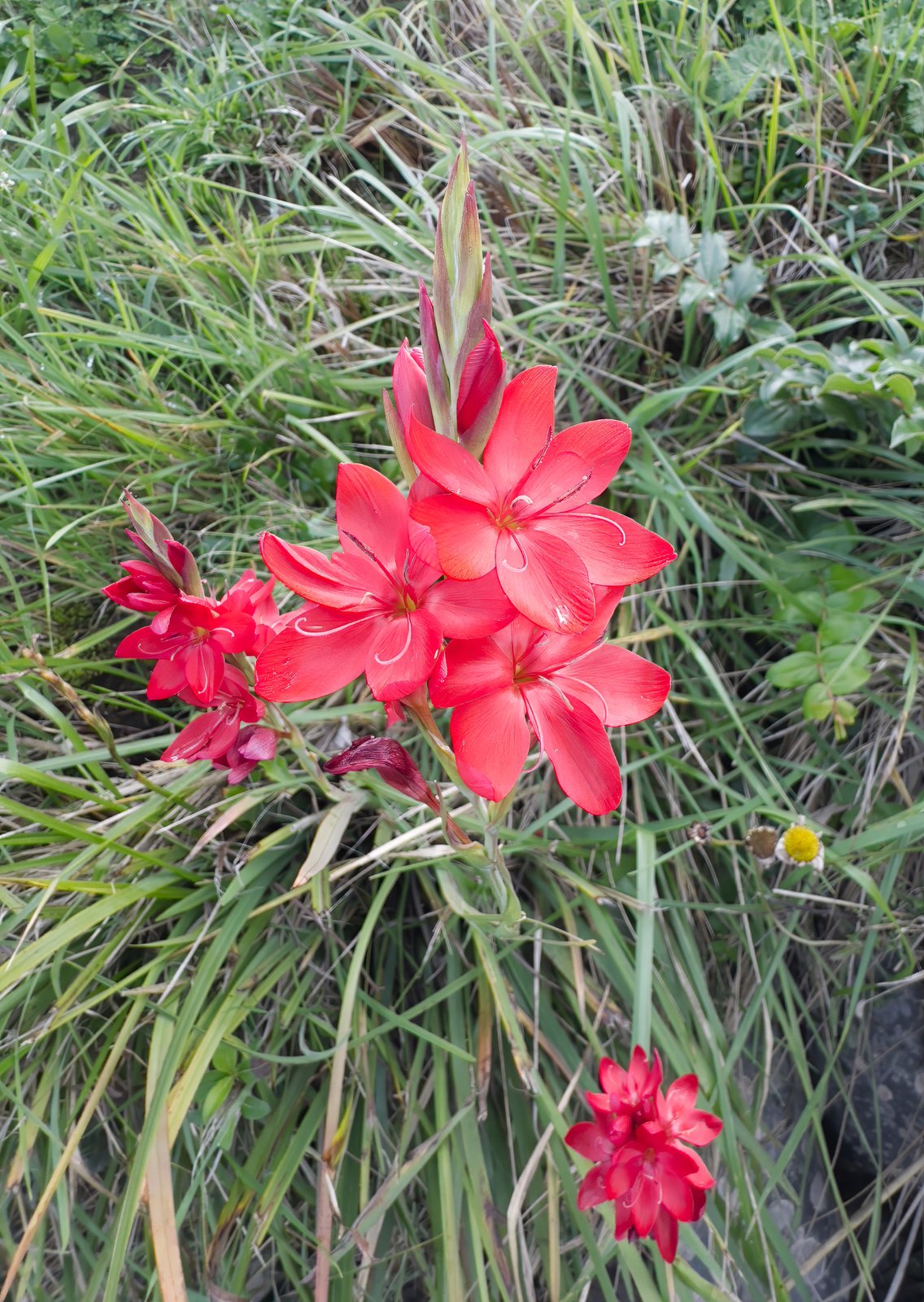
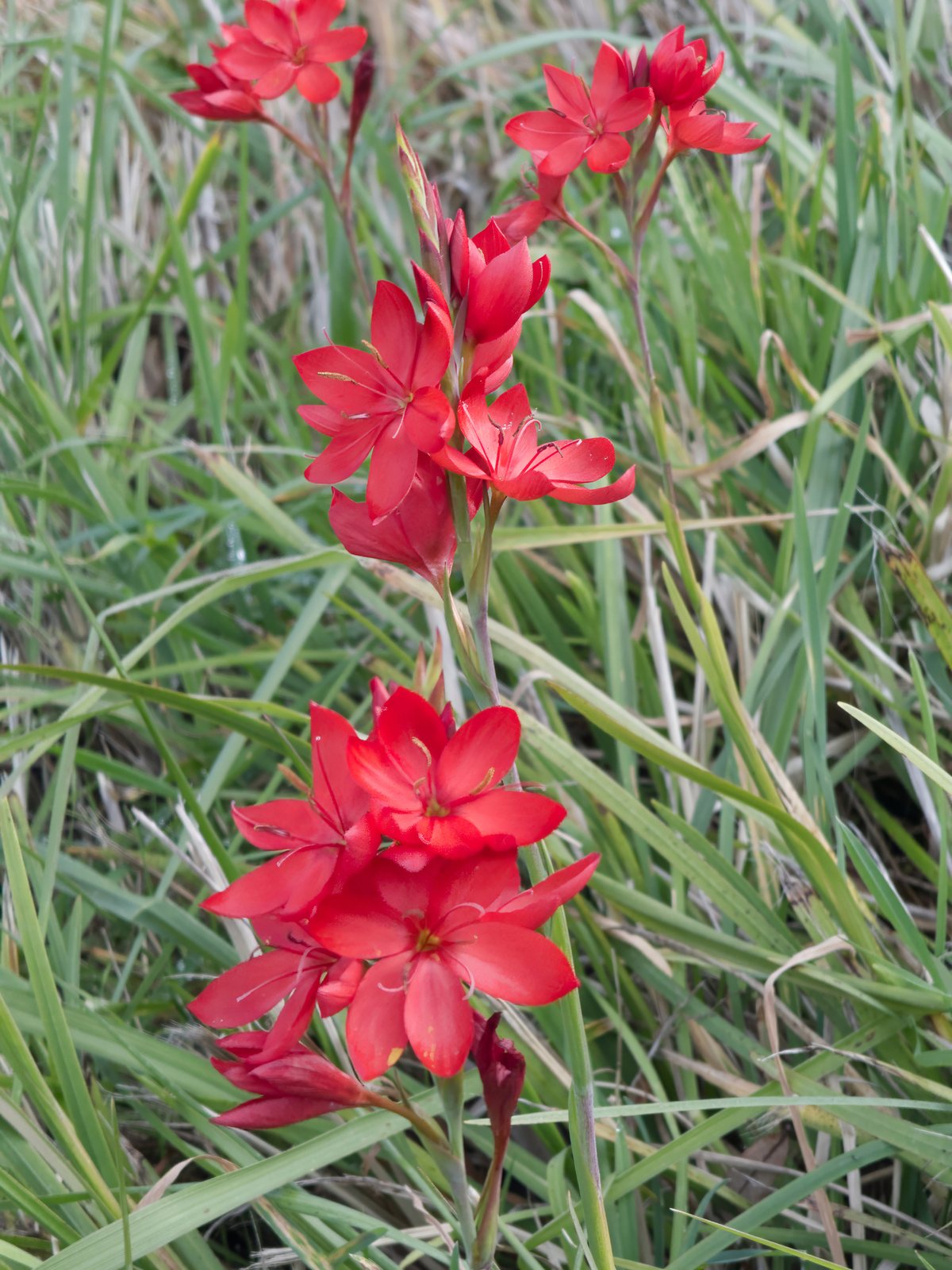
Crimson flag lily is a clump-forming South African perennial with narrow leaves and slender stems of open, scarlet flowers in late summer and autumn. Gardeners grow it for late colour in sunny, moisture-retentive borders and beside ponds, where its roots can stay moist without sitting in deep water.
At a glance
- Sun
- Full sun; tolerates light shade, but flowers less freely.
- Water
- Keep the soil consistently moist during growth and flowering. Avoid sites that dry out in summer.
- Soil
- Humus-rich, moisture-retentive soil, from sandy loam to clay; avoid stagnant, poorly aerated winter conditions.
- Height
- 2-3 ft (0.6-0.9 m)
- Spread
- 1-2 ft (0.3-0.6 m), gradually widening through short rhizomes
- Flowers
- Late summer through autumn, sometimes into early winter in mild climates; scarlet-red in the species, with pink and white garden selections available.
- Foliage
- Narrow, upright to arching, sword-shaped green leaves; semi-evergreen in mild climates and usually deciduous in colder areas.
- Growth
- Moderate
- Care needed
- Medium
The year at a glance
- Pollinators
- Heat tolerant
- Low allergen
| J | F | M | A | M | J | J | A | S | O | N | D | |
|---|---|---|---|---|---|---|---|---|---|---|---|---|
| Flowers | ||||||||||||
| Plant |
Northern hemisphere months. In Australia, shift them by six.
- Difficulty
- Moderate
- Toughness
- Fairly tough
Will it suit your garden?
Pick your zone, country, light and whether you have pets.
Full sun is 6 or more hours of direct sun a day, part shade 3 to 6 hours, shade under 3.
How it grows
Planting day
1 ft (0.3 m)
After 1 year
1.5 ft (0.45 m)
After 2 years
2 ft (0.6 m)
After 3 years
2.5 ft (0.75 m)
full size
About 3 years to full size.
From a typical nursery size, at an average rate for this kind of plant. A rule of thumb, not a forecast.
Good to know
- Cats and dogs
- Safe
- In the garden
- Spreads vigorously: plan to contain it.
- Growth rate
- Moderate
Care
Jobs through the year
- WaterApr–May, every 7 days
- Water established clumps if rain is insufficient; new plantings need closer moisture checks.
- WaterJun–Sep, every 4 days
- Water deeply when rain is insufficient, keeping the root zone consistently moist.
- WaterOct–Nov, every 7 days
- Maintain moisture during flowering if autumn weather is dry.
- MulchApr–May
- Top-dress moist soil with compost, keeping it clear of leaf bases.
- FeedApr
- Apply a balanced fertilizer only on poor soil or where growth is weak.
- DivideApr–May
- Divide congested clumps every three to four years and replant vigorous outer sections.
- DeadheadSep–Nov, every 14 days
- Remove finished flower stems at the base unless retaining seed.
- PruneFeb–Mar
- Remove dead or frost-damaged leaves without cutting healthy green foliage.
- ProtectNov–Dec
- Add loose winter mulch after soil cools; in zone 6, lift and overwinter frost-free.
- Water deeply during dry spells so the root zone stays moist, especially as flower stems develop.
- Spread compost around the clump in spring; use a balanced fertiliser only if growth is weak or the soil is poor.
- Apply an organic mulch to conserve summer moisture, keeping it clear of the leaf bases.
- In colder gardens, add a loose winter mulch after the ground cools and choose a sheltered planting site.
- Divide congested clumps in spring every three to four years, replanting the vigorous outer sections.
Pruning. Cut spent flower stems down to the base after flowering, unless you want seed. Remove dead or frost-damaged leaves in late winter or early spring, leaving healthy green foliage intact.
Through the year
- Late winter
- Remove dead foliage and check that winter mulch is not smothering new shoots.
- Spring
- Plant or divide clumps, water them in thoroughly and top-dress with compost.
- Early summer
- Mulch moist soil and begin regular watering if rainfall is insufficient.
- Late summer
- Keep the roots moist as flowering begins; support stems only if they lean in exposed positions.
- Autumn
- Remove faded flower stems, or leave a few to ripen seed where unwanted seedlings will not be a problem.
- Late autumn
- Protect the root zone with a loose mulch in colder gardens.
In the garden
- Plant in groups along a sunny pond or stream edge, above the permanently submerged zone.
- Weave through moisture-retentive borders with asters and ornamental grasses for late-season colour.
- Use beside paths or patios where the open flowers can be seen at close range.
- Repeat small clumps through a damp cottage border to connect summer planting with autumn flowers.
Garden styles it suits: Cottage garden, English country, Bog garden, Autumn colour, New perennial (prairie) and Hot border.
Plant it with: Joe-Pye weed, Japanese iris, Purple moor grass, Sneezeweed, New England aster and Meadowsweet.
Wildlife: The open flowers provide pollen and nectar for visiting insects late in the season. Its value to local wildlife varies with climate and which pollinators remain active during flowering.
Problems to watch for
- Slugs and snails can damage young shoots: check plants on damp evenings, remove pests and use iron-phosphate bait where necessary.
- Few flowers often result from shade or dry soil: move the clump to a sunnier position and maintain moisture through summer.
- Crowded clumps may flower poorly: divide in spring and replant healthy outer sections in compost-enriched soil.
- Winter losses can follow severe frost or stagnant soil: choose a sheltered site, improve soil structure and mulch the root zone in colder areas.
Safety
Not known to be toxic to people, cats, dogs or horses, although species-specific toxicity information is limited. No particular poisonous part is established; it is an ornamental plant, not a food plant.
Where it spreads. Naturalised and regarded as an environmental weed in parts of New Zealand, particularly in damp habitats. It spreads by rhizomes and can also seed; keep garden waste and divisions out of waterways and natural wetlands.
Easily confused with
Crocosmia (Crocosmia spp.)
Crocosmia usually flowers earlier, with more tubular flowers on arching, often branched stems, and grows from chains of corms. Crimson flag lily has more open, starry flowers and short spreading rhizomes.
Garden gladiolus (Gladiolus hybrids)
Garden gladioli generally have larger, distinctly hooded flowers arranged along a stout spike and grow from rounded corms. Crimson flag lily has smaller, open flowers on slender stems and forms a persistent leafy clump.
The name
Hesperantha comes from Greek words meaning 'evening flower', while coccinea is Latin for 'scarlet', referring to the species' flower colour.
Propagation. Divide established clumps in spring, keeping roots and several healthy shoots on each section. Seed can be sown in spring, but seedlings take longer to flower and named cultivars do not reliably come true.
Checked against open data
- Accepted botanical name
- Hesperantha coccinea
- Native range
- Cape Provinces, Free State, KwaZulu-Natal, Lesotho, Northern Provinces, Swaziland and Zimbabwe.
Sources: GBIF (CC BY 4.0) and Trefle (CC BY 4.0). The care and design notes are LandscapeGPT's own.
See it in your own yard.
Upload a photo of your yard and see it redesigned with plants that suit your climate, each checked against your zone.