Crown of thorns
Euphorbia milii. Family Euphorbiaceae. Succulent.
Also called Christ plant, Christ thorn.
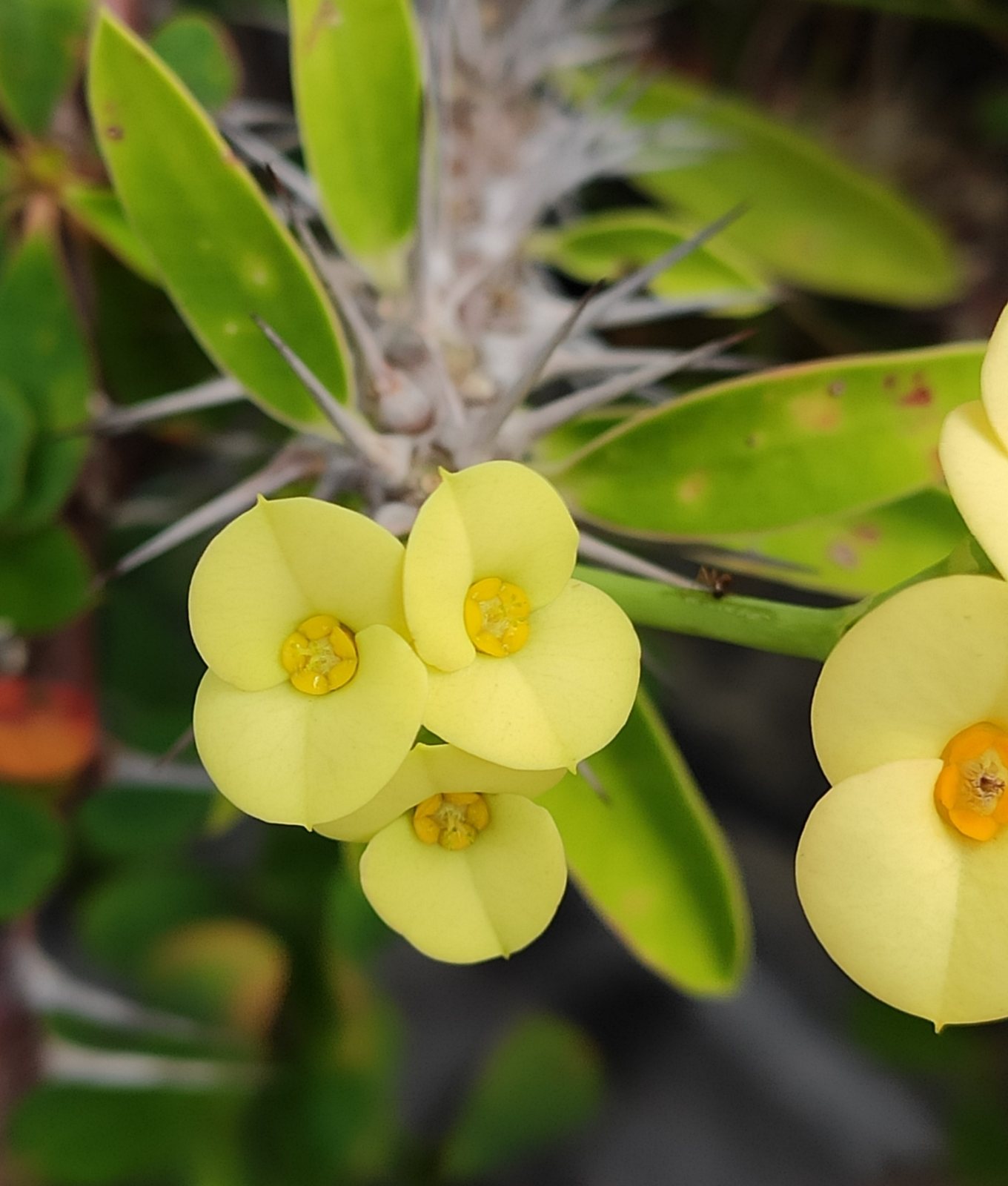
Crown of thorns is a thorny succulent shrub from Madagascar, grown for colourful flower bracts that can appear through much of the year in warm, bright conditions. It suits frost-free gardens and sunny containers; in colder regions, grow it as a houseplant or bring it indoors before autumn temperatures fall.
At a glance
- Sun
- Full sun to light partial shade outdoors; a very bright, sunny window indoors. Acclimatise indoor plants gradually to outdoor sun.
- Water
- Low once established. Let the upper soil dry between waterings, then water thoroughly and allow excess water to drain; keep considerably drier in cool weather.
- Soil
- Sharply drained sandy or gravelly soil. In containers, use cactus compost with added pumice, perlite or grit, and a pot with drainage holes.
- Height
- 3-6 ft (0.9-1.8 m); compact cultivars stay smaller
- Spread
- 2-3 ft (0.6-0.9 m)
- Flowers
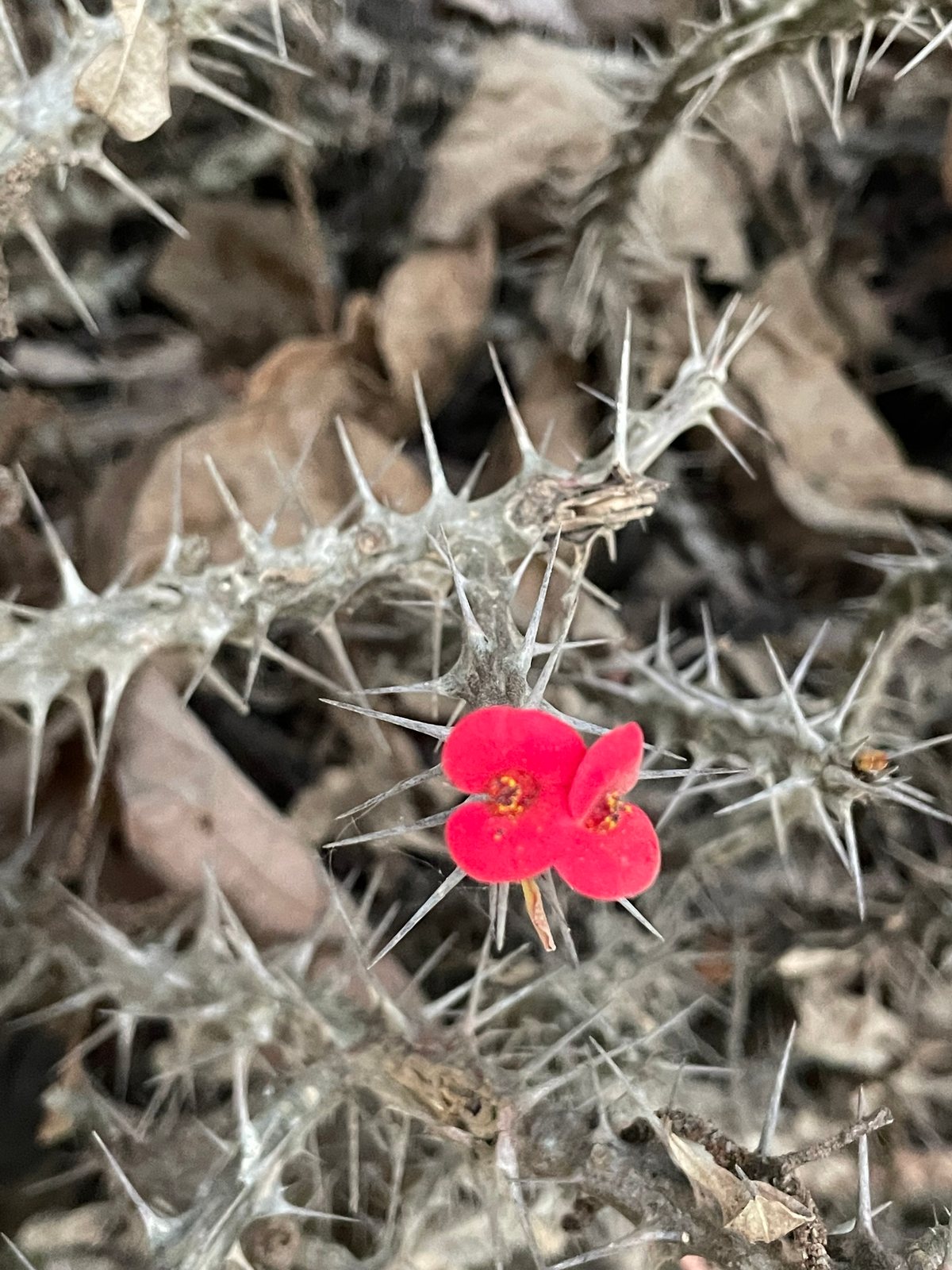
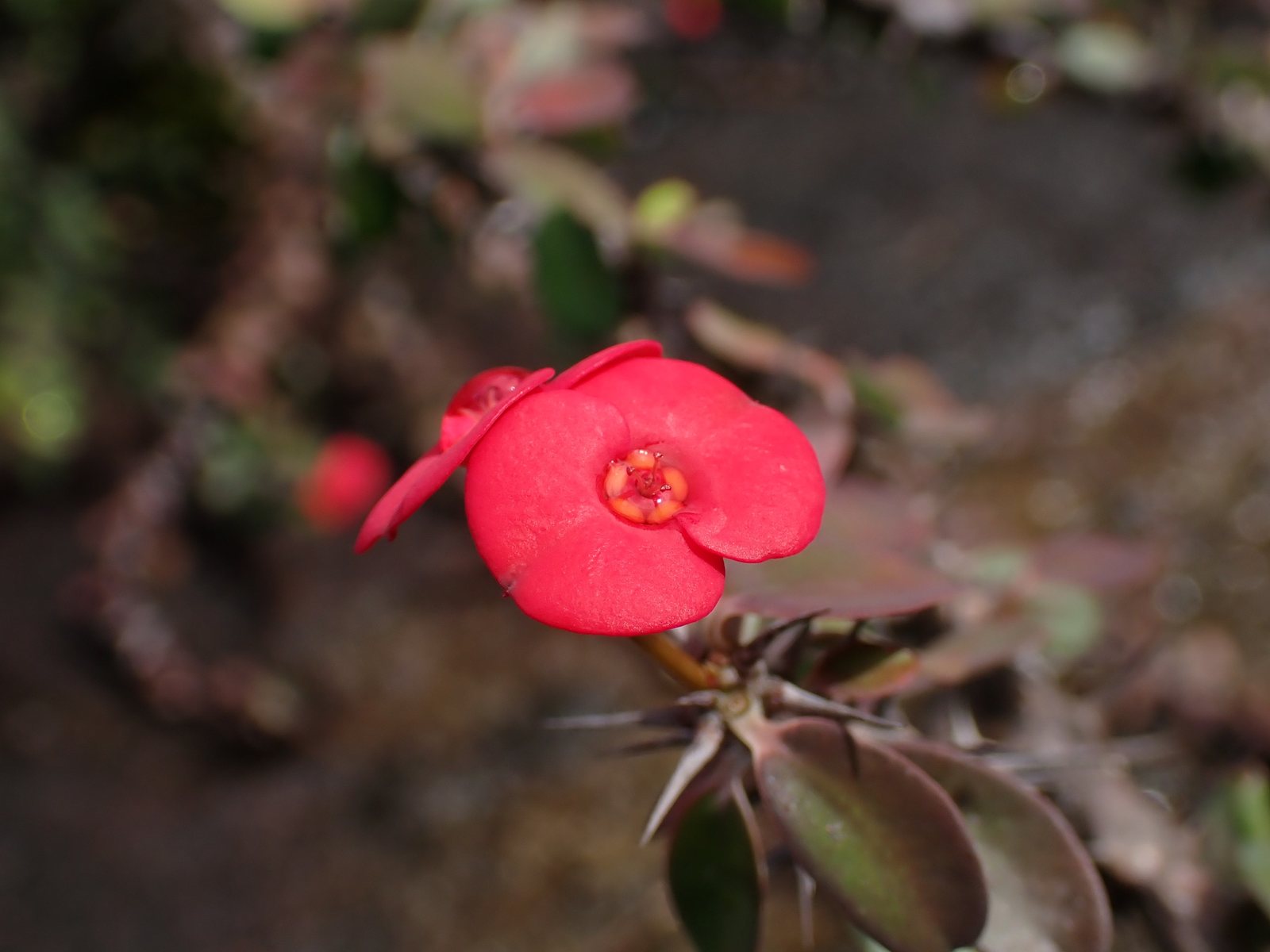
- Potentially year-round in warm, sunny conditions, often strongest from spring to autumn. Tiny flowers are surrounded by showy red, pink, yellow, cream or white bracts, depending on the cultivar.
- Foliage
- Evergreen. Green oval leaves cluster near the tips of grey-brown, heavily thorned stems. Leaves may drop during drought, cold or other stress.
- Growth
- Slow to moderate
- Care needed
- Low
The year at a glance
- Deer resistant
- Drought tolerant
- Heat tolerant
- Low allergen
| J | F | M | A | M | J | J | A | S | O | N | D | |
|---|---|---|---|---|---|---|---|---|---|---|---|---|
| Flowers | ||||||||||||
| Plant |
Northern hemisphere months. In Australia, shift them by six.
- Difficulty
- Easy
- Toughness
- Fairly tough
Will it suit your garden?
Pick your zone, country, light and whether you have pets.
Full sun is 6 or more hours of direct sun a day, part shade 3 to 6 hours, shade under 3.
How it grows
Planting day
0.8 ft (0.25 m)
After 1 year
1.3 ft (0.39 m)
After 2 years
1.7 ft (0.53 m)
After 3 years
2.2 ft (0.67 m)
After 5 years
3 ft (0.96 m)
About 8 years to full size.
From a typical nursery size, at an average rate for this kind of plant. A rule of thumb, not a forecast.
Good to know
- Cats and dogs
- Toxic
- Growth rate
- Slow
Care
Jobs through the year
- WaterMar–May, Sep–Oct, every 14 days
- Grow in a container here; water only after the upper mix dries, then drain thoroughly.
- WaterJun–Aug, every 7 days
- Water only when the upper mix is dry; never leave the pot standing in water.
- WaterJan–Feb, Nov–Dec, every 28 days
- Indoors, water sparingly after the mix dries; extend the interval in cool conditions.
- FeedApr–Aug, every 30 days
- Feed actively growing container plants with half-strength balanced liquid fertilizer.
- PruneMar–Apr
- Shorten lanky stems; wear stout gloves and eye protection against thorns and toxic sap.
- ProtectJan–May, Sep–Dec
- Keep in bright shelter above 10°C; summer outdoors only when nights remain warm.
- Water only after the upper soil has dried; never leave the pot standing in a water-filled saucer.
- Feed container plants monthly at half strength with a balanced liquid fertiliser during active spring and summer growth.
- Keep plants frost-free, preferably above 10°C (50°F), and give overwintering plants the brightest available position.
- Repot in spring only when roots fill the container, moving up one pot size.
- Wear stout gloves and eye protection when handling; keep thorny stems away from paths and play areas.
Pruning. Prune in spring as growth resumes, shortening lanky stems just above a leaf or branch junction to encourage branching. Remove dead stems with clean tools, avoiding contact with the milky sap.
Through the year
- Early spring
- Prune lanky growth and repot root-bound plants into a sharply drained mix.
- Spring
- Resume light feeding as active growth starts and increase watering only as the soil dries faster.
- Late spring
- Move indoor plants outdoors once nights remain above 10°C (50°F), gradually increasing their sun exposure.
- Summer
- Check pots regularly for drying and inspect leaf joints for mealybugs.
- Autumn
- Bring container plants indoors before cool nights; stop feeding as growth slows.
- Winter
- Keep in strong light and water sparingly, especially in cool rooms.
In the garden
- Use a single plant in a terracotta pot on a sunny, sheltered terrace, away from passing traffic.
- Combine with aloes and echeverias in raised, sharply drained beds in frost-free gardens.
- Group compact cultivars in containers for repeated flower colour against gravel and simple paving.
- Use the thorny branching outline as a small sculptural accent beside softer succulent foliage.
Garden styles it suits: Desert modern, Desert / xeriscape, Dry gravel garden, Modern courtyard, Modern Mediterranean and Small-space.
Plant it with: Aloe vera, Echeveria, Jade plant, Elephant bush and Paddle plant.
Wildlife: The tiny flowers can provide nectar for visiting insects in warm climates. It is not a host plant for the native wildlife of most regions where it is grown.
Problems to watch for
- Root or stem rot in wet soil: improve drainage, empty saucers and allow the mix to dry between waterings; discard plants with extensive soft, rotting stems.
- Mealybugs: isolate affected pots, remove visible insects and treat persistent infestations with a labelled insecticidal soap, testing a small area first.
- Spider mites in hot, dry indoor conditions: check for fine webbing and stippled leaves, then use a labelled mite treatment or insecticidal soap.
- Leaf drop or poor flowering: check for cold, drought and insufficient light; restore suitable conditions without compensating with excessive water.
Safety
Toxic to people, cats, dogs and horses. All parts contain irritating milky latex; chewing or swallowing can cause mouth irritation, drooling, vomiting and diarrhoea. Sap can inflame skin and cause serious eye injury, while the thorns can puncture skin. Keep away from children and animals; seek urgent medical advice for eye exposure.
Easily confused with
Thornless crown of thorns (Euphorbia geroldii)
Has smooth, thornless stems and glossy green leaves, unlike the stoutly thorned stems of crown of thorns.
African milk tree (Euphorbia trigona)
Has upright, three-sided green succulent stems with small leaves and paired thorns along the edges, rather than rounded woody stems with long thorns.
The name
The common name refers to its thorny stems and their association with the biblical crown of thorns, while milii honours Baron Milius, who introduced the plant to France.
Propagation. Take stem cuttings in spring or summer, wearing gloves and eye protection. Let the cut ends dry and callus for several days, then insert into a barely moist, sharply drained propagation mix; keep warm in bright, indirect light until rooted.
Checked against open data
- Accepted botanical name
- Euphorbia milii
- In the US and Canada
- Introduced in the lower 48 states and Puerto Rico.
- Native range
- Madagascar.
Sources: GBIF (CC BY 4.0), USDA PLANTS and Trefle (CC BY 4.0). The care and design notes are LandscapeGPT's own.
See it in your own yard.
Upload a photo of your yard and see it redesigned with plants that suit your climate, each checked against your zone.