Desert willow
Chilopsis linearis. Family Bignoniaceae. Tree.
Also called Desert catalpa, Flowering willow.
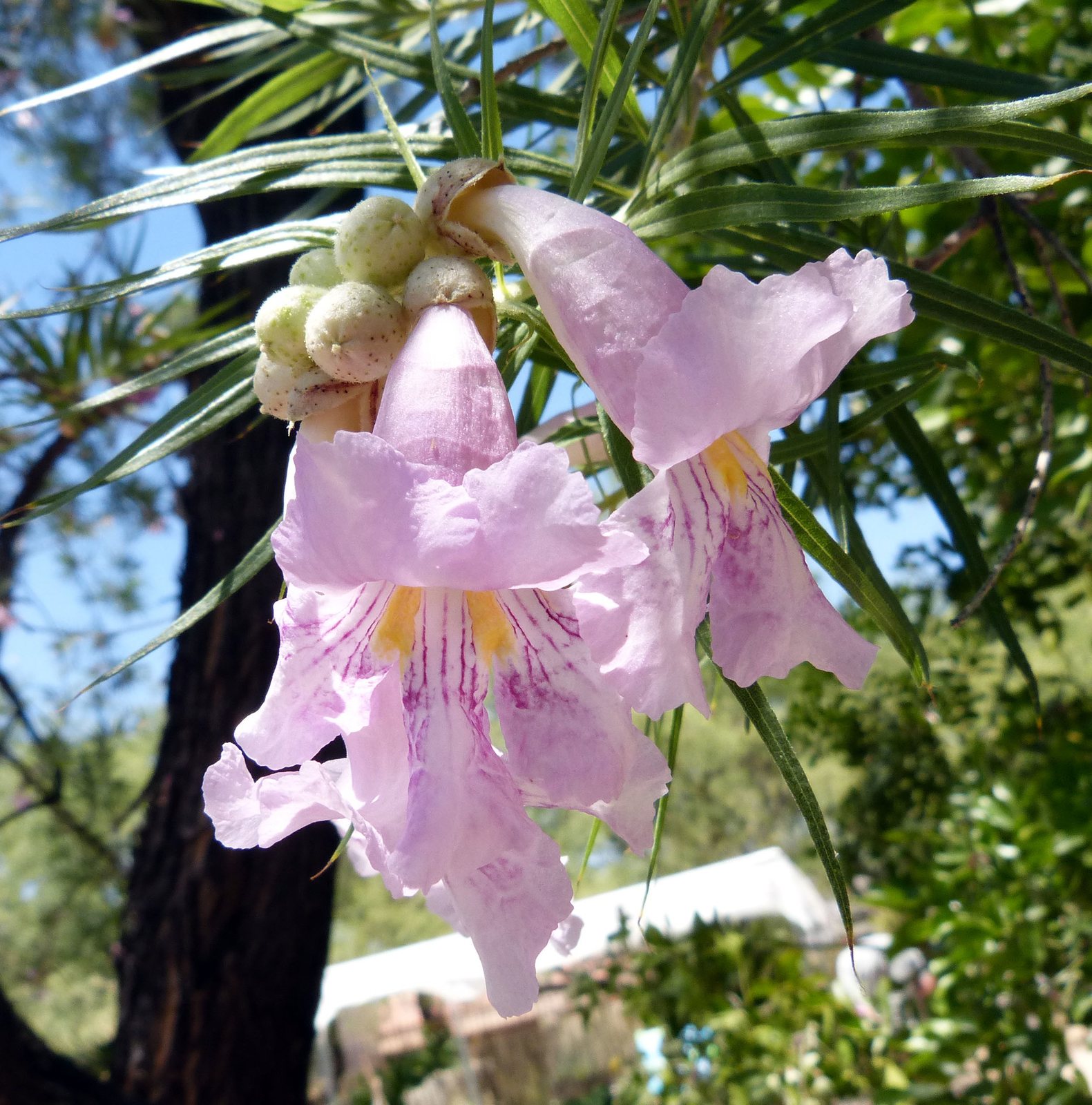
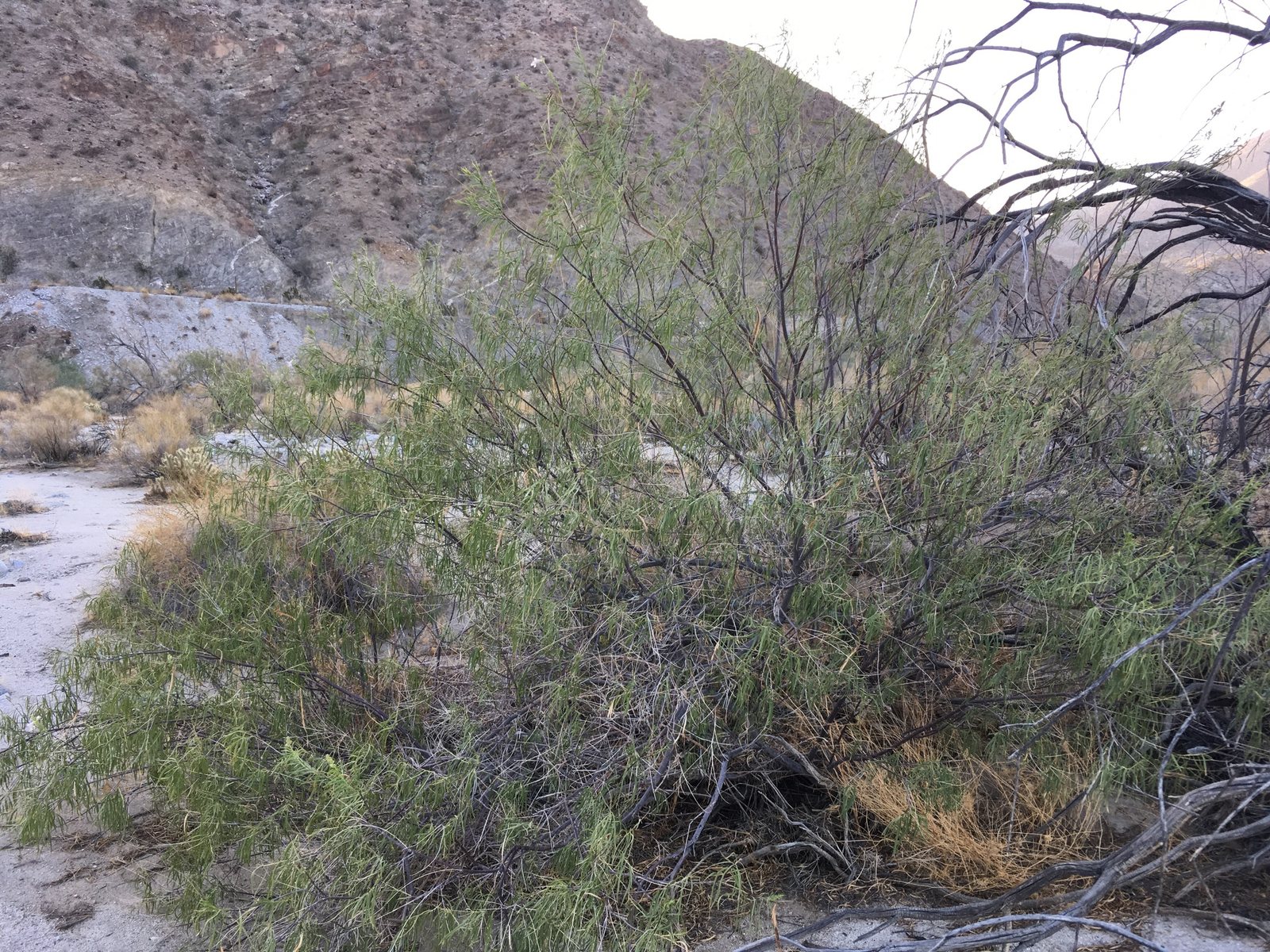
Desert willow is a deciduous small tree or large shrub native to the southwestern United States and northern Mexico, grown for its narrow leaves and fragrant, trumpet-shaped flowers. It suits hot, dry gardens with sharply drained soil; it is not a true willow and does not need a wet site. Flowering and winter survival are less dependable in cool, damp climates.
At a glance
- Sun
- Full sun; flowering is best with long, hot summers.
- Water
- Low once established. Water young trees deeply, then let the soil dry between waterings; established trees usually need supplemental water only during prolonged drought.
- Soil
- Well-drained sandy, gravelly or loamy soil, including alkaline soil. Avoid waterlogged ground and heavy clay that stays wet.
- Height
- 15-30 ft (4.6-9.1 m)
- Spread
- 10-20 ft (3-6.1 m)
- Flowers
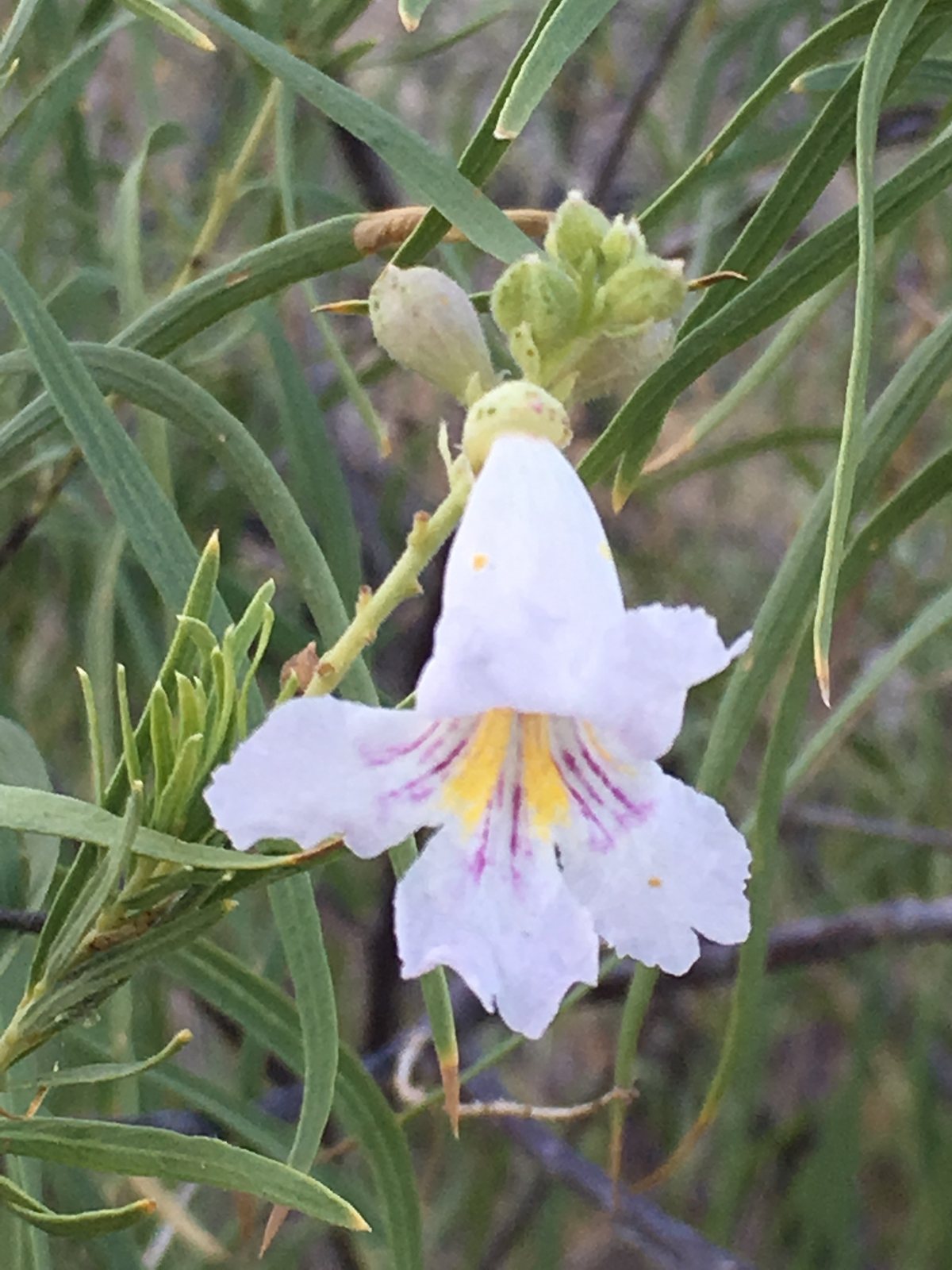
- Late spring to early autumn in warm climates; pink, lavender or purple trumpets with pale, yellow-marked throats. Some plants flower nearly white.
- Foliage
- Long, narrow green leaves on an open, airy framework; leaves emerge relatively late in spring.
- Growth
- Moderate to fast in warm conditions.
- Care needed
- Low
The year at a glance
- Pollinators
- Deer resistant
- Drought tolerant
- Heat tolerant
- Wildlife
- Low allergen
| J | F | M | A | M | J | J | A | S | O | N | D | |
|---|---|---|---|---|---|---|---|---|---|---|---|---|
| Flowers | ||||||||||||
| Fruit | ||||||||||||
| Plant |
Northern hemisphere months. In Australia, shift them by six.
- Difficulty
- Moderate
- Toughness
- Fairly tough
Will it suit your garden?
Pick your zone, country, light and whether you have pets.
Full sun is 6 or more hours of direct sun a day, part shade 3 to 6 hours, shade under 3.
How it grows
Planting day
7 ft (2 m)
After 1 year
8 ft (2.3 m)
After 2 years
9 ft (2.6 m)
After 3 years
10 ft (2.9 m)
After 5 years
12 ft (3.5 m)
About 16 years to full size.
From a typical nursery size, at an average rate for this kind of plant. A rule of thumb, not a forecast.
Good to know
- Cats and dogs
- Safe
- Native to
- the US
- Growth rate
- Fast
Care
Jobs through the year
- WaterApr–May, Sep, every 30 days
- For established ground-grown trees, water only during prolonged drought; young trees need more frequent deep watering.
- WaterJun–Aug, every 21 days
- During extended drought, soak established trees only once the root zone has dried.
- PruneMar–Apr
- Remove dead and crossing branches before growth; delay suspected frost-damage cuts until live shoots appear.
- MulchApr–May
- Use gravel mulch if wanted, leaving the trunk and root flare exposed.
- ProtectJan–Mar, Nov–Dec
- Marginal in zone 7 and unreliable in zone 6; use a warm sheltered site with excellent winter drainage and protect young stems during severe frost.
- Plant in full sun with excellent drainage, away from lawn irrigation.
- Water deeply during establishment, allowing the root zone to dry between waterings.
- Once established, give an occasional deep watering during extended drought rather than frequent light watering.
- Avoid routine feeding; excess nitrogen encourages leafy growth at the expense of flowers.
- Keep mulch away from the trunk; gravel mulch suits dry sites.
Pruning. Prune in late winter or early spring before new growth, removing dead, damaged and crossing branches. Train a young plant to one trunk or a few well-spaced stems, and avoid topping or severe annual cutting.
Through the year
- Late winter
- Prune for structure while dormant, but delay removing suspected frost damage until live growth is clear.
- Spring
- Plant after severe frost risk has passed and the soil has begun to warm.
- Late spring
- Check soil moisture around newly planted trees; do not assume late leaf emergence means the tree has died.
- Summer
- Water young trees deeply during dry weather and inspect tender shoots for aphids.
- Early autumn
- Collect mature seed pods before they split if you want to raise seedlings.
- Late autumn
- Clear fallen leaves and pods from paths, and check that winter rain drains freely from the root zone.
In the garden
- Use as an airy specimen tree in a sunny gravel courtyard, allowing room for its spreading crown.
- Place above drought-tolerant shrubs and perennials to provide light, filtered shade rather than dense canopy cover.
- Combine with agaves, red yucca and ornamental grasses for contrasting leaf shapes in a dry garden.
- Use in a sunny wildlife border where its summer flowers and persistent seed pods can be appreciated.
Garden styles it suits: Desert modern, Southwestern, Desert / xeriscape, Dry gravel garden, Wildlife garden and Modern Mediterranean.
Plant it with: Red yucca, Texas sage, Autumn sage, Desert marigold, Blue grama and Parry's agave.
Wildlife: Flowers attract bees and, within their range, hummingbirds. The branching canopy provides shelter and nesting places for small birds.
Problems to watch for
- Root rot and decline in wet soil: improve drainage or move a young plant to a drier site; stop frequent irrigation.
- Aphids on soft shoots: wash off small colonies with water and encourage natural predators; use insecticidal soap if necessary.
- Powdery mildew in humid conditions: improve airflow, avoid crowding and keep the foliage dry when watering.
- Winter dieback in cold or damp sites: choose a warm, sheltered position and prune damaged wood after new growth reveals what survived.
Safety
Not known to be toxic to people, cats, dogs or horses. No part is generally identified as poisonous, but it is not an established food plant; discourage pets and children from eating leaves, flowers or seed pods.
Easily confused with
True willows (Salix spp.)
True willows produce catkins rather than large trumpet flowers and generally favour moister ground.
Southern catalpa (Catalpa bignonioides)
Both have trumpet flowers and long seed pods, but southern catalpa has very large, heart-shaped leaves rather than narrow, willow-like leaves.
Oleander (Nerium oleander)
Oleander has leathery evergreen leaves, often in whorls of three, and flatter, five-lobed flowers. Unlike desert willow, all parts of oleander are highly poisonous.
The name
Desert willow refers to its dry native habitat and willow-like leaves, while Chilopsis means lip-like, referring to the flowers, and linearis describes the narrow leaves.
Propagation. Sow fresh seed in spring in a free-draining seed mix; seedlings vary in flower colour and form. Root semi-ripe cuttings in summer to preserve the characteristics of a selected plant.
Checked against open data
- Accepted botanical name
- Chilopsis linearis
- In the US and Canada
- Native in the lower 48 states.
- Native range
- Arizona, California, Mexico Northeast, Mexico Northwest, Nevada, New Mexico, Texas and Utah.
- Measured
- Soil pH 7 to 10. Average height 762 cm.
Sources: GBIF (CC BY 4.0), USDA PLANTS and Trefle (CC BY 4.0). The care and design notes are LandscapeGPT's own.
See it in your own yard.
Upload a photo of your yard and see it redesigned with plants that suit your climate, each checked against your zone.