Foothills palo verde
Parkinsonia microphylla. Family Fabaceae. Tree.
Also called Littleleaf palo verde, Yellow palo verde.
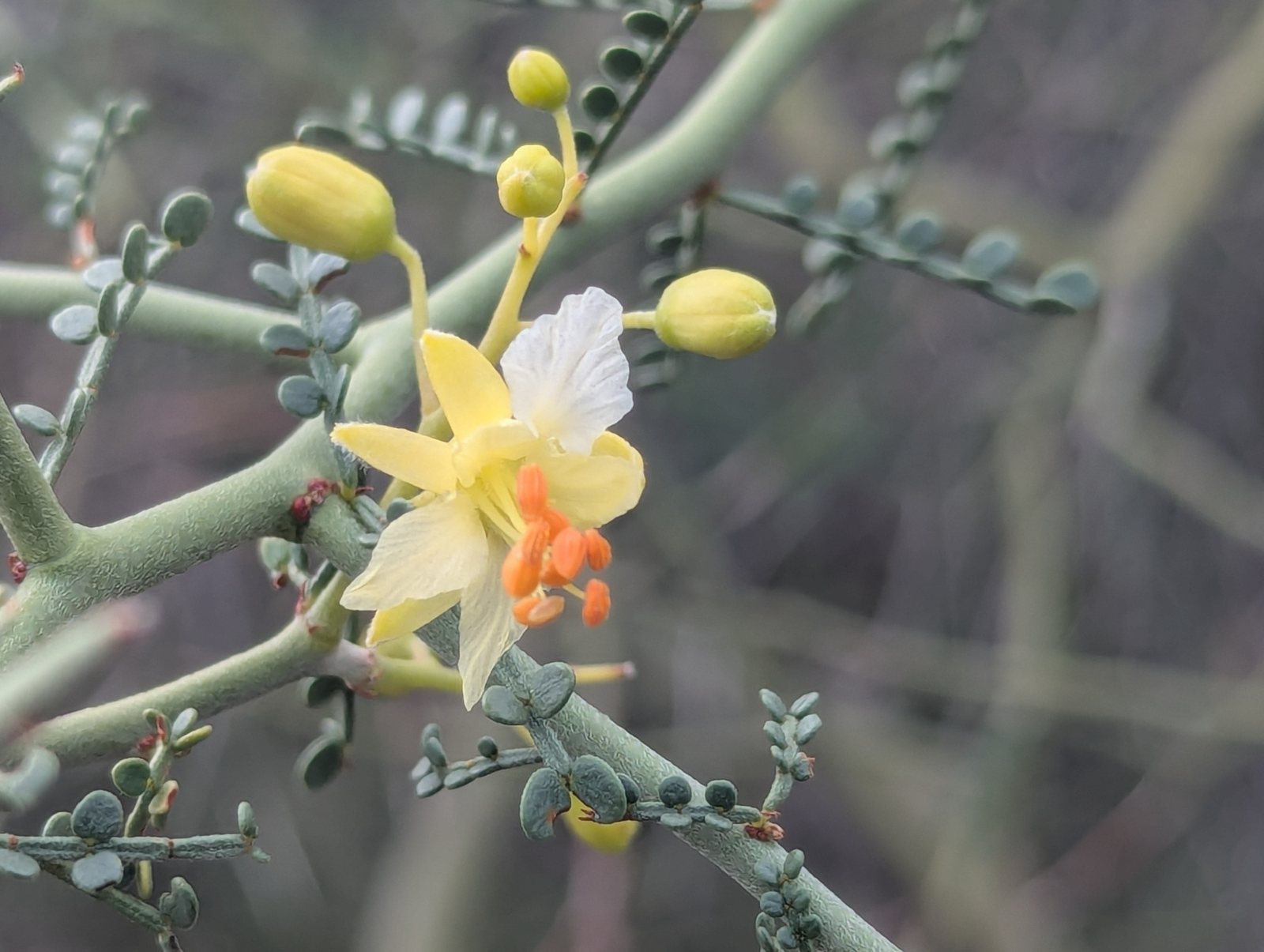
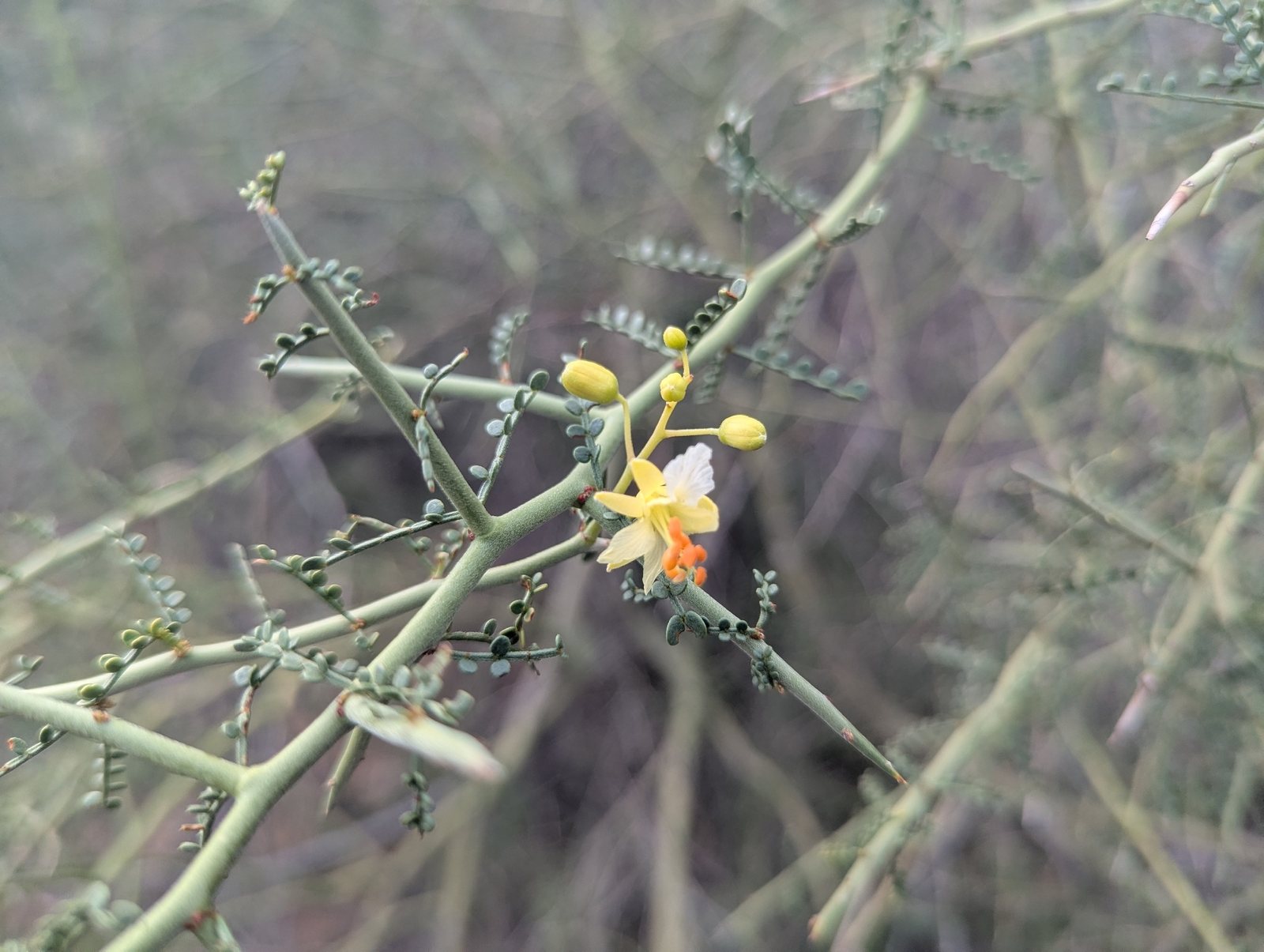
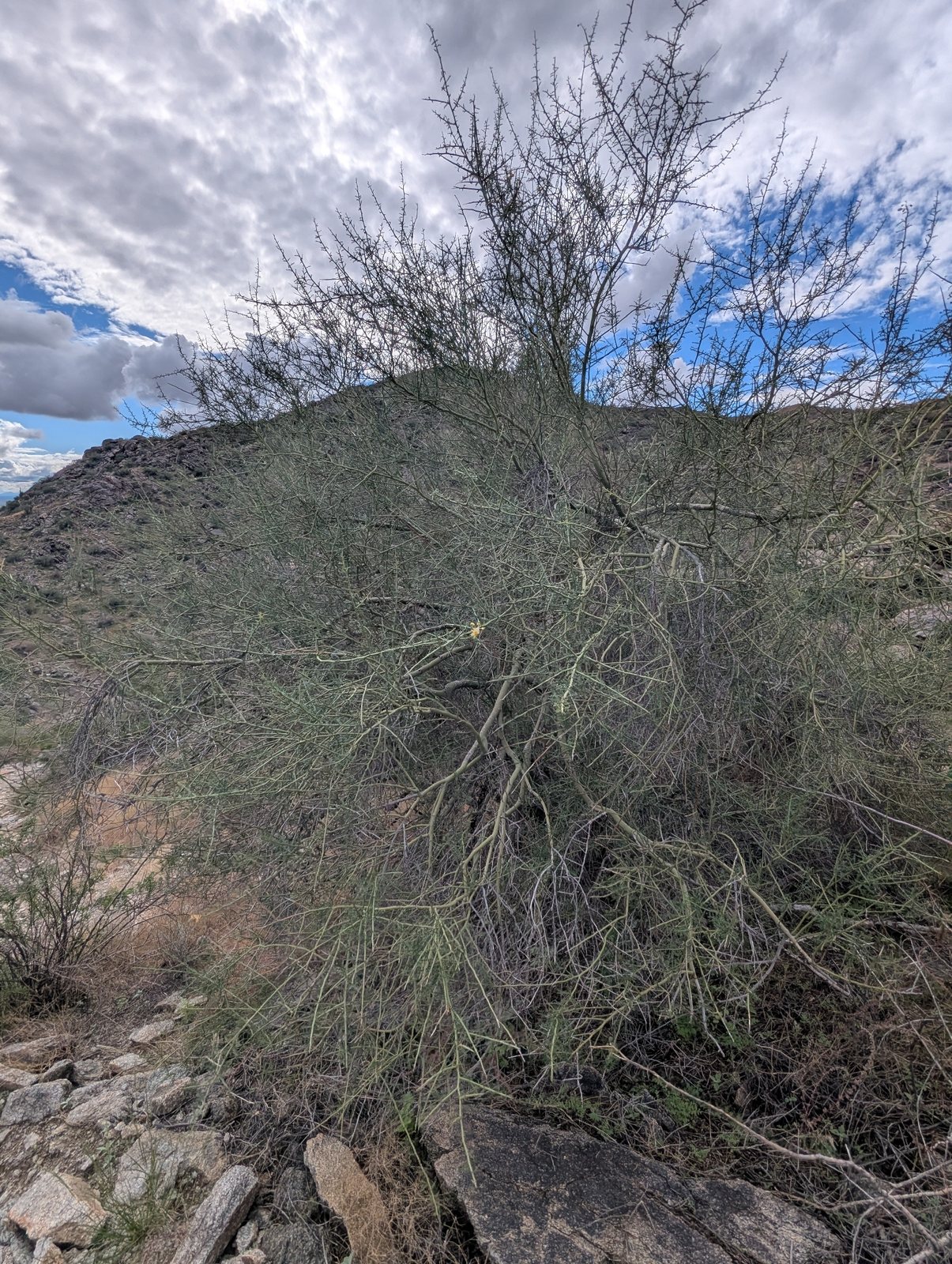
A small, slow-growing desert tree native to the Sonoran Desert of the southwestern United States and northwestern Mexico, with green bark, thorny branches and pale yellow spring flowers. Gardeners grow it for light shade, its sculptural branching and very low water needs once established. It needs hot summers and excellent drainage; it is not a reliable outdoor tree for most of the United Kingdom or Canada.
At a glance
- Sun
- Full sun; best in an open, hot position.
- Water
- Very low once established; water deeply but infrequently, allowing the root zone to dry between soakings.
- Soil
- Well-drained sandy, gravelly or rocky soil, including alkaline soils; avoid waterlogged ground and regularly irrigated lawns.
- Height
- 15-25 ft (4.6-7.6 m)
- Spread
- 15-25 ft (4.6-7.6 m)
- Flowers
- Spring, sometimes extending into early summer; pale yellow flowers with a cream or whitish upper petal.
- Foliage
- Tiny paired leaflets appear after rain and fall during drought or cold; the yellow-green bark continues photosynthesis when the tree is leafless.
- Growth
- Slow
- Care needed
- Low
The year at a glance
- Pollinators
- Drought tolerant
- Heat tolerant
- Wildlife
- Low allergen
| J | F | M | A | M | J | J | A | S | O | N | D | |
|---|---|---|---|---|---|---|---|---|---|---|---|---|
| Flowers | ||||||||||||
| Fruit | ||||||||||||
| Plant |
Northern hemisphere months. In Australia, shift them by six.
- Difficulty
- Hard
- Toughness
- Needs looking after
Will it suit your garden?
Pick your zone, country, light and whether you have pets.
Full sun is 6 or more hours of direct sun a day, part shade 3 to 6 hours, shade under 3.
How it grows
Planting day
7 ft (2 m)
After 1 year
7 ft (2.1 m)
After 2 years
7 ft (2.3 m)
After 3 years
8 ft (2.4 m)
After 5 years
9 ft (2.6 m)
About 32 years to full size.
From a typical nursery size, at an average rate for this kind of plant. A rule of thumb, not a forecast.
Good to know
- Cats and dogs
- Safe
- Native to
- the US
- Growth rate
- Slow
Care
Jobs through the year
- WaterApr–May, Sep, every 35 days
- For established ground trees in suitable climates, water only in prolonged drought; young trees need more.
- WaterJun–Aug, every 28 days
- Deep-water established ground trees only in prolonged hot drought; water more often during the first two summers.
- PruneMay–Jun
- After flowering, remove dead or crossing branches sparingly; retain natural branching and shaded bark.
- MulchMay
- Apply a light gravel mulch, leaving the root flare and trunk clear.
- ProtectJan–Apr, Oct–Dec
- Unsuitable outdoors year-round in zones 6–7; a container specimen needs a spacious, bright, frost-free greenhouse.
- Plant with the root flare at ground level in freely draining soil; do not enrich the planting hole heavily.
- Water deeply through the first two summers, letting the soil dry between waterings and gradually increasing the interval.
- Once established, give occasional deep water only during prolonged hot drought; avoid frequent shallow irrigation.
- Do not routinely fertilize; rich soil and excess feeding are unnecessary.
- Keep mulch away from the trunk and place the thorny canopy clear of paths and play areas.
Pruning. Prune lightly in late spring or early summer, after flowering, to remove dead, damaged or crossing branches and gradually establish clearance. Retain the natural branching structure, avoid topping or heavy thinning, and do not suddenly expose shaded bark to intense sun.
Through the year
- Late winter
- Check for frost damage, but wait until new growth shows which branches are dead before cutting.
- Spring
- Plant once damaging frosts have passed, keeping the root flare above any surrounding mulch.
- Late spring
- After flowering, remove dead or crossing branches with minimal pruning.
- Summer
- Deep-water young trees as the root zone dries; check soil moisture before watering established trees.
- Autumn
- Reduce supplemental watering as temperatures fall and check that runoff drains away from the trunk.
- Winter
- Keep irrigation off unless conditions are unusually dry; protect newly planted trees during brief hard freezes.
In the garden
- Use as a small specimen tree in a sunny gravel garden, where its green trunk remains visible when leafless.
- Provide light, filtered shade over a desert planting of agaves, yuccas and low shrubs.
- Plant in a broad, dry courtyard with enough room to keep thorny branches away from seating and circulation.
- Combine with other Sonoran Desert plants in an informal wildlife garden with little supplemental irrigation.
Garden styles it suits: Desert modern, Southwestern, Desert / xeriscape, Dry gravel garden, Wildlife garden and Architectural minimal.
Plant it with: Brittlebush, Desert marigold, Fairy duster, Red yucca, Desert spoon and Saguaro.
Wildlife: Flowers attract native bees and other pollinating insects. Birds use the branches for shelter and nesting, and seeds are eaten by desert wildlife; young trees can also shelter establishing desert plants.
Problems to watch for
- Root and crown rot in wet soil: improve drainage, keep water away from the trunk and stop frequent irrigation.
- Palo verde root borer: larvae can damage roots, especially on stressed trees; maintain sound watering practices and have declining or unstable trees assessed by an arborist.
- Desert mistletoe: remove affected small branches well below the attachment when practical; seek arborist advice for heavy infestations.
- Frost injury or sunburn after heavy pruning: choose a warm site, protect young trees during freezes and preserve enough canopy to shade previously sheltered bark.
Safety
Not known to be toxic to people, cats, dogs or horses. Species-specific safety information is limited, so discourage pets and livestock from eating it; the sharp thorns are the main household hazard and can cause puncture wounds.
Easily confused with
Blue palo verde (Parkinsonia florida)
Usually larger and faster-growing, with blue-green rather than yellow-green bark, larger leaflets and flowers whose petals are all yellow.
Mexican palo verde (Parkinsonia aculeata)
Has conspicuously long, narrow, drooping leaf axes carrying many tiny leaflets, rather than the short leaves of foothills palo verde; it is invasive in parts of Australia and other warm regions.
The name
Palo verde is Spanish for 'green stick', referring to the green bark, while microphylla means 'small-leaved' and Parkinsonia honours the English botanist John Parkinson.
Propagation. Grow from seed. Carefully nick the hard seed coat away from the embryo, soak overnight, then sow in a freely draining mix in warm conditions; move seedlings to their permanent position while young to limit root disturbance.
Checked against open data
- Accepted botanical name
- Parkinsonia microphylla
- In the US and Canada
- Native in the lower 48 states.
- Native range
- Arizona, California and Mexico Northwest.
- Measured
- Average height 700 cm.
Sources: GBIF (CC BY 4.0), USDA PLANTS and Trefle (CC BY 4.0). The care and design notes are LandscapeGPT's own.
See it in your own yard.
Upload a photo of your yard and see it redesigned with plants that suit your climate, each checked against your zone.