Fuchsia-flowered gooseberry
Ribes speciosum. Family Grossulariaceae. Shrub.
Also called Fuchsia-flowering gooseberry, California fuchsia-flowered gooseberry.
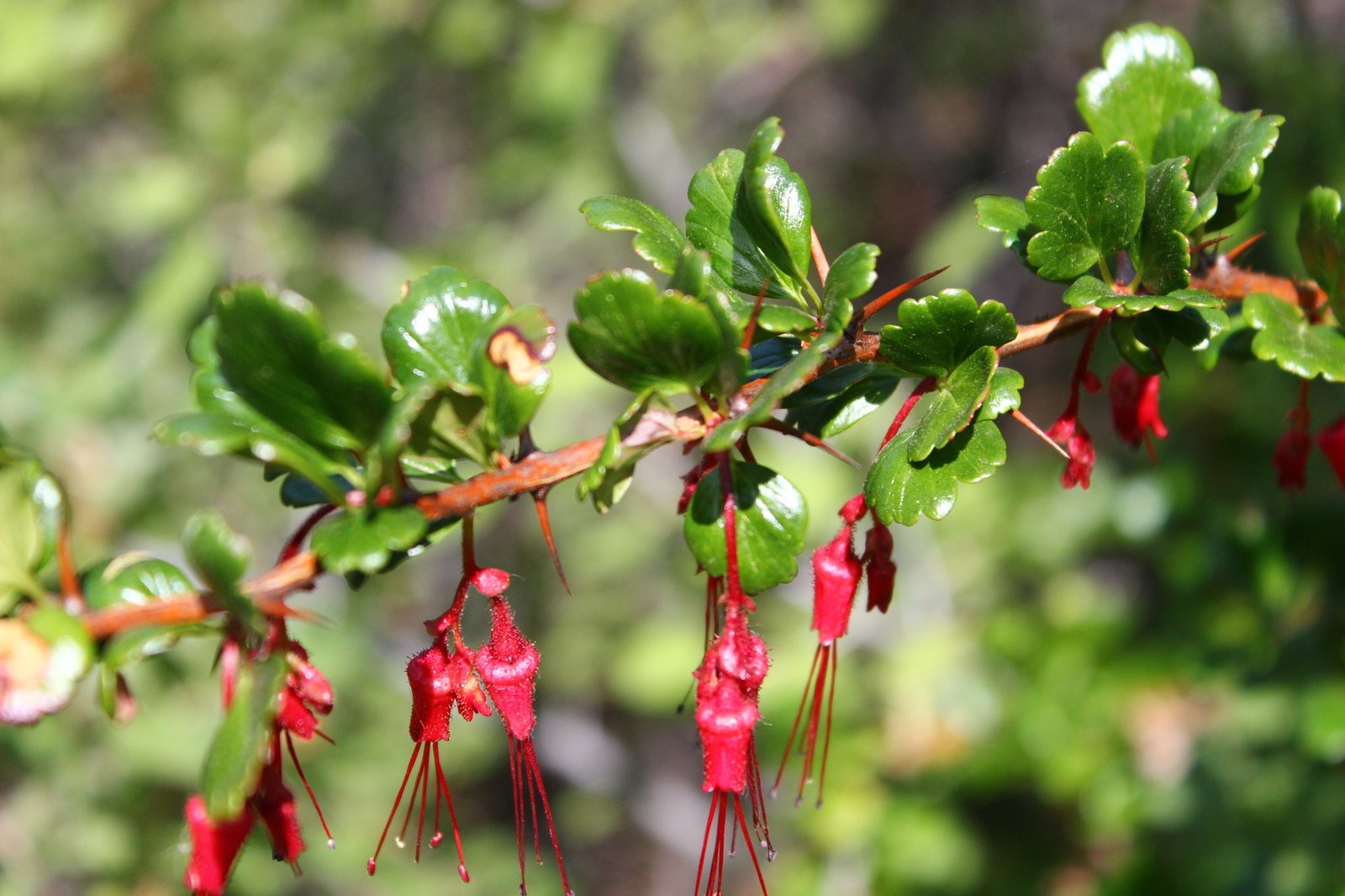
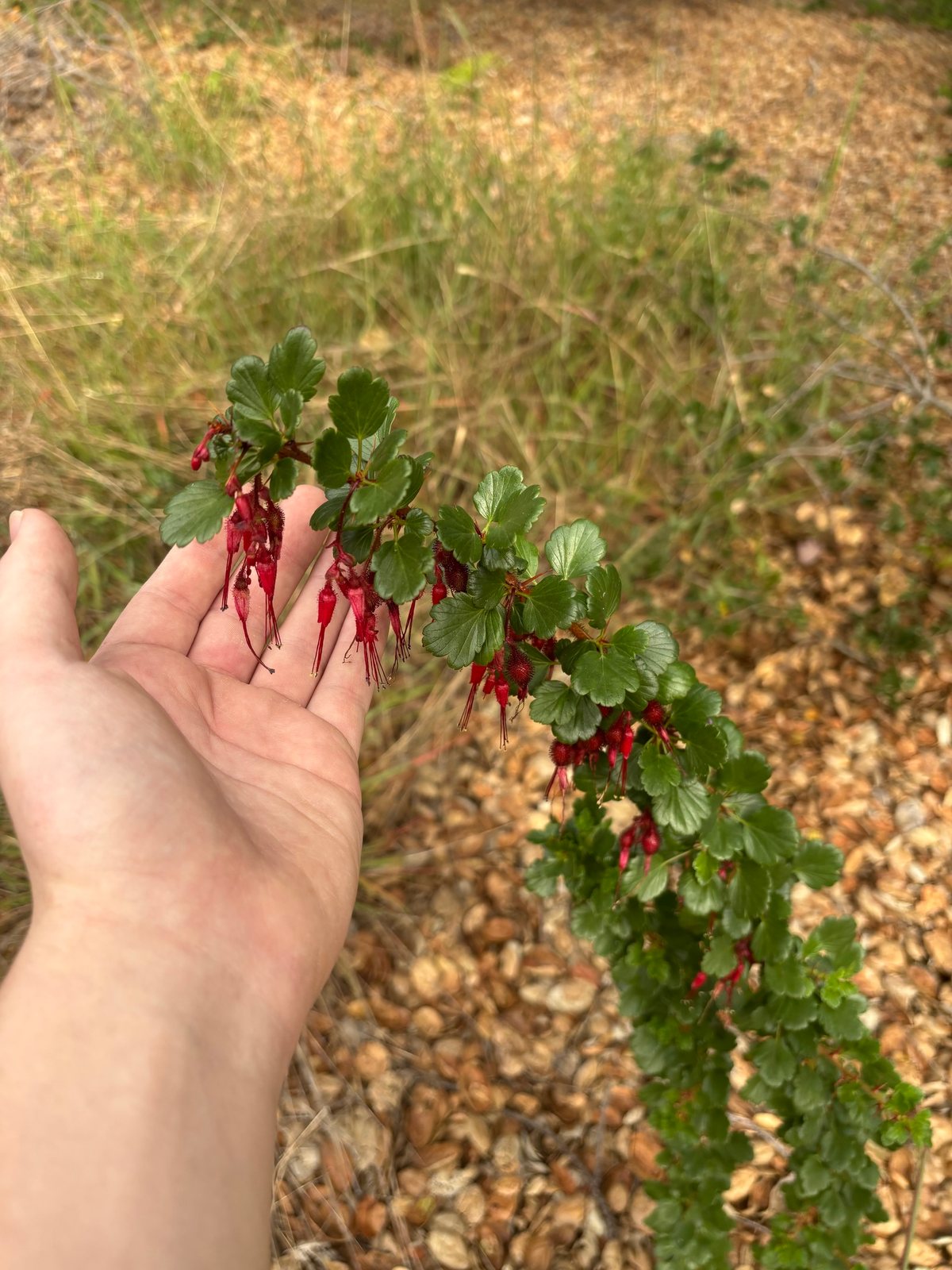
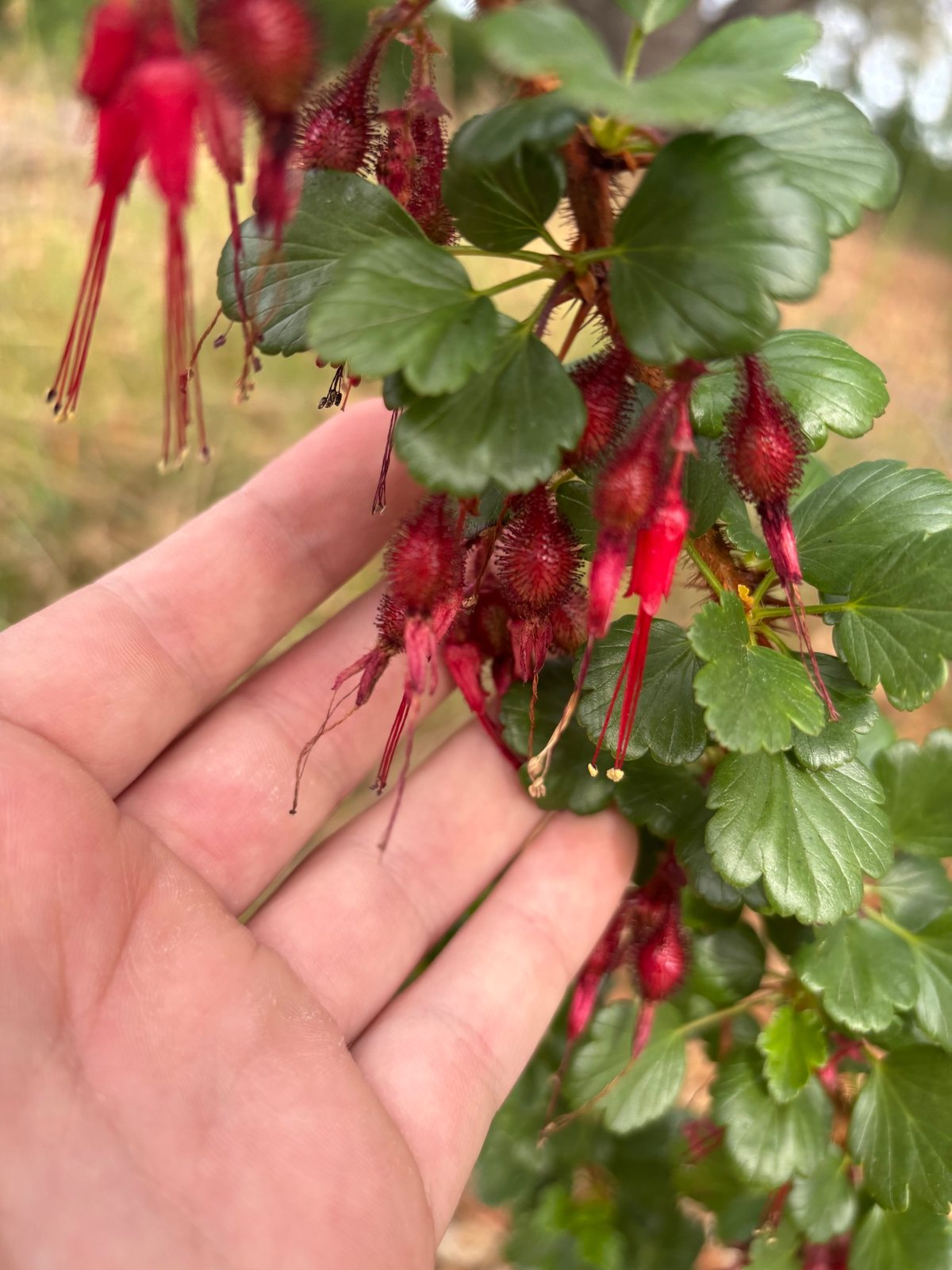
This spiny shrub from coastal California and northern Baja California bears dangling, scarlet flowers with long, projecting stamens. Gardeners grow it for its winter-to-spring flowers, arching branches and tolerance of dry summers once established; it may lose its leaves during drought or cold weather.
At a glance
- Sun
- Full sun to partial shade; afternoon shade is helpful in hot inland gardens.
- Water
- Low once established in suitable climates; water regularly during establishment, then sparingly in summer.
- Soil
- Well-drained sandy, loamy or stony soil; tolerates clay only where drainage is good. Avoid waterlogged ground.
- Height
- 6-10 ft (1.8-3 m)
- Spread
- 6-10 ft (1.8-3 m)
- Flowers
- Late winter to spring; pendant scarlet-red flowers with long red stamens.
- Foliage
- Small, glossy, dark-green leaves with three to five rounded lobes; evergreen to semi-evergreen, but sometimes summer-deciduous in dry conditions.
- Growth
- Moderate
- Care needed
- Low
The year at a glance
- Pollinators
- Drought tolerant
- Heat tolerant
- Wildlife
- Low allergen
| J | F | M | A | M | J | J | A | S | O | N | D | |
|---|---|---|---|---|---|---|---|---|---|---|---|---|
| Flowers | ||||||||||||
| Fruit | ||||||||||||
| Plant |
Northern hemisphere months. In Australia, shift them by six.
- Difficulty
- Moderate
- Toughness
- Fairly tough
Will it suit your garden?
Pick your zone, country, light and whether you have pets.
Full sun is 6 or more hours of direct sun a day, part shade 3 to 6 hours, shade under 3.
How it grows
Planting day
1.6 ft (0.5 m)
After 1 year
2.9 ft (0.88 m)
After 2 years
4 ft (1.3 m)
After 3 years
5 ft (1.6 m)
After 5 years
8 ft (2.4 m)
full size
About 5 years to full size.
From a typical nursery size, at an average rate for this kind of plant. A rule of thumb, not a forecast.
Good to know
- Cats and dogs
- Safe
- Native to
- the US
- Growth rate
- Moderate
Care
Jobs through the year
- WaterApr–May, Sep–Oct, every 21 days
- Water established shrubs only if soil is dry; water new plants more regularly.
- WaterJun–Aug, every 30 days
- Give an occasional deep watering only during prolonged drought; avoid frequent summer irrigation.
- MulchApr
- Apply a light mulch around the root zone, keeping the stems clear.
- PruneMay–Jun
- After flowering, lightly shape and remove damaged or crowded stems; wear thick gloves.
- ProtectJan–Mar, Nov–Dec
- Use a sheltered wall in zone 7; in zone 6, overwinter in a cool, frost-free container shelter.
- Plant in a sheltered position with freely draining soil; in colder districts, use a sunny wall for protection.
- Water deeply during the first growing season, letting the surface soil dry between waterings.
- Once established, avoid frequent summer irrigation, especially in heavy soil.
- Apply a light mulch, keeping it clear of the stems; routine feeding is usually unnecessary.
- Keep the thorny branches away from narrow paths, play areas and places where pets brush past.
Pruning. Prune just after flowering, removing dead, damaged or crossing branches and shortening wayward shoots to a healthy side branch. Remove an occasional old stem at ground level if the shrub becomes crowded, and wear thick gloves.
Through the year
- Autumn
- Plant in mild climates while the soil is still warm and seasonal rain is returning.
- Winter
- Check drainage and protect young plants from severe frost or drying winds.
- Spring
- In colder districts, plant after severe frost has passed and water new plants thoroughly.
- Late spring
- After flowering finishes, remove damaged wood and lightly shape the shrub.
- Summer
- Reduce watering on established plants; some leaf loss during dry weather is normal.
- Late summer
- Take semi-ripe cuttings from healthy, non-flowering shoots.
In the garden
- Train loosely against a sheltered wall to display the dangling flowers and arching stems.
- Use in a California-native shrub border with ceanothus, manzanita and sages.
- Plant on a well-drained bank for a thorny, informal barrier away from foot traffic.
- Place at a woodland edge where bright flowers stand out against evergreen foliage.
Garden styles it suits: California native, Mediterranean, Wildlife garden, Woodland, Coastal and Desert / xeriscape.
Plant it with: California lilac, Manzanita, Coffeeberry, Cleveland sage, Western sword fern and Douglas iris.
Wildlife: The tubular flowers attract hummingbirds in its native range and provide nectar for visiting insects. Dense, thorny branches offer shelter for small birds.
Problems to watch for
- Root rot in wet soil: improve drainage before planting and avoid frequent irrigation, particularly during summer.
- Aphids on soft shoots: wash off small colonies with water and encourage ladybirds and other predators.
- Powdery mildew: provide air circulation, avoid excessive nitrogen feeding and remove badly affected growth.
- Cold damage to exposed shoots: choose a sheltered site and prune damaged stems once new growth shows which wood is alive.
Safety
Not known to be toxic to people, cats, dogs or horses, although species-specific safety information is limited. It is grown as an ornamental rather than a food crop; avoid eating unidentified berries. The sharp spines can cause puncture wounds.
Easily confused with
Red-flowering currant (Ribes sanguineum)
Has upright clusters of pink, red or white flowers, lacks the stout gooseberry spines and does not have long, fuchsia-like flowers.
Spreading gooseberry (Ribes divaricatum)
Also has spiny stems, but its flowers are smaller and greenish-purple rather than long, bright scarlet tubes.
Hardy fuchsia (Fuchsia magellanica)
Usually has red sepals surrounding a purple corolla, unlobed leaves and no stout stem spines.
The name
The epithet speciosum means showy, while fuchsia-flowered refers to the resemblance of its hanging red flowers to those of a fuchsia.
Propagation. Take semi-ripe cuttings in summer or hardwood cuttings in autumn to winter. Seed can also be used, but germination may be slow and requires suitable cold treatment. Before planting or sharing plants, check local Ribes restrictions in parts of the United States and Canada because of white pine blister rust regulations.
Checked against open data
- Accepted botanical name
- Ribes speciosum
- In the US and Canada
- Native in the lower 48 states.
- Native range
- California and Mexico Northwest.
Sources: GBIF (CC BY 4.0), USDA PLANTS and Trefle (CC BY 4.0). The care and design notes are LandscapeGPT's own.
See it in your own yard.
Upload a photo of your yard and see it redesigned with plants that suit your climate, each checked against your zone.