Golden trumpet
Allamanda cathartica. Family Apocynaceae. Climber.
Also called Golden trumpet vine, Yellow allamanda, Common allamanda.
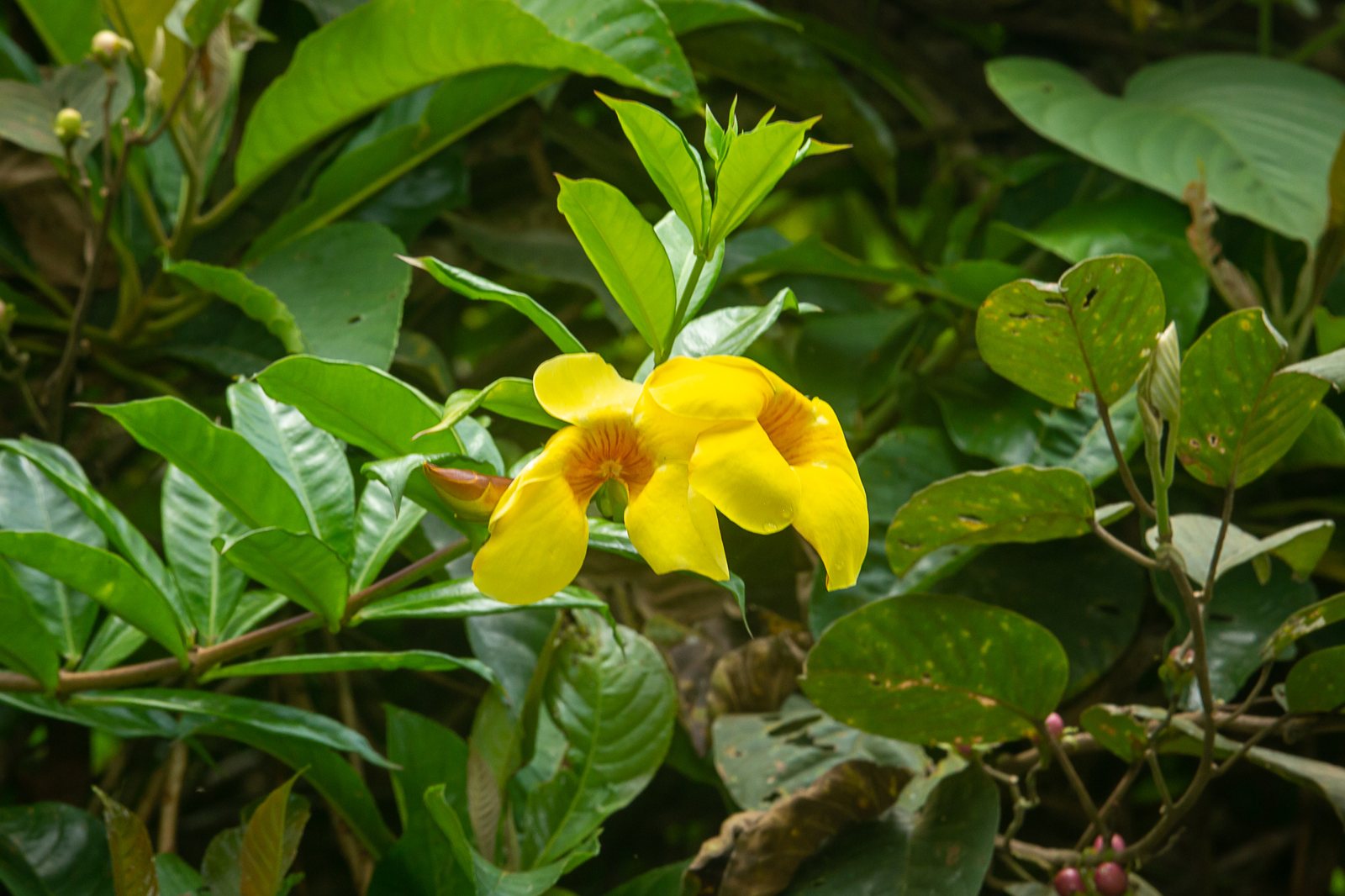
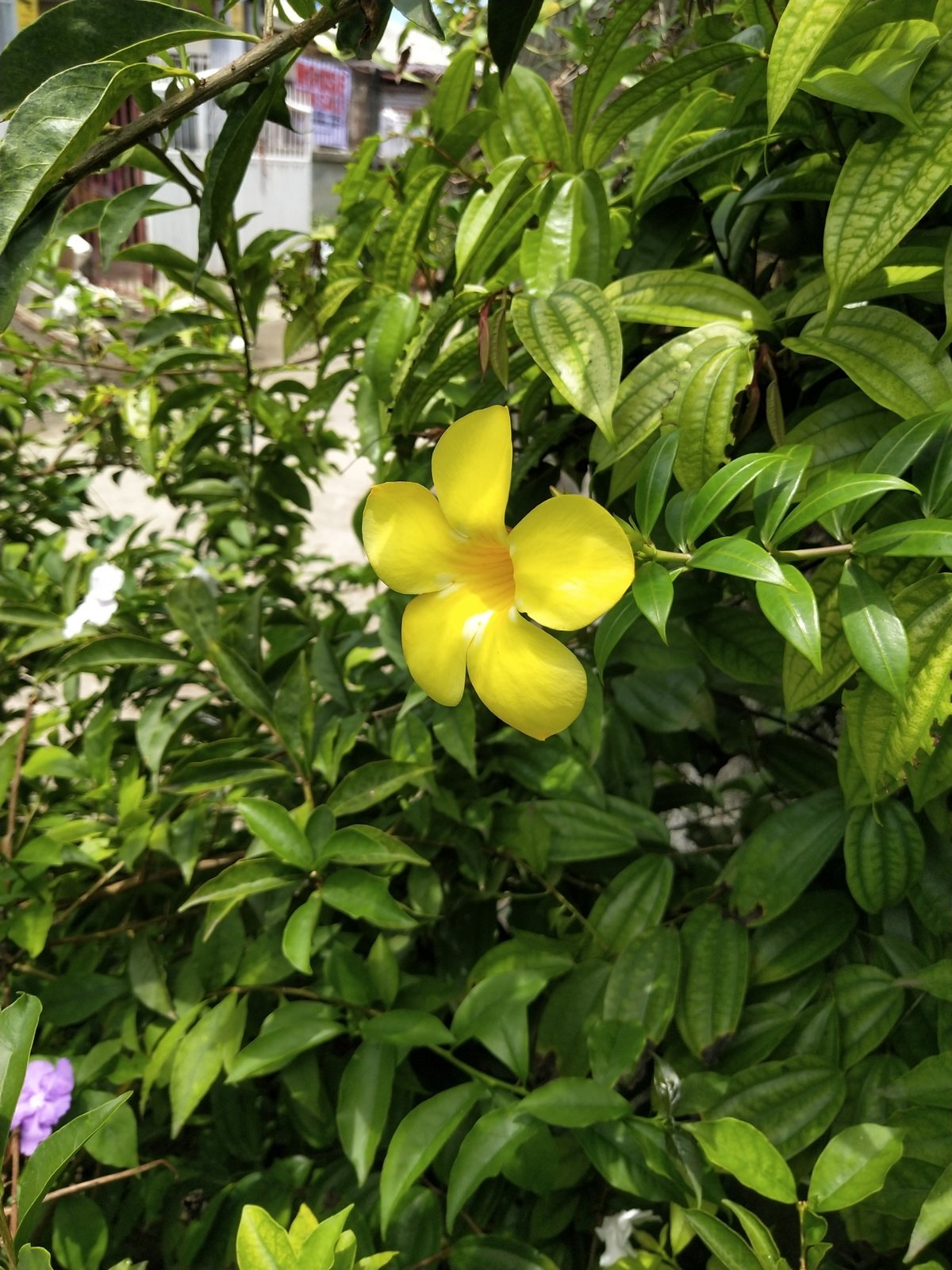
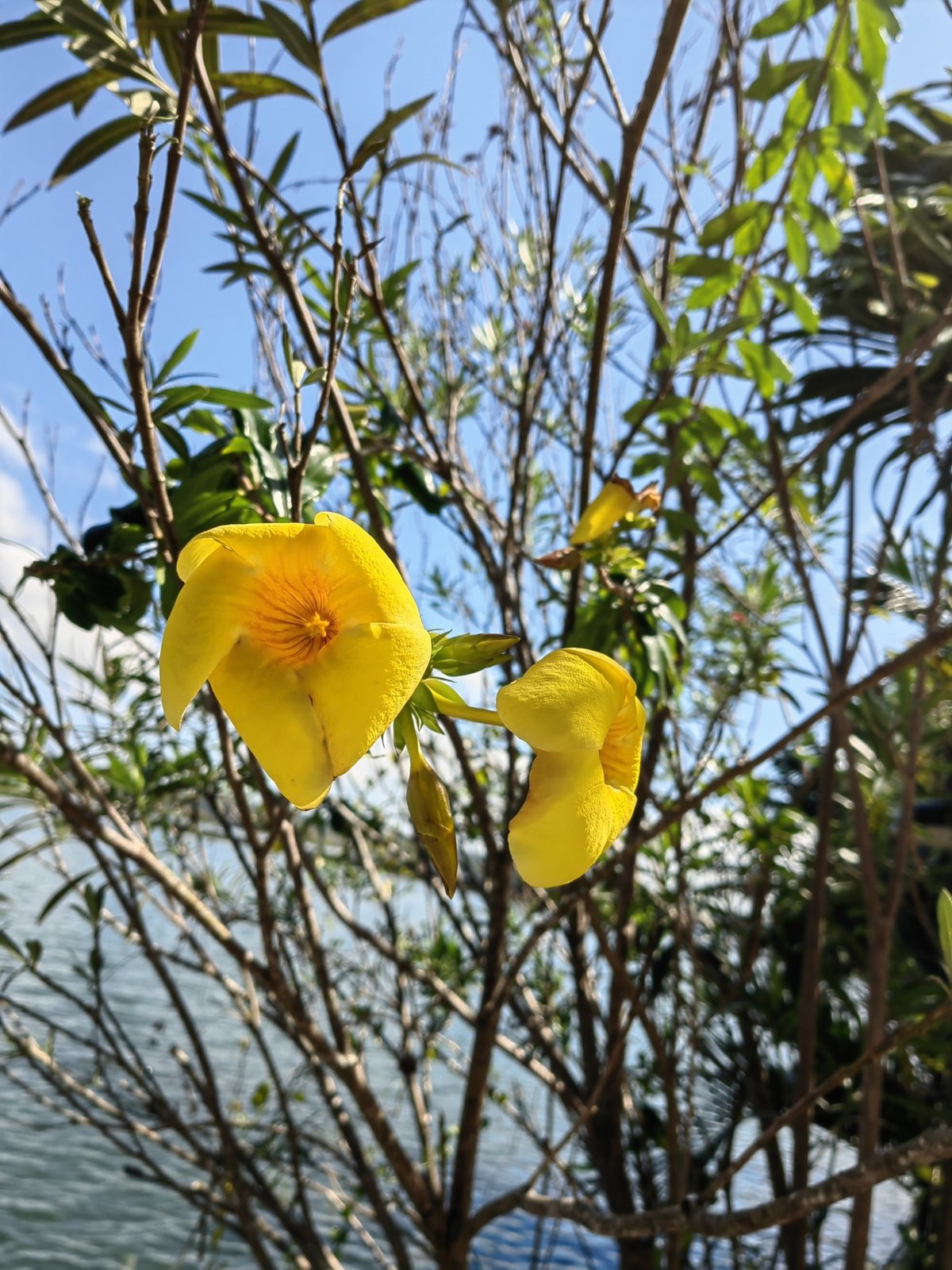
Golden trumpet is a vigorous evergreen scrambling climber from tropical South America, grown for its large yellow trumpet-shaped flowers. Its stems need tying to a support, or it can be pruned into a broad shrub. In colder parts of the United States, the United Kingdom, Canada and southern Australia, grow it in a container and overwinter it in a warm, bright, frost-free room or greenhouse.
At a glance
- Sun
- Full sun gives the best flowering; light afternoon shade is useful in very hot inland gardens.
- Water
- Water thoroughly when the soil surface begins to dry during active growth. Keep the root zone lightly moist but never waterlogged; water less in winter.
- Soil
- Fertile, moisture-retentive but freely draining soil, preferably slightly acidic. Use a well-drained potting mix in containers.
- Height
- 10-20 ft (3-6 m) with support
- Spread
- 6-12 ft (1.8-3.7 m)
- Flowers
- Large golden-yellow trumpets from late spring through autumn; flowering can continue much of the year in consistently warm tropical conditions.
- Foliage
- Evergreen. Glossy, leathery green leaves, usually arranged in whorls along the stems.
- Growth
- Fast in warm weather
- Care needed
- Medium
The year at a glance
- Pollinators
- Heat tolerant
- Low allergen
| J | F | M | A | M | J | J | A | S | O | N | D | |
|---|---|---|---|---|---|---|---|---|---|---|---|---|
| Flowers | ||||||||||||
| Plant |
Northern hemisphere months. In Australia, shift them by six.
- Difficulty
- Hard
- Toughness
- Needs looking after
Will it suit your garden?
Pick your zone, country, light and whether you have pets.
Full sun is 6 or more hours of direct sun a day, part shade 3 to 6 hours, shade under 3.
How it grows
Planting day
2 ft (0.6 m)
After 1 year
3 ft (1.1 m)
After 2 years
5 ft (1.5 m)
After 3 years
6 ft (1.8 m)
full size
About 3 years to full size.
From a typical nursery size, at an average rate for this kind of plant. A rule of thumb, not a forecast.
Good to know
- Cats and dogs
- Toxic
- Invasive in
- Australia
- Growth rate
- Fast
Care
Jobs through the year
- WaterApr–May, Sep, every 7 days
- Water established roots as the surface dries; young plants and containers need more frequent checks.
- WaterJun–Aug, every 5 days
- Keep established roots lightly moist, not waterlogged; containers may need daily watering.
- WaterJan–Mar, Oct–Dec, every 14 days
- In warm winter shelter, water sparingly without letting the root ball dry completely.
- FeedApr–Sep, every 21 days
- Feed containers with flowering-plant fertiliser at the label rate while actively growing.
- MulchMay
- Mulch outdoor roots to conserve moisture, keeping stem bases clear.
- PruneFeb–Mar
- Shorten long shoots and remove weak or crowded growth; wear gloves against irritating sap.
- ProtectJan–Apr, Sep–Dec
- Keep in warm, bright shelter before nights fall below 10°C; return outside only when reliably warm.
- Provide a sturdy trellis or wires and tie in stems; they do not attach themselves to supports.
- Water container plants frequently in warm weather, allowing excess water to drain away.
- Feed container plants every two to four weeks during active growth with a balanced flowering-plant fertiliser at the labelled rate.
- Mulch outdoor plants to conserve moisture, keeping mulch clear of the stem bases.
- Move containers under cover before nights regularly fall below 50°F (10°C), and provide the brightest available winter position.
Pruning. In late winter or early spring, shorten long shoots and remove weak, damaged or crowded growth before new growth starts. Pinch young shoots to encourage branching, and wear gloves to avoid contact with the milky sap.
Through the year
- Late winter
- Prune and train the framework before vigorous new growth begins.
- Spring
- Repot container plants if root-bound, and resume regular feeding as growth starts.
- Late spring
- Move overwintered plants outdoors gradually once nights stay above 50°F (10°C).
- Summer
- Water regularly, tie in new stems and check leaf undersides for pests.
- Autumn
- Bring containers into warm, bright shelter before cold nights; inspect for pests first.
- Winter
- Water sparingly without letting the root ball dry out completely, and pause feeding if growth stops.
In the garden
- Train over a sunny trellis or pergola for a long display of yellow flowers.
- Grow against a warm courtyard wall, using wires to support the arching stems.
- Use a large container as a seasonal patio feature where winter protection is necessary.
- Prune into a loose flowering shrub among hibiscus, crotons and other tropical foliage plants.
Garden styles it suits: Tropical, Modern tropical, Luxury resort, Modern courtyard, Caribbean and Florida subtropical.
Plant it with: Tropical hibiscus, Croton, Cordyline, Canna, Ixora and Pentas.
Wildlife: Flowers may attract bees and other nectar-seeking insects in warm climates. Wildlife value varies with local pollinators; it is not a substitute for locally native habitat plants.
Problems to watch for
- Whitefly: inspect leaf undersides and treat with insecticidal soap or horticultural oil labelled for the plant and pest; repeat as directed.
- Spider mites in hot, dry conditions: rinse foliage, especially leaf undersides, and use a labelled mite treatment if needed.
- Root rot in wet soil: improve drainage, empty container saucers and let the surface begin to dry before watering again.
- Few flowers: provide more direct sun, avoid excessive nitrogen feeding and protect the plant from prolonged cool weather.
Safety
All parts are poisonous if eaten, and the milky sap can irritate skin and eyes. Keep away from children, cats, dogs and grazing horses; ingestion can cause vomiting, abdominal pain and diarrhoea, sometimes severe. Horse-specific poisoning information is limited, so do not allow access to plants or prunings.
Where it spreads. An environmental weed in parts of tropical and subtropical Queensland, Australia, where it can scramble over other vegetation. Keep it out of bushland and waterways, and dispose of prunings so they cannot take root.
Easily confused with
Bush allamanda (Allamanda schottii)
Usually forms a smaller, more upright shrub with narrower leaves and smaller yellow flowers rather than long scrambling stems.
Yellow bells (Tecoma stans)
Has compound leaves divided into toothed leaflets; golden trumpet has simple, smooth-edged leaves.
Yellow oleander (Cascabela thevetia)
Has much narrower, willow-like leaves and usually grows as a self-supporting shrub or small tree; it is also highly poisonous.
The name
Allamanda honours the Swiss botanist Frédéric-Louis Allamand, while cathartica refers to the plant's strong purgative effects, not a safe medicinal use.
Propagation. Take semi-ripe stem cuttings in summer and root them in a moist, freely draining medium with warmth and high humidity. Wear gloves when handling cut stems.
Checked against open data
- Accepted botanical name
- Allamanda cathartica
- In the US and Canada
- Introduced in the lower 48 states, Pacific Basin, Puerto Rico and US Virgin Islands.
- Native range
- Bolivia, Brazil North, Brazil Northeast, Brazil South, Brazil Southeast, Brazil West-Central, Colombia, Costa Rica, French Guiana, Guyana, Honduras and Nicaragua.
Sources: GBIF (CC BY 4.0), USDA PLANTS and Trefle (CC BY 4.0). The care and design notes are LandscapeGPT's own.
See it in your own yard.
Upload a photo of your yard and see it redesigned with plants that suit your climate, each checked against your zone.