Gray's sedge
Carex grayi. Family Cyperaceae. Ornamental grass.
Also called Mace sedge, Morning star sedge.
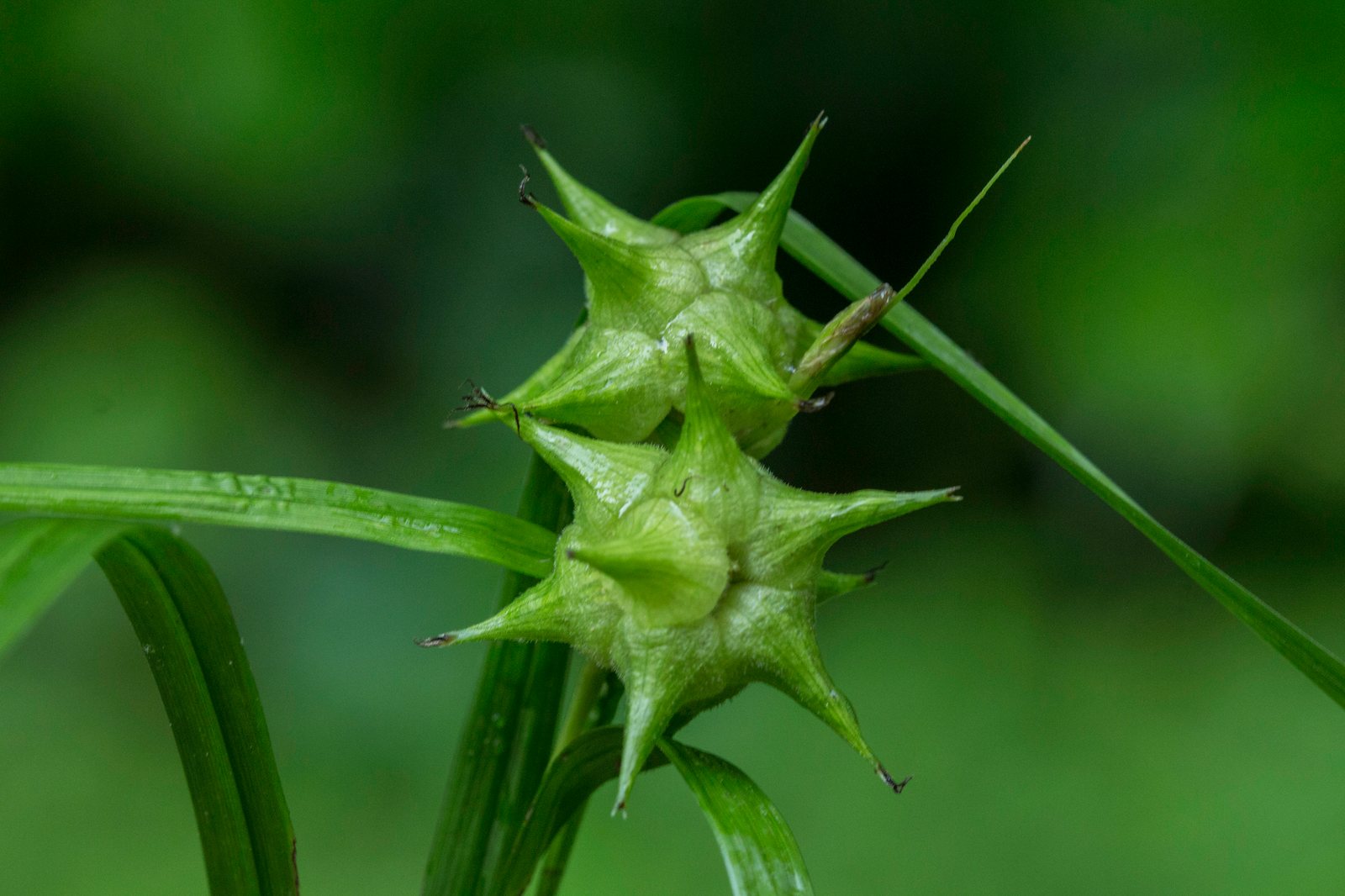
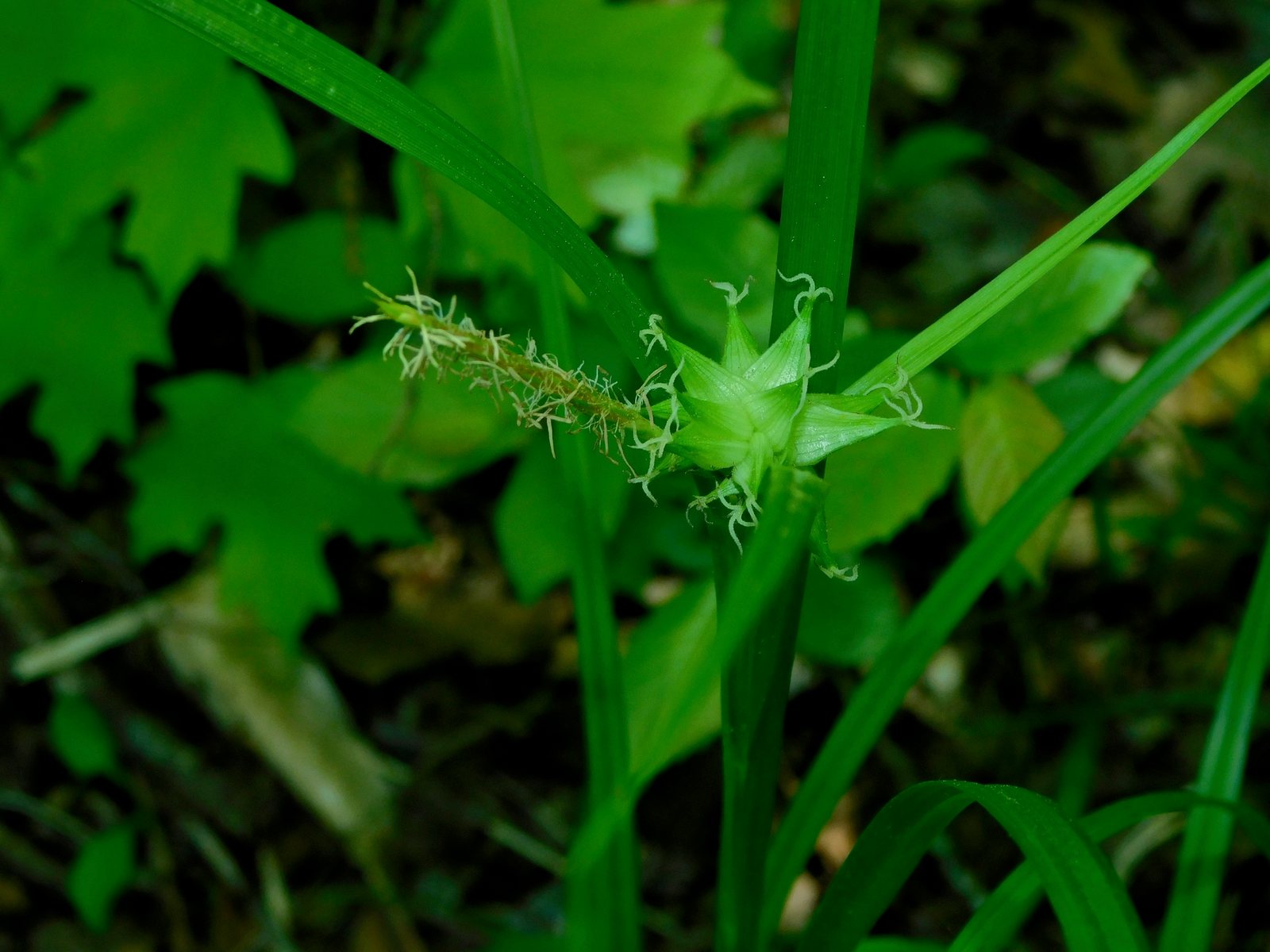
Gray's sedge is a clump-forming, grass-like perennial native to moist woods and floodplains in eastern North America. Gardeners grow it for its arching green leaves and distinctive starburst seed heads, which resemble small medieval maces.
At a glance
- Sun
- Partial shade is ideal; full sun suits it where the soil stays consistently moist.
- Water
- Keep consistently moist to wet. Established plants tolerate brief drier spells, but prolonged drought causes browning and poor growth.
- Soil
- Moisture-retentive soil enriched with organic matter; tolerates clay, wet ground and occasional flooding.
- Height
- 2-3 ft (0.6-0.9 m)
- Spread
- 1.5-2.5 ft (0.45-0.75 m)
- Flowers
- Inconspicuous greenish flowers in late spring to early summer, followed by conspicuous green starburst fruit clusters that turn brown as they mature.
- Foliage
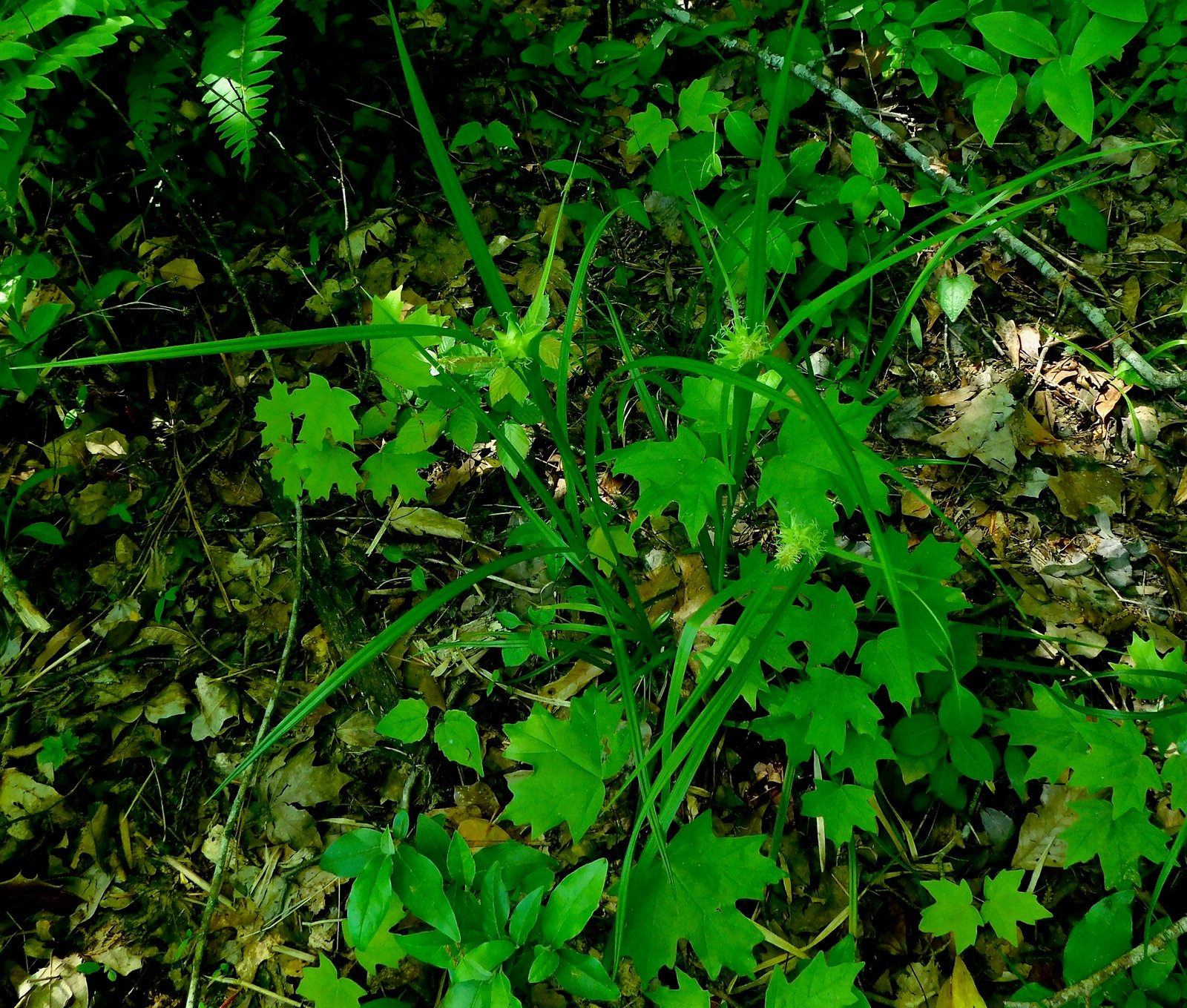
- Bright green, narrow, arching leaves form upright to fountain-shaped clumps; foliage usually dies back for winter.
- Growth
- Moderate
- Care needed
- Low
The year at a glance
- Deer resistant
- Cold hardy
- Heat tolerant
- Wildlife
| J | F | M | A | M | J | J | A | S | O | N | D | |
|---|---|---|---|---|---|---|---|---|---|---|---|---|
| Flowers | ||||||||||||
| Fruit | ||||||||||||
| Plant |
Northern hemisphere months. In Australia, shift them by six.
- Difficulty
- Easy
- Toughness
- Fairly tough
Will it suit your garden?
Pick your zone, country, light and whether you have pets.
Full sun is 6 or more hours of direct sun a day, part shade 3 to 6 hours, shade under 3.
How it grows
Planting day
1.1 ft (0.35 m)
After 1 year
1.7 ft (0.51 m)
After 2 years
2.2 ft (0.67 m)
After 3 years
2.5 ft (0.75 m)
full size
About 3 years to full size.
From a typical nursery size, at an average rate for this kind of plant. A rule of thumb, not a forecast.
Good to know
- Cats and dogs
- Safe
- Native to
- the US and Canada
- Growth rate
- Moderate
Care
Jobs through the year
- WaterMar–May, Sep–Oct, every 7 days
- Water established ground-grown plants if rain is insufficient to keep soil consistently moist; new plants need closer checks.
- WaterJun–Aug, every 3 days
- Water if needed to prevent drying; skip irrigation in naturally wet soil and check new plants more often.
- PruneFeb–Mar
- Cut dead leaves and stems to 8–10 cm before fresh growth.
- MulchMar–Apr
- Spread leaf mould or compost around the clump without covering the crown.
- DivideMar–Apr
- Divide crowded clumps only as needed and replant promptly into moist soil.
- DeadheadJul–Aug
- Remove seed heads before shedding only if self-sowing is unwanted; otherwise retain for winter interest.
- Water during dry spells so the root zone does not dry out completely.
- Spread leaf mould or compost around the clump in spring, keeping it clear of the crown.
- Avoid routine fertilising; rich soil usually supplies enough nutrients.
- Divide crowded clumps in early spring and replant divisions promptly into moist soil.
- Remove unwanted seedlings while small, or cut off seed heads before they shed.
Pruning. In late winter or early spring, cut dead leaves and stems back to about 3-4 in (8-10 cm), before fresh growth develops. Leave the seed heads standing through autumn and winter if you enjoy their shape.
Through the year
- Late winter
- Cut back dead foliage before new shoots emerge.
- Early spring
- Plant or divide clumps, water thoroughly and mulch with leaf mould.
- Late spring
- Check soil moisture as growth speeds up, especially beneath trees.
- Summer
- Water during dry weather and leave the green starburst seed heads for display.
- Late summer
- Remove seed heads before seed falls if you want to limit self-sowing.
- Autumn
- Remove unwanted seedlings and leave healthy stems standing for winter structure.
In the garden
- Plant in groups along pond margins, with the crowns above the normal waterline.
- Use in rain gardens where soil stays moist but water levels fluctuate.
- Combine with ferns and broad-leaved perennials in damp woodland borders for contrasting leaf shapes.
- Repeat clumps through naturalistic planting, where the starburst seed heads provide summer detail.
Garden styles it suits: Woodland, Bog garden, Wildlife garden, New perennial (prairie), Green on green and Low-maintenance.
Plant it with: Royal fern, Sensitive fern, Cardinal flower, Turtlehead, Blue flag iris and Marsh marigold.
Wildlife: Provides cover for small animals and habitat for wetland insects. Sedge seeds are eaten by some birds, and native sedges support caterpillars and other plant-feeding insects. Flowers are wind-pollinated rather than a significant nectar source.
Problems to watch for
- Brown leaf tips or early dieback usually indicate dry soil; water deeply and add an organic mulch.
- Hot sun can scorch foliage where moisture is insufficient; improve watering or move the clump into partial shade.
- Rust or leaf spots may occur; remove badly affected foliage and improve airflow around crowded plants.
- Self-sown seedlings can appear in moist bare soil; pull them young or remove seed heads before they ripen.
Safety
Not known to be toxic to people, cats, dogs or horses; no part is recognised as a significant poisoning hazard. It is not grown as a food plant.
Easily confused with
Bladder sedge (Carex intumescens)
Its fruit clusters contain fewer inflated sacs and look looser and less evenly spherical than the dense starbursts of Gray's sedge.
Hop sedge (Carex lupulina)
Its inflated fruit sacs form elongated, hop-like spikes rather than the rounded mace-shaped heads of Gray's sedge.
The name
The epithet grayi honours the American botanist Asa Gray, while mace sedge refers to the shape of its fruit clusters.
Propagation. Divide established clumps in early spring. Seed can be sown outdoors in autumn; a period of cold, moist conditions helps germination, which may be uneven.
Checked against open data
- Accepted botanical name
- Carex grayi
- In the US and Canada
- Native in Canada and the lower 48 states.
- Native range
- Alabama, Arkansas, Connecticut, Delaware, District of Columbia, Florida, Georgia, Illinois, Indiana, Iowa, Kansas and Kentucky.
- Measured
- Soil pH 5.7 to 7.2. Average height 51 cm.
Sources: GBIF (CC BY 4.0), USDA PLANTS and Trefle (CC BY 4.0). The care and design notes are LandscapeGPT's own.
See it in your own yard.
Upload a photo of your yard and see it redesigned with plants that suit your climate, each checked against your zone.