Lady's bedstraw
Galium verum. Family Rubiaceae. Perennial.
Also called Yellow bedstraw, True bedstraw.
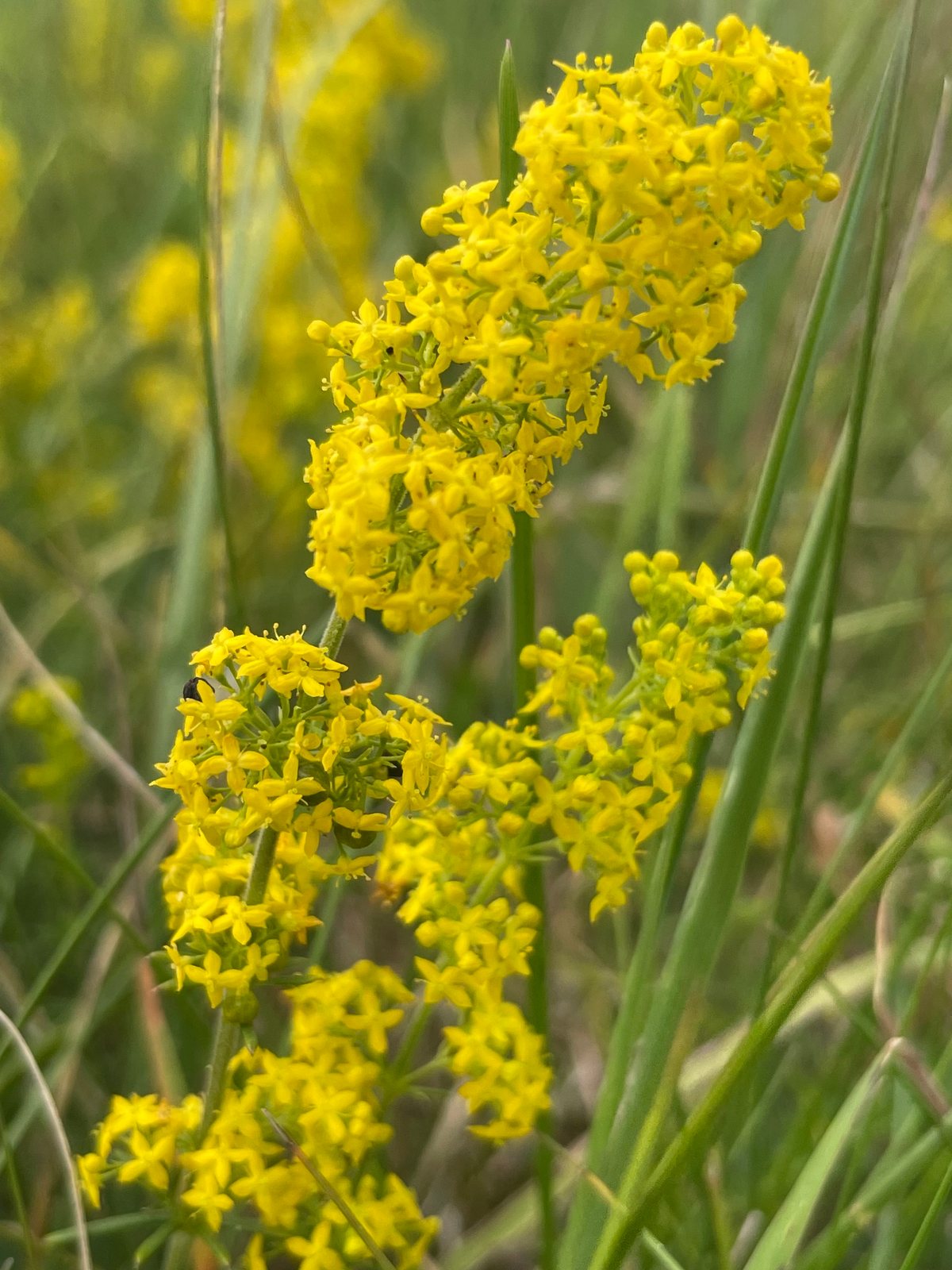
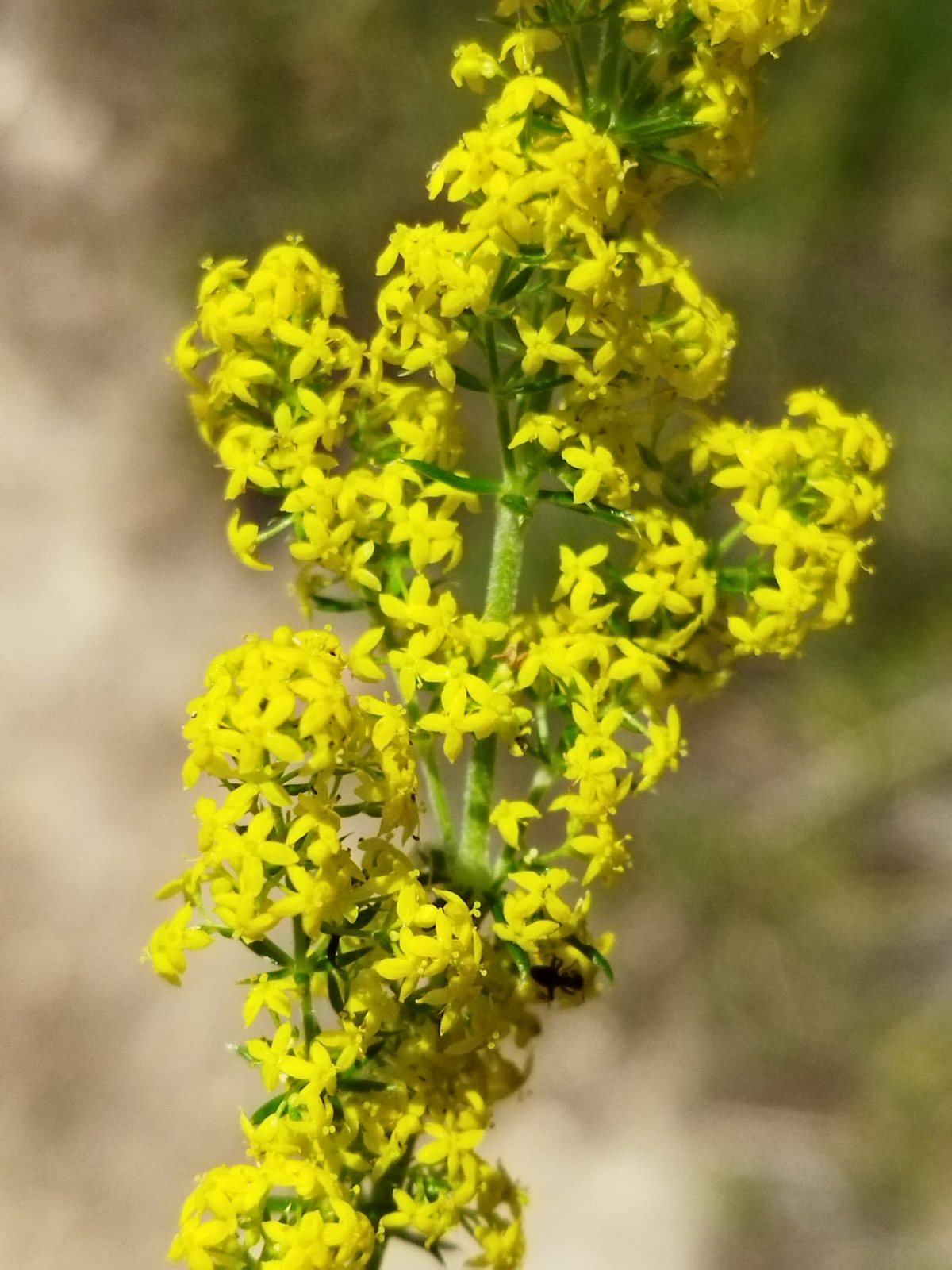
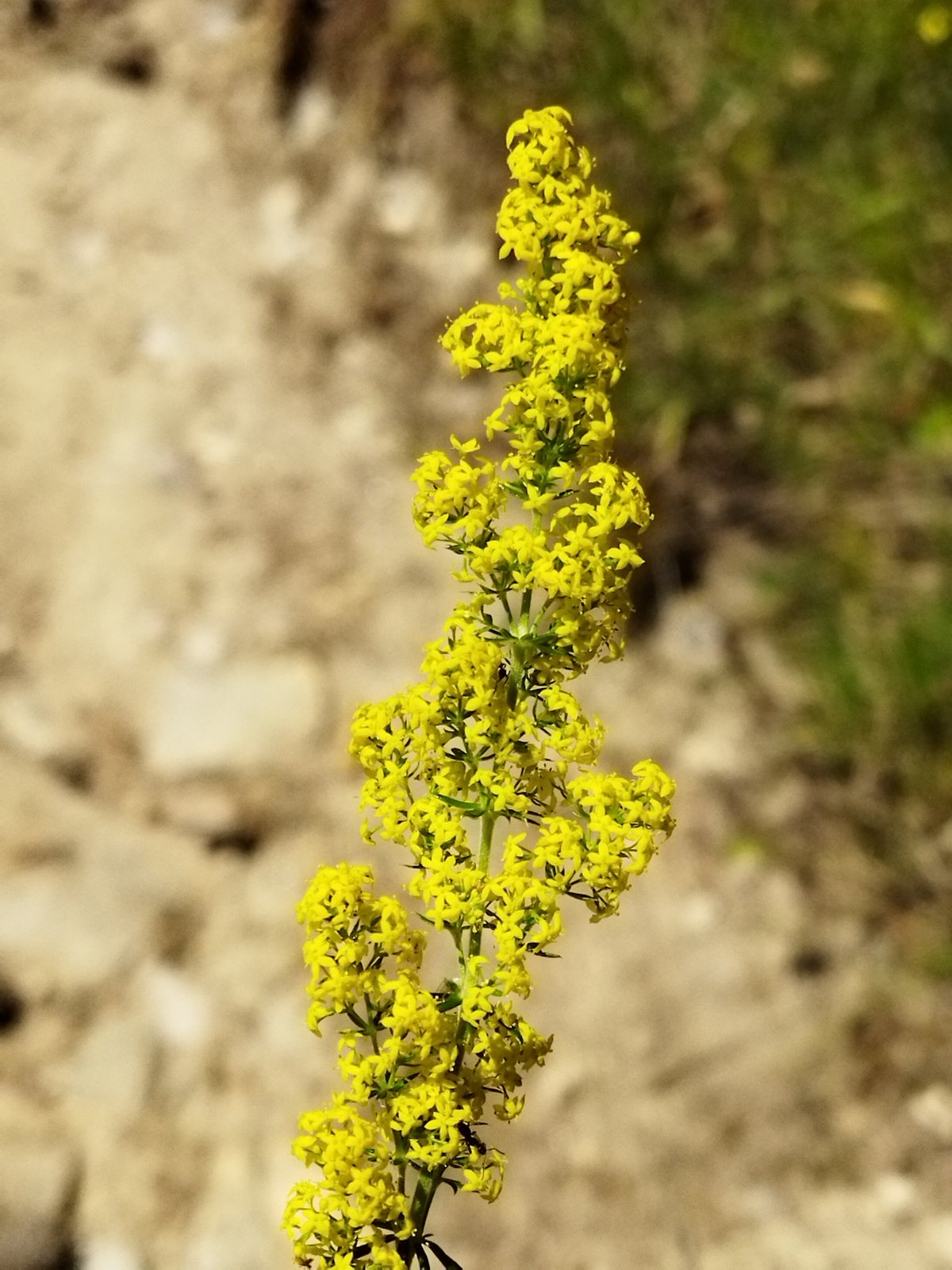
Lady's bedstraw is a spreading perennial with fine, needle-like leaves and frothy clusters of fragrant yellow summer flowers. Gardeners grow it in sunny meadows, informal borders and wildlife gardens, especially on lean, lime-rich soil. Its creeping roots can form substantial colonies, so it is better among robust meadow plants than beside small, delicate specimens.
At a glance
- Sun
- Full sun is best; tolerates light shade but may flower less and flop.
- Water
- Low to moderate; water regularly while establishing, then mainly during prolonged drought.
- Soil
- Well-drained, lean to moderately fertile soil; particularly suited to chalky, limestone and sandy soils. Avoid waterlogged ground.
- Height
- 1-3 ft (0.3-0.9 m)
- Spread
- 1-2 ft (0.3-0.6 m) initially; creeping roots can spread much farther over time.
- Flowers
- Summer to early autumn; dense clusters of tiny golden-yellow flowers.
- Foliage
- Narrow, dark green leaves arranged in whorls around slender, sometimes sprawling stems; leaf edges are rolled under.
- Growth
- Moderate to fast once established.
- Care needed
- Low
The year at a glance
- Pollinators
- Drought tolerant
- Cold hardy
- Wildlife
- Low allergen
- Fragrant
| J | F | M | A | M | J | J | A | S | O | N | D | |
|---|---|---|---|---|---|---|---|---|---|---|---|---|
| Flowers | ||||||||||||
| Plant |
Northern hemisphere months. In Australia, shift them by six.
- Difficulty
- Easy
- Toughness
- Very tough
Will it suit your garden?
Pick your zone, country, light and whether you have pets.
Full sun is 6 or more hours of direct sun a day, part shade 3 to 6 hours, shade under 3.
How it grows
Planting day
1 ft (0.3 m)
After 1 year
1.4 ft (0.42 m)
After 2 years
1.8 ft (0.55 m)
After 3 years
2 ft (0.6 m)
full size
About 2 years to full size.
From a typical nursery size, at an average rate for this kind of plant. A rule of thumb, not a forecast.
Good to know
- Cats and dogs
- Safe
- Native to
- the UK and Australia
- Invasive in
- the US
- In the garden
- Spreads vigorously: plan to contain it.
- Growth rate
- Fast
Care
Jobs through the year
- WaterApr–May, Sep, every 21 days
- Water established colonies only in prolonged drought; water new plants regularly through their first season.
- WaterJun–Aug, every 14 days
- During prolonged drought only, soak established plants and allow the surface to dry between waterings.
- PruneFeb–Mar
- Cut remaining dead stems close to the ground before new shoots lengthen.
- DivideMar–Apr
- Divide crowded clumps and lift spreading edges; replant only the portions needed.
- DeadheadJul–Sep, every 14 days
- Cut fading flower stems before seed ripens where seedlings are unwanted.
- ProtectJan–Feb, Nov–Dec
- Keep crowns free of thick wet mulch and ensure winter drainage remains good.
- Water new plants through their first growing season, allowing the surface soil to dry between waterings.
- Avoid routine feeding; rich soil encourages soft, floppy growth.
- Keep winter drainage good and avoid thick, moisture-holding mulch over the crown.
- Lift spreading edges in spring to keep colonies within bounds.
- Divide crowded clumps in spring and replant only the portions you need.
Pruning. Cut spent flower stems back after flowering if you want to limit self-seeding. Cut remaining dead growth close to the ground in late winter or early spring before new shoots lengthen.
Through the year
- Early spring
- Cut back dead stems and remove unwanted shoots around the colony.
- Spring
- Plant or divide clumps into well-drained soil; water thoroughly.
- Late spring
- Check that neighbouring plants have room and lift any spreading edges that are crowding them.
- Summer
- Water young plants during dry spells; established colonies usually need little extra water.
- Late summer
- Remove fading flower stems before seed ripens where seedlings would be unwelcome.
- Autumn
- In meadow plantings, cut after flowering and seed set, then remove the cut material to keep fertility low.
In the garden
- Weave through a sunny meadow with fine grasses and oxeye daisies for a soft yellow summer layer.
- Plant in informal cottage borders with field scabious and hardy geraniums, allowing room for spreading.
- Use in a sunny gravel garden to contrast its fine foliage with upright flower spikes.
- Grow in a wildlife border where its small, accessible flowers can support visiting insects.
Garden styles it suits: Cottage garden, Wildflower, Wildlife garden, Pollinator garden, Dry gravel garden and Sensory garden.
Plant it with: Field scabious, Oxeye daisy, Common knapweed, Sheep's fescue, Meadow sage and Bloody cranesbill.
Wildlife: Flowers provide nectar and pollen for bees, flies and other insects. The foliage is food for several moth caterpillars, including bedstraw-feeding hawk-moths where they occur.
Problems to watch for
- Unwanted spread: creeping roots and seedlings can crowd nearby plants; lift the edges regularly and remove flowers before seed ripens.
- Flopping stems: shade or rich soil encourages weak growth; move to a sunnier position and stop feeding.
- Winter losses in wet soil: improve drainage or move plants to a raised, free-draining site.
- Powdery mildew: dry roots and crowded growth can encourage a white coating on leaves; improve airflow and water the soil during prolonged drought.
Safety
Not known to be toxic to people, cats, dogs or horses. Species-specific safety information for pets is limited; do not treat the leaves, stems, flowers or roots as food or allow animals to eat large quantities.
Where it spreads. Spreads by creeping roots and seed. It is introduced and reported as invasive in parts of the northeastern and midwestern United States, where it can invade grassland. Check local guidance before planting outside its native Eurasian range, and keep it away from natural grasslands.
Easily confused with
Hedge bedstraw (Galium mollugo)
Has white rather than yellow flowers and generally broader leaves.
Cleavers (Galium aparine)
An annual with hooked, clinging hairs, broader leaves and tiny whitish flowers rather than dense yellow flower clusters.
Crosswort (Cruciata laevipes)
Has broader leaves in whorls of four and small yellow flower clusters at the leaf joints, rather than large clusters at the stem tips.
The name
The name bedstraw refers to the historical use of its dried, sweet-smelling stems and leaves as mattress stuffing.
Propagation. Divide rooted clumps in spring or early autumn. Sow seed outdoors in autumn, or in spring; germination can be uneven, and a period of cold, moist conditions may help.
Checked against open data
- Accepted botanical name
- Galium verum
- In the US and Canada
- Introduced in Canada, Greenland and the lower 48 states.
- Native range
- Albania, Algeria, Altay, Austria, Baltic States, Belarus, Belgium, Bulgaria, Buryatiya, Central European Rus, China North-Central and China South-Central.
- Measured
- Soil pH 7 to 7.5. Average height 11 cm.
Sources: GBIF (CC BY 4.0), USDA PLANTS and Trefle (CC BY 4.0). The care and design notes are LandscapeGPT's own.
See it in your own yard.
Upload a photo of your yard and see it redesigned with plants that suit your climate, each checked against your zone.