Common knapweed
Centaurea nigra. Family Asteraceae. Perennial.
Also called Black knapweed, Lesser knapweed, Hardheads.
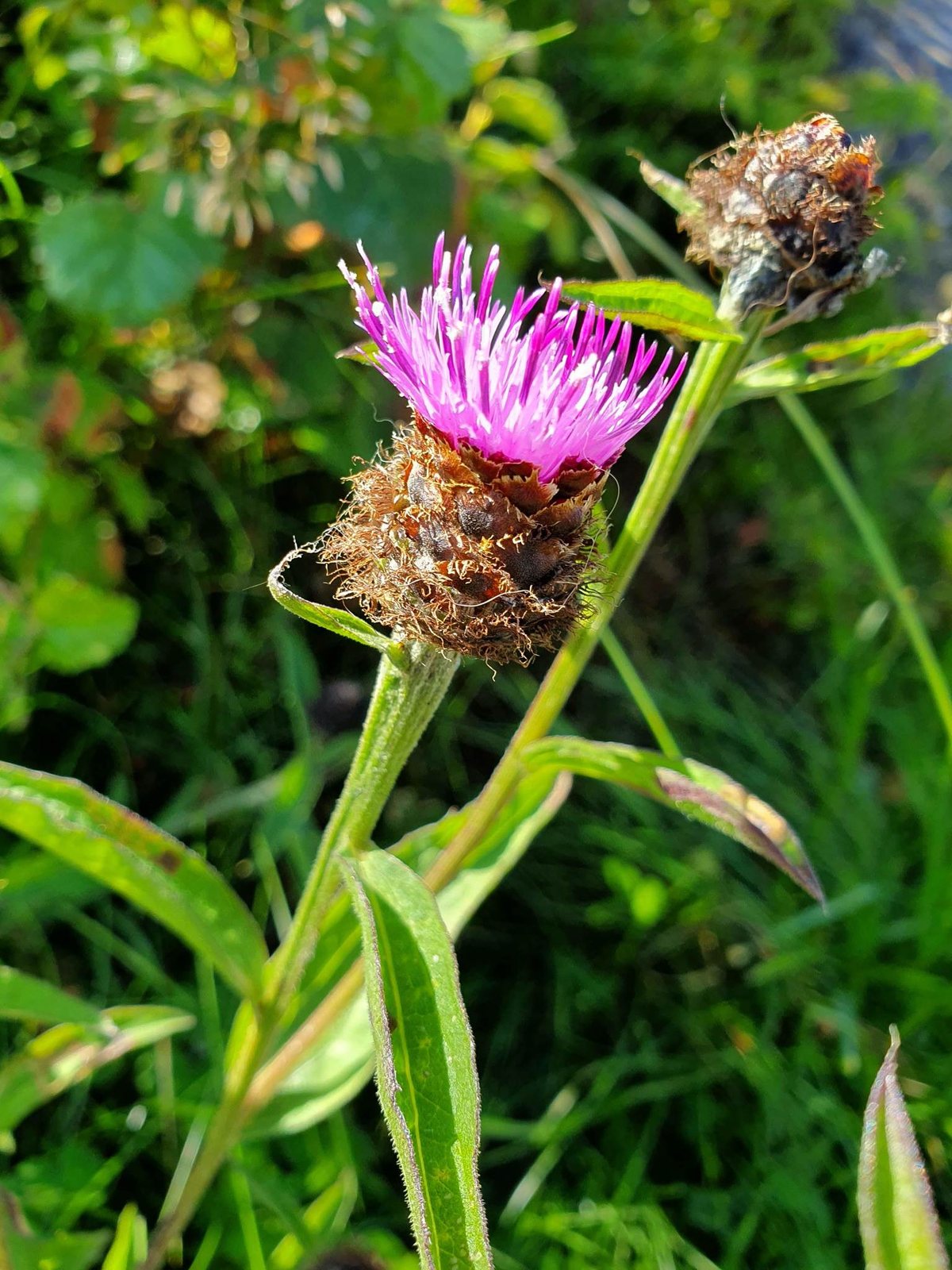
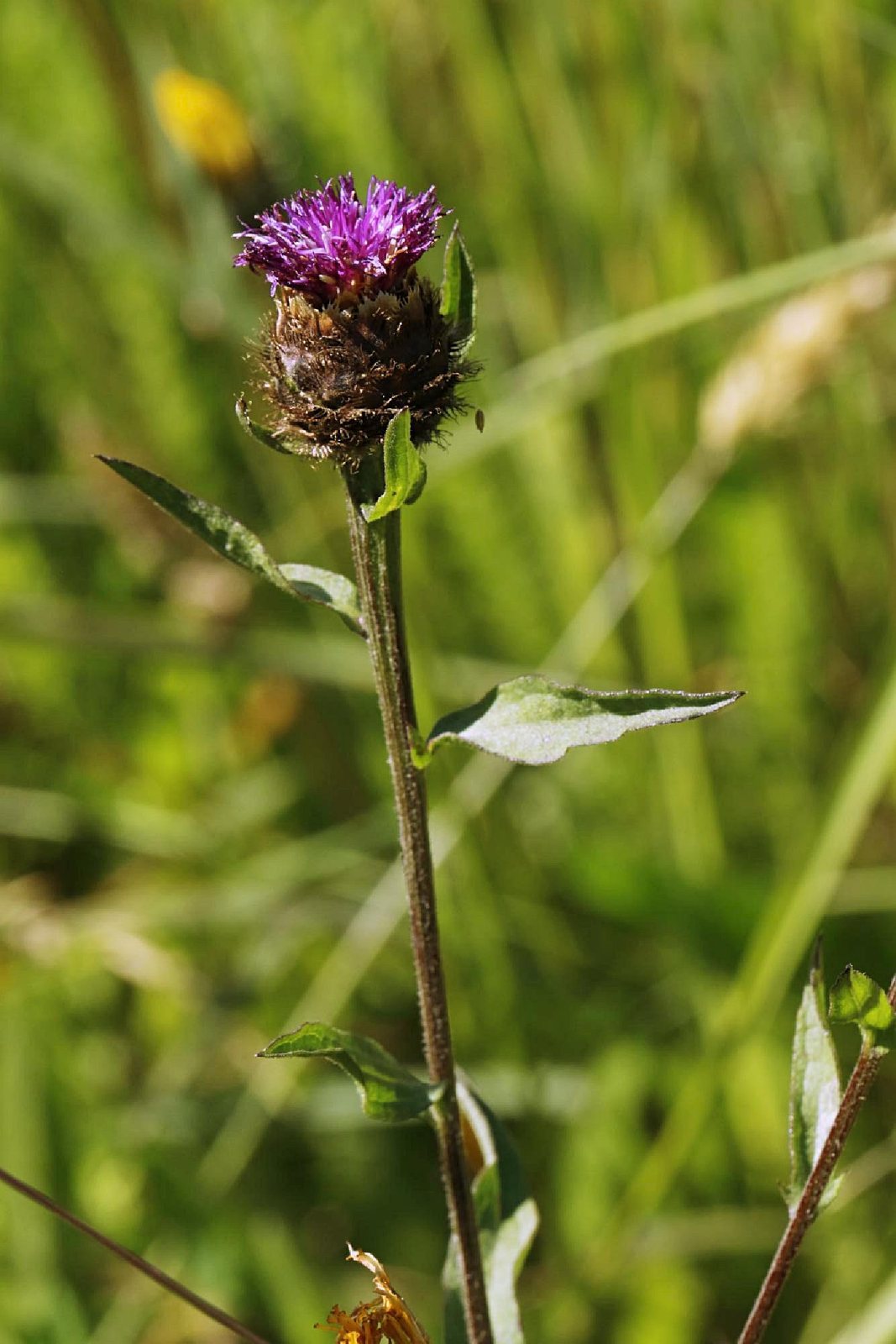
Common knapweed is a clump-forming meadow perennial with wiry stems and purple, thistle-like flower heads. Native to Britain and much of Europe, it provides nectar for insects and suits sunny, informal planting, but it can seed freely and is invasive in some regions outside its native range.
At a glance
- Sun
- Full sun; tolerates light shade but flowers less freely.
- Water
- Water regularly while establishing; established plants usually need watering only during prolonged drought.
- Soil
- Well-drained to moisture-retentive soil, including clay, loam and chalk. Tolerates low fertility and a broad pH range; avoid persistently waterlogged ground.
- Height
- 1-3 ft (0.3-0.9 m)
- Spread
- 1-2 ft (0.3-0.6 m)
- Flowers
- Purple to reddish-purple flower heads from early summer into early autumn.
- Foliage
- Rough, dull-green leaves; lower leaves are stalked and sometimes lobed, while upper leaves are narrower and usually unstalked.
- Growth
- Moderate; can spread quickly by seed.
- Care needed
- Low
The year at a glance
- Pollinators
- Drought tolerant
- Cold hardy
- Wildlife
- Low allergen
| J | F | M | A | M | J | J | A | S | O | N | D | |
|---|---|---|---|---|---|---|---|---|---|---|---|---|
| Flowers | ||||||||||||
| Fruit | ||||||||||||
| Plant |
Northern hemisphere months. In Australia, shift them by six.
- Difficulty
- Easy
- Toughness
- Very tough
Will it suit your garden?
Pick your zone, country, light and whether you have pets.
Full sun is 6 or more hours of direct sun a day, part shade 3 to 6 hours, shade under 3.
How it grows
Planting day
1 ft (0.3 m)
After 1 year
1.3 ft (0.4 m)
After 2 years
1.6 ft (0.5 m)
After 3 years
2 ft (0.6 m)
full size
About 3 years to full size.
From a typical nursery size, at an average rate for this kind of plant. A rule of thumb, not a forecast.
Good to know
- Cats and dogs
- Safe
- Native to
- the UK
- Invasive in
- the US and Canada
- In the garden
- Spreads vigorously: plan to contain it.
- Growth rate
- Moderate
Care
Jobs through the year
- WaterApr–May, Sep, every 21 days
- Water established clumps only in prolonged drought; water new plants more often as soil dries.
- WaterJun–Aug, every 14 days
- Water established clumps only during prolonged drought, never while soil remains wet.
- DivideMar–Apr
- Divide crowded clumps as growth begins.
- PruneFeb–Mar
- Cut old stems down before substantial new growth develops.
- PruneAug
- Optionally cut finished stems back for fresh growth, retaining selected seed heads for birds.
- DeadheadJun–Sep, every 7 days
- Remove fading heads before seed ripens where spread is unwanted; otherwise leave some for birds.
- ProtectMar–May, Sep–Oct, every 30 days
- Pull unwanted seedlings promptly and keep thick mulch away from the crown.
- Water during dry spells in the first growing season; reduce watering once established.
- Avoid routine feeding: rich soil encourages tall, floppy growth.
- Keep thick mulch away from the crown, especially on heavy soil.
- Support floppy stems with neighbouring meadow plants rather than individual stakes.
- Remove unwanted seedlings early and divide crowded clumps in spring.
Pruning. Cut back spent flowering stems in late summer for tidier growth and sometimes a smaller second flush. Where self-seeding is acceptable, leave some heads for birds and cut the remaining stems down in late winter; otherwise remove heads before seeds ripen.
Through the year
- Late winter
- Cut down old stems before new growth becomes substantial.
- Spring
- Plant or divide clumps, water them in and remove unwanted seedlings.
- Early summer
- Check for leaning stems and add discreet support if needed.
- Summer
- Water new plants during dry weather; deadhead where seed spread must be prevented.
- Late summer
- Cut back finished stems for fresh growth, or retain selected seed heads where appropriate.
- Autumn
- Sow fresh seed outdoors where growing this species is permitted.
In the garden
- Weave through a sunny wildflower meadow with fine grasses for loose purple summer colour.
- Plant in informal borders with oxeye daisies and yarrow for contrasting flower shapes.
- Use in a sunny wildlife garden where nectar-rich flowers can remain accessible to insects.
- Repeat small groups along a rural garden edge to connect cultivated planting with surrounding grassland, within its native range.
Garden styles it suits: Wildflower, Cottage garden, Wildlife garden, Pollinator garden, Rewilded and English country.
Plant it with: Oxeye daisy, Field scabious, Yarrow, Bird's-foot trefoil, Selfheal and Quaking grass.
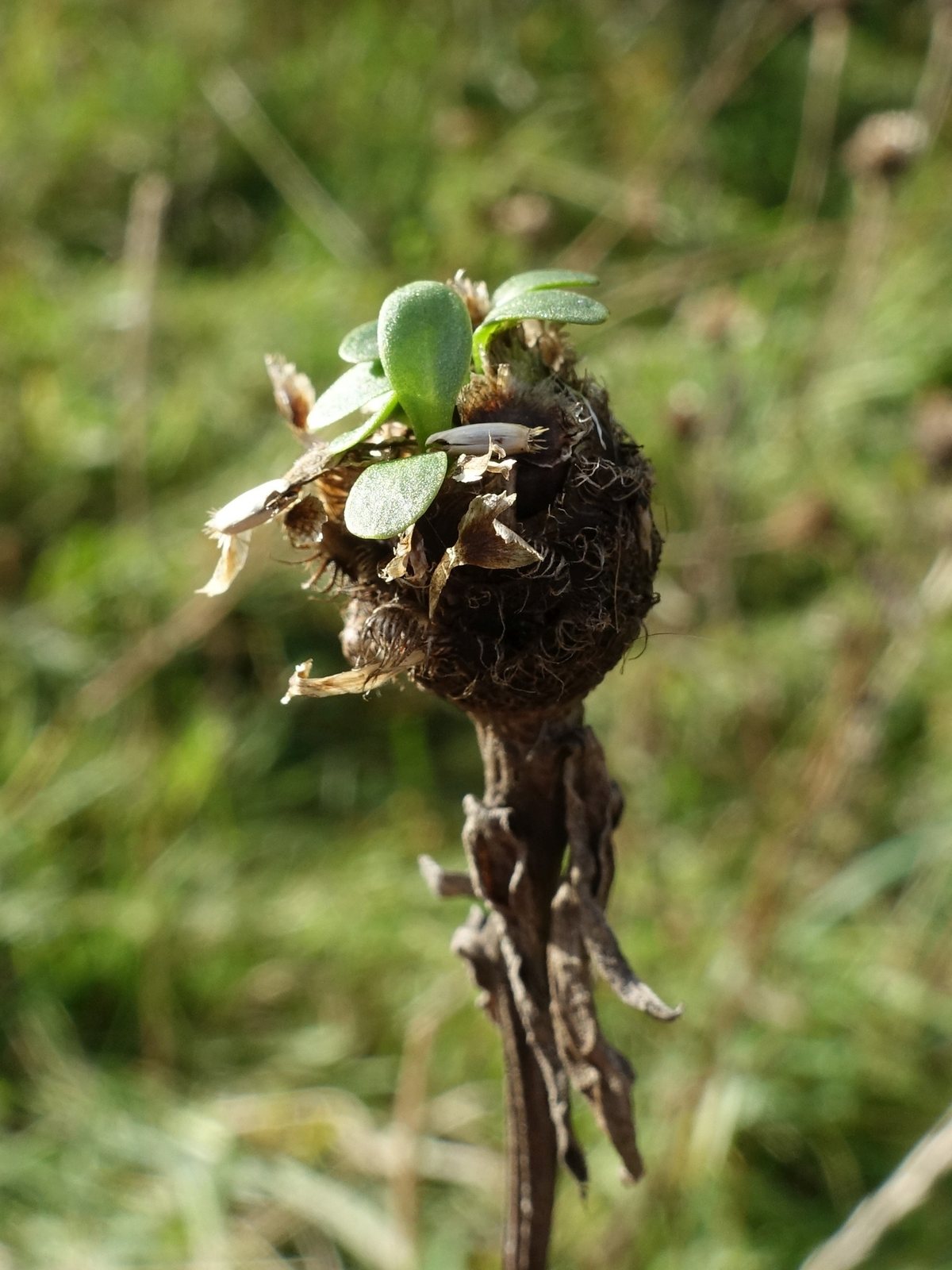
Wildlife: Flowers provide nectar and pollen for bees, butterflies, hoverflies and other insects. Seed heads feed birds, including goldfinches, and the plant supports several insects within its native range.
Problems to watch for
- Excessive self-seeding: remove flower heads before seed ripens and pull seedlings while small.
- Flopping stems in rich soil or shade: stop feeding, provide more sun and support stems with neighbouring plants.
- Powdery mildew: improve airflow and avoid letting newly planted clumps become severely drought-stressed.
- Crown decline in waterlogged soil: move plants to a better-drained position rather than watering on a fixed schedule.
Safety
Not known to be toxic to people, cats, dogs or horses. It has no commonly recognised poisonous parts, but it is not a culinary plant and should not be deliberately fed to pets or livestock. Do not confuse it with yellow starthistle or Russian knapweed, which can poison horses.
Where it spreads. Introduced and invasive in parts of the Pacific Northwest of the United States and British Columbia, Canada; black knapweed is listed as a noxious weed in Washington and Oregon. It is also an introduced weed in southeastern Australia, including Victoria and Tasmania. Check local restrictions before buying or sowing it, and keep it out of native-meadow restoration outside its native range.
Easily confused with
Greater knapweed (Centaurea scabiosa)
Usually has larger flower heads with conspicuous, spreading outer florets and deeply divided leaves; common knapweed generally has less-divided leaves and more compact flower heads.
Brown knapweed (Centaurea jacea)
The bracts beneath its flower head have pale to brown, papery appendages rather than the dense, dark fringes typical of common knapweed. Hybrids occur and can be difficult to identify.
Creeping thistle (Cirsium arvense)
Has prickly leaves and spreads through creeping roots. Common knapweed has no leaf spines and forms a distinct clump.
The name
The species name nigra means black, referring to the dark, fringed bracts beneath the flower heads, which also give rise to the name black knapweed.
Propagation. Sow seed outdoors in autumn or spring, covering lightly; autumn sowing provides natural winter chilling. Divide established clumps in spring. It also self-seeds readily, so avoid propagation where it is invasive or regulated.
Checked against open data
- Accepted botanical name
- Centaurea nigra
- In the US and Canada
- Introduced in Canada, the lower 48 states and St. Pierre and Miquelon.
- Native range
- Austria, Belgium, Denmark, France, Germany, Great Britain, Ireland, Italy, Morocco, Netherlands, Norway and Poland.
- Measured
- Average height 60 cm.
Sources: GBIF (CC BY 4.0), USDA PLANTS and Trefle (CC BY 4.0). The care and design notes are LandscapeGPT's own.
See it in your own yard.
Upload a photo of your yard and see it redesigned with plants that suit your climate, each checked against your zone.