Lemonade berry
Rhus integrifolia. Family Anacardiaceae. Shrub.
Also called Lemonade sumac, Lemonadeberry.
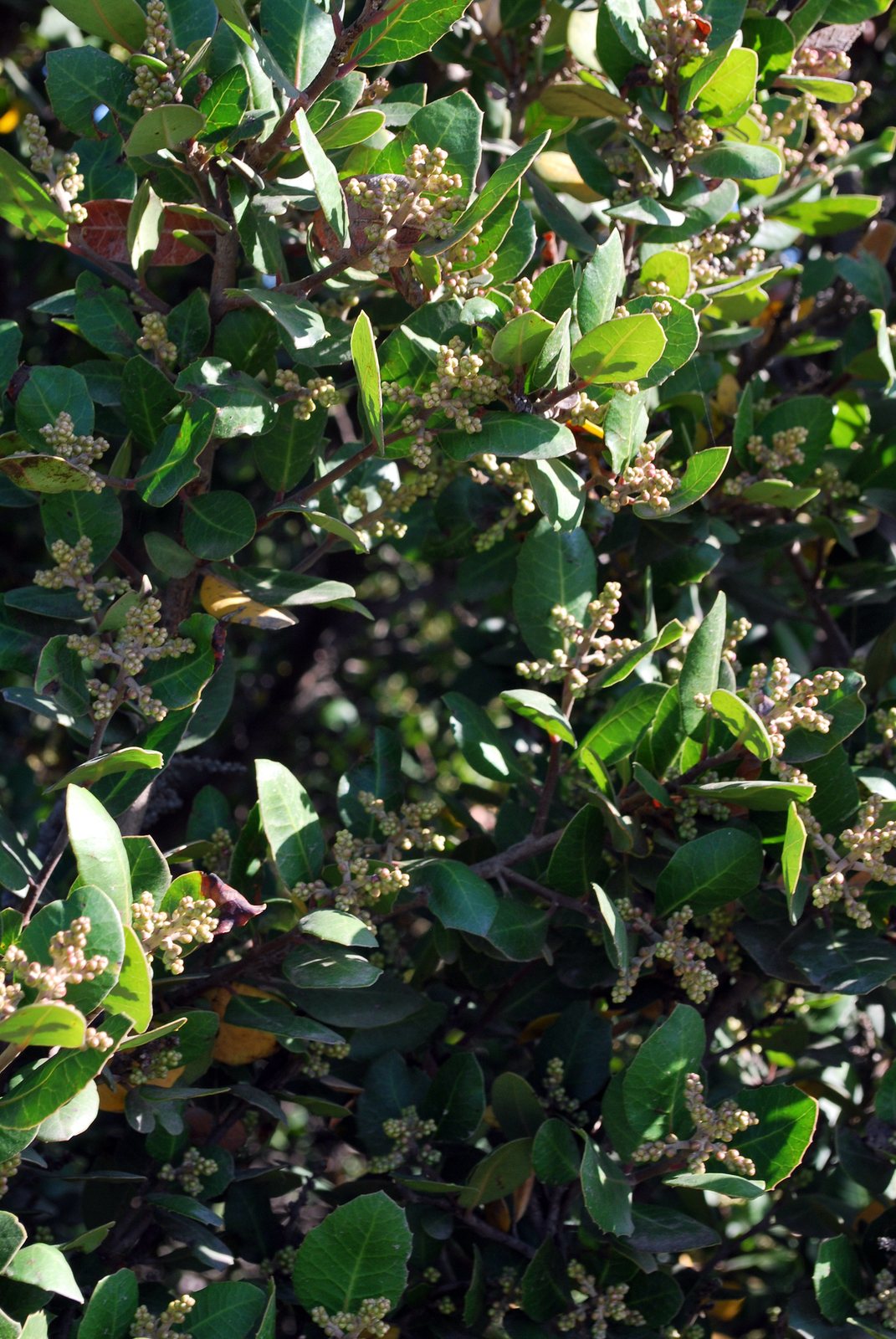
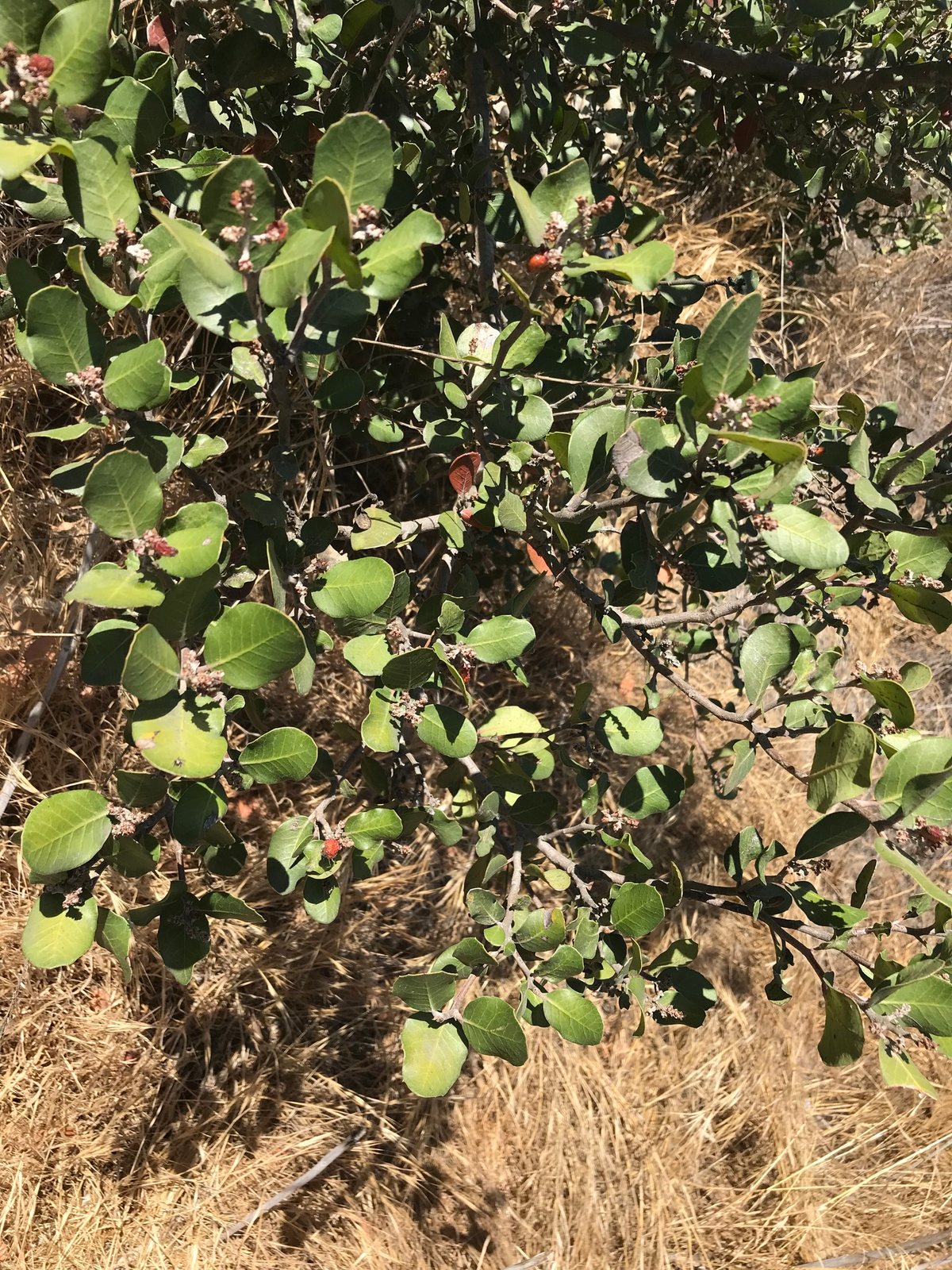
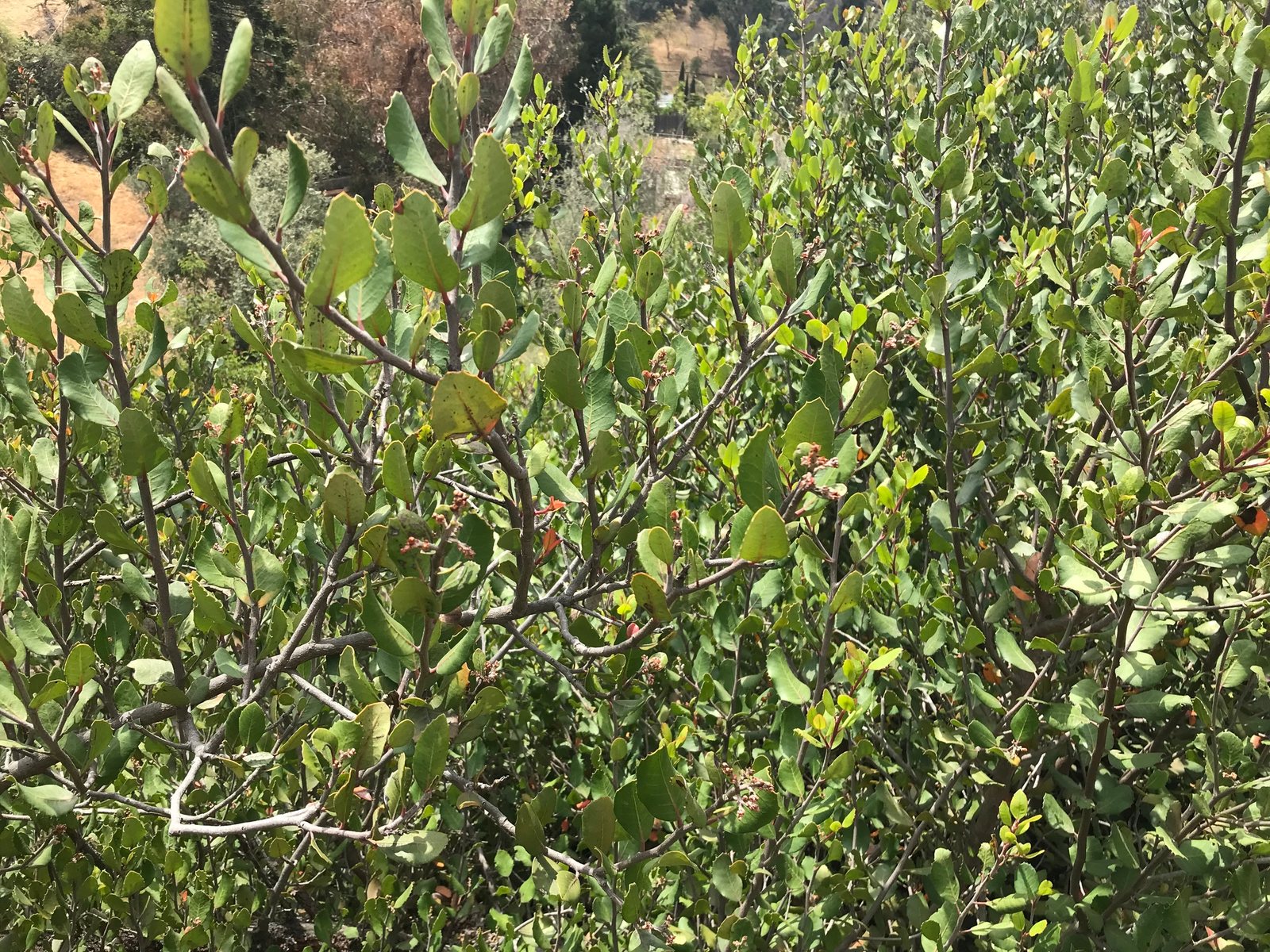
A broad evergreen shrub native to coastal southern California and Baja California, lemonade berry has leathery leaves, small pinkish flowers and sticky red fruit. Gardeners grow it for drought-tolerant screens, slope cover and wildlife habitat, especially in mild coastal gardens. It tolerates salt-laden winds but is poorly suited to prolonged freezes or persistently wet soil.
At a glance
- Sun
- Full sun to partial shade; give it afternoon shade in hot inland gardens.
- Water
- Low once established. Water deeply during establishment, then occasionally during prolonged dry weather; avoid frequent summer irrigation.
- Soil
- Well-drained sandy, loamy or rocky soil; tolerates clay where drainage is good.
- Height
- 6-20 ft (1.8-6 m)
- Spread
- 10-20 ft (3-6 m)
- Flowers
- Small clusters of white to pale pink flowers in late winter and spring.
- Foliage
- Evergreen. Thick, leathery, dark green leaves with rounded to oval outlines and smooth or shallowly toothed edges.
- Growth
- Moderate; usually slower in dry, unirrigated sites.
- Care needed
- Low
The year at a glance
- Pollinators
- Deer resistant
- Drought tolerant
- Heat tolerant
- Wildlife
- Low allergen
| J | F | M | A | M | J | J | A | S | O | N | D | |
|---|---|---|---|---|---|---|---|---|---|---|---|---|
| Flowers | ||||||||||||
| Fruit | ||||||||||||
| Plant |
Northern hemisphere months. In Australia, shift them by six.
- Difficulty
- Hard
- Toughness
- Needs looking after
Will it suit your garden?
Pick your zone, country, light and whether you have pets.
Full sun is 6 or more hours of direct sun a day, part shade 3 to 6 hours, shade under 3.
How it grows
Planting day
1.6 ft (0.5 m)
After 1 year
3 ft (1 m)
After 2 years
5 ft (1.5 m)
After 3 years
7 ft (2.1 m)
After 5 years
10 ft (3.1 m)
About 7 years to full size.
From a typical nursery size, at an average rate for this kind of plant. A rule of thumb, not a forecast.
Good to know
- Cats and dogs
- Safe
- Native to
- the US
- Growth rate
- Slow
Care
Jobs through the year
- WaterApr–May, Sep–Oct, every 28 days
- For established plants, water only if deeply dry; young plants need more frequent watering.
- WaterJun–Aug, every 28 days
- Water established plants only during extended drought, allowing soil to dry and keeping the crown dry.
- MulchMay
- Apply loose mulch with a clear gap around the stems.
- PruneMay
- Shape lightly after flowering, retaining fruiting shoots where a crop is wanted.
- ProtectJan–Apr, Oct–Dec
- Not reliably hardy in zones 6–7; grow in a movable container and overwinter frost-free.
- Plant in autumn or spring, keeping the root crown level with the surrounding soil.
- Water deeply through the first two dry seasons, allowing the soil to dry between waterings.
- Once established, water only during extended drought; keep irrigation away from the trunk.
- Apply a loose organic mulch, leaving a clear gap around the stems.
- Do not routinely fertilize; excessive feeding encourages unnecessary soft growth.
Pruning. Prune lightly after flowering to shape the shrub, understanding that this removes some developing fruit. Remove dead or crossing branches and gradually shorten overlong stems rather than repeatedly shearing the whole plant.
Harvest
Pick fully red, sticky berries in late spring or summer; their tart outer coating is traditionally steeped in cool water and strained to make a drink, rather than eating the hard seeds. Allow several years after planting for a useful crop; a dependable first-crop age is not well documented, and fruiting can depend on having a compatible pollen source nearby.
Through the year
- Late winter
- Check for frost-damaged branches, but wait until new growth shows before removing uncertain wood.
- Spring
- Plant where winters are cool, and water new plants deeply.
- Late spring
- Prune lightly after flowering if shaping is needed; leave fruiting shoots where berries are wanted.
- Summer
- Harvest ripe red berries if wanted, leaving plenty for birds.
- Summer
- Check young plants for drought stress; avoid keeping established plants constantly moist.
- Autumn
- Plant in mild-winter climates and renew mulch without covering the root crown.
In the garden
- Use as an informal evergreen screen where its broad natural outline has room to develop.
- Plant on well-drained banks for substantial shrub cover and erosion control.
- Combine with California sagebrush, sages and buckwheats in a dry native border.
- Use as a wind-tolerant background shrub in mild coastal gardens.
- Train an established specimen gradually into a small, multi-stemmed tree.
Garden styles it suits: California native, Coastal, Mediterranean, Desert / xeriscape, Wildlife garden and Native hedgerow.
Plant it with: California sagebrush, Black sage, California buckwheat, Toyon, Deer grass and California lilac.
Wildlife: Flowers provide food for bees and other insects. Birds eat the fruit, and the dense evergreen branches provide shelter and nesting cover.
Problems to watch for
- Root and crown rot: improve drainage, keep the crown exposed and reduce frequent irrigation, especially in summer.
- Scale insects: inspect stems and leaf undersides; prune heavily affected shoots and use a labelled horticultural oil if needed.
- Aphids on tender growth: wash them off with water and preserve ladybirds and other natural predators.
- Frost injury: choose a sheltered site within its hardiness range and protect young plants during brief cold spells.
Safety
Not known to be poisonous to people when the fruit's outer coating is used traditionally for drinks, but the sap and other plant parts may cause contact irritation or allergic reactions in susceptible people. It is not known to be toxic to cats, dogs or horses, although species-specific safety information is limited; discourage chewing and eating large quantities.
Easily confused with
Sugar bush (Rhus ovata)
Sugar bush usually has more pointed, often folded leaves with smooth margins; lemonade berry generally has flatter, rounder leaves that may be toothed. The two can hybridize, making some plants difficult to identify.
Toyon (Heteromeles arbutifolia)
Toyon has longer, sharply toothed leaves and conspicuous clusters of smooth red berries in autumn and winter; lemonade berry has broader leaves and sticky fruit ripening earlier.
Laurel sumac (Malosma laurina)
Laurel sumac has longer, pointed leaves commonly folded upward along the midrib, and large, branching clusters of whitish flowers rather than lemonade berry's compact pinkish clusters.
The name
The common name refers to the lemon-like acidity of the fruit coating, while integrifolia means entire-leaved, referring to the often smooth leaf margins.
Propagation. Grow from cleaned seed or semi-ripe cuttings. The hard seed coat can delay germination, so scarification may help; cuttings can be slow and inconsistent to root.
Checked against open data
- Accepted botanical name
- Rhus integrifolia
- In the US and Canada
- Native in the lower 48 states.
- Native range
- California, Mexican Pacific Is. and Mexico Northwest.
Sources: GBIF (CC BY 4.0), USDA PLANTS and Trefle (CC BY 4.0). The care and design notes are LandscapeGPT's own.
See it in your own yard.
Upload a photo of your yard and see it redesigned with plants that suit your climate, each checked against your zone.