Matilija poppy
Romneya coulteri. Family Papaveraceae. Perennial.
Also called Coulter's Matilija poppy, California tree poppy, Fried egg plant.
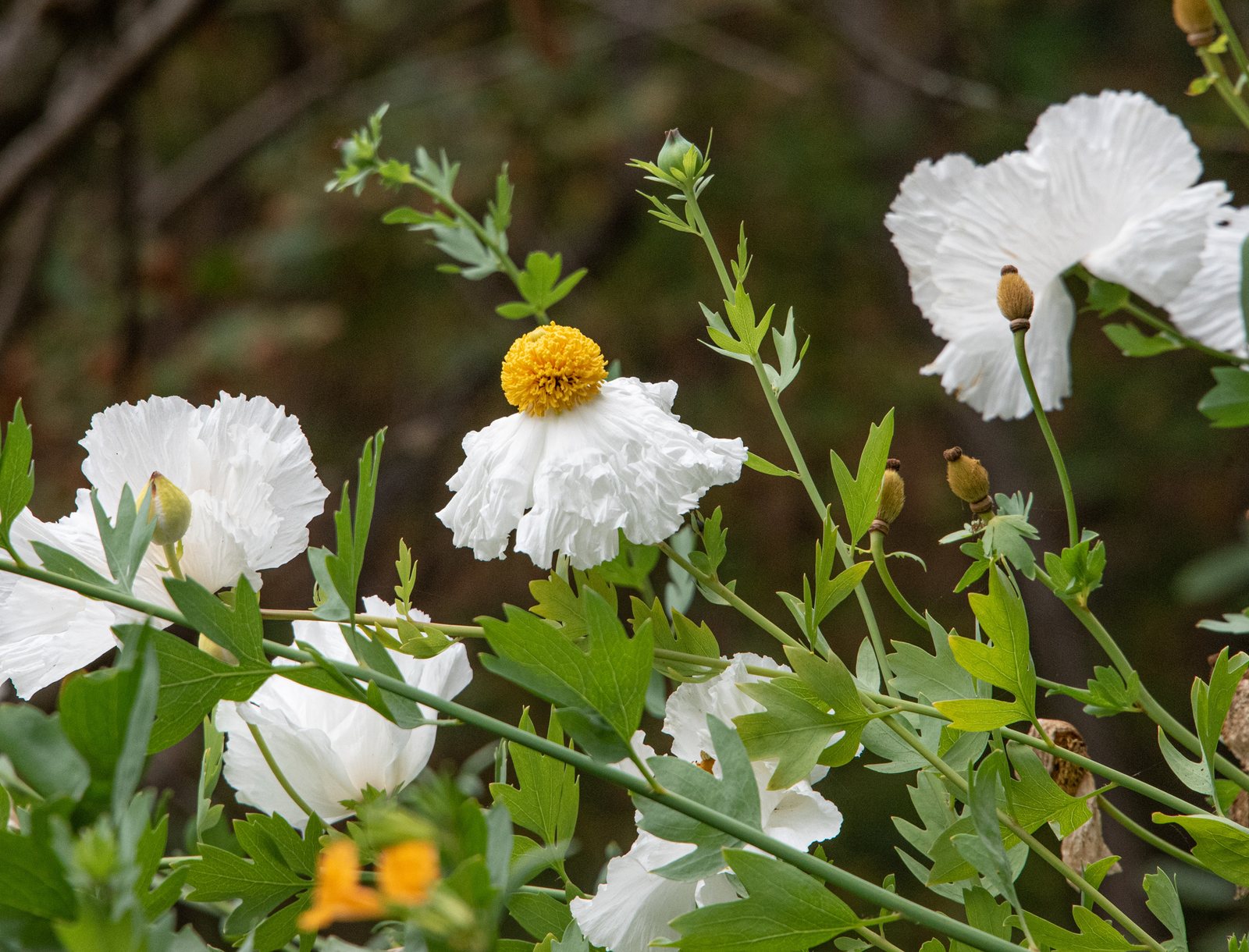
Matilija poppy is a tall, woody-based perennial native to southern California and Baja California, grown for enormous, crinkled white flowers with golden centres. It suits sunny, dry gardens with room for its spreading underground stems, but dislikes disturbance and wet winter soil.
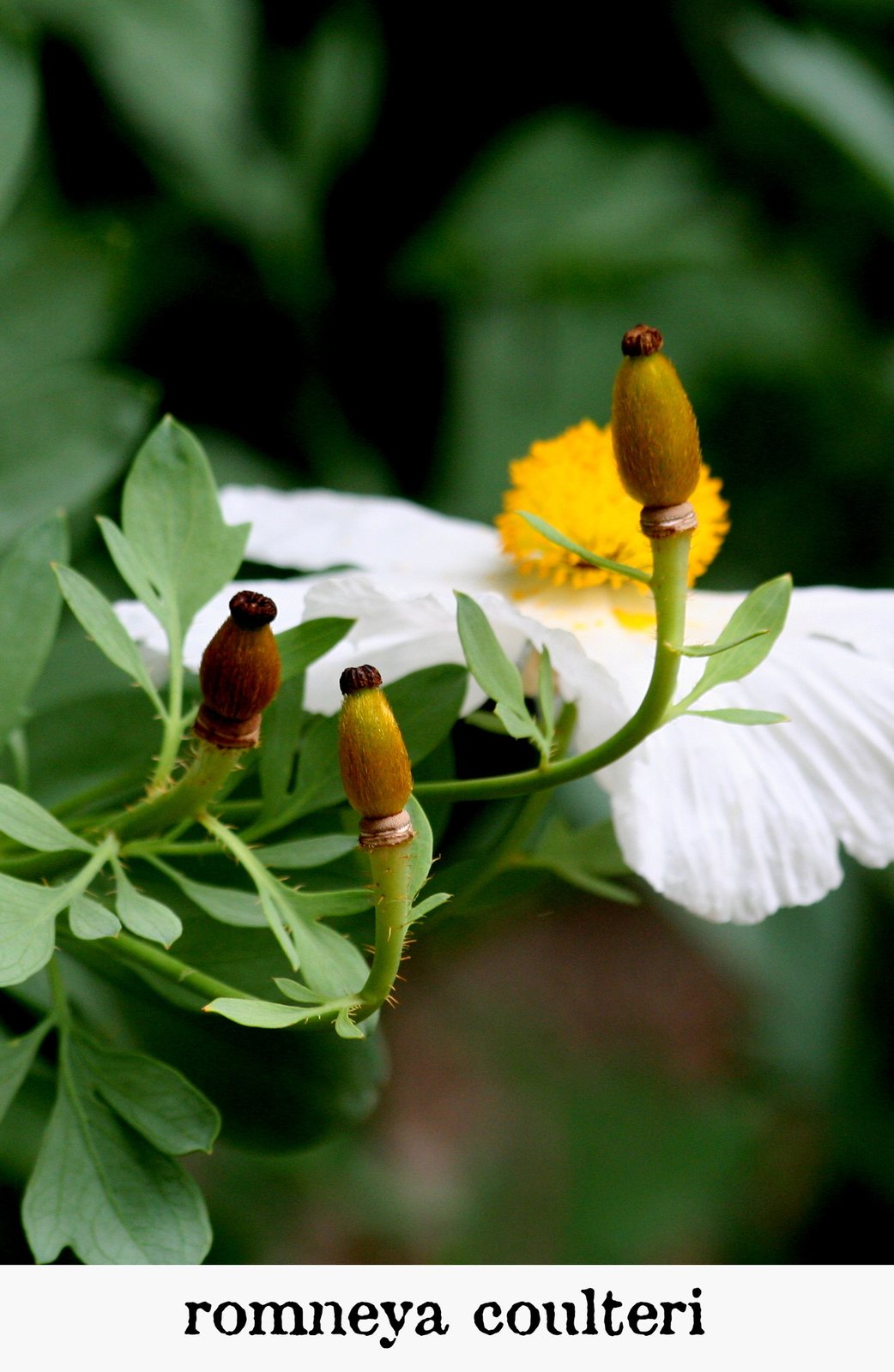
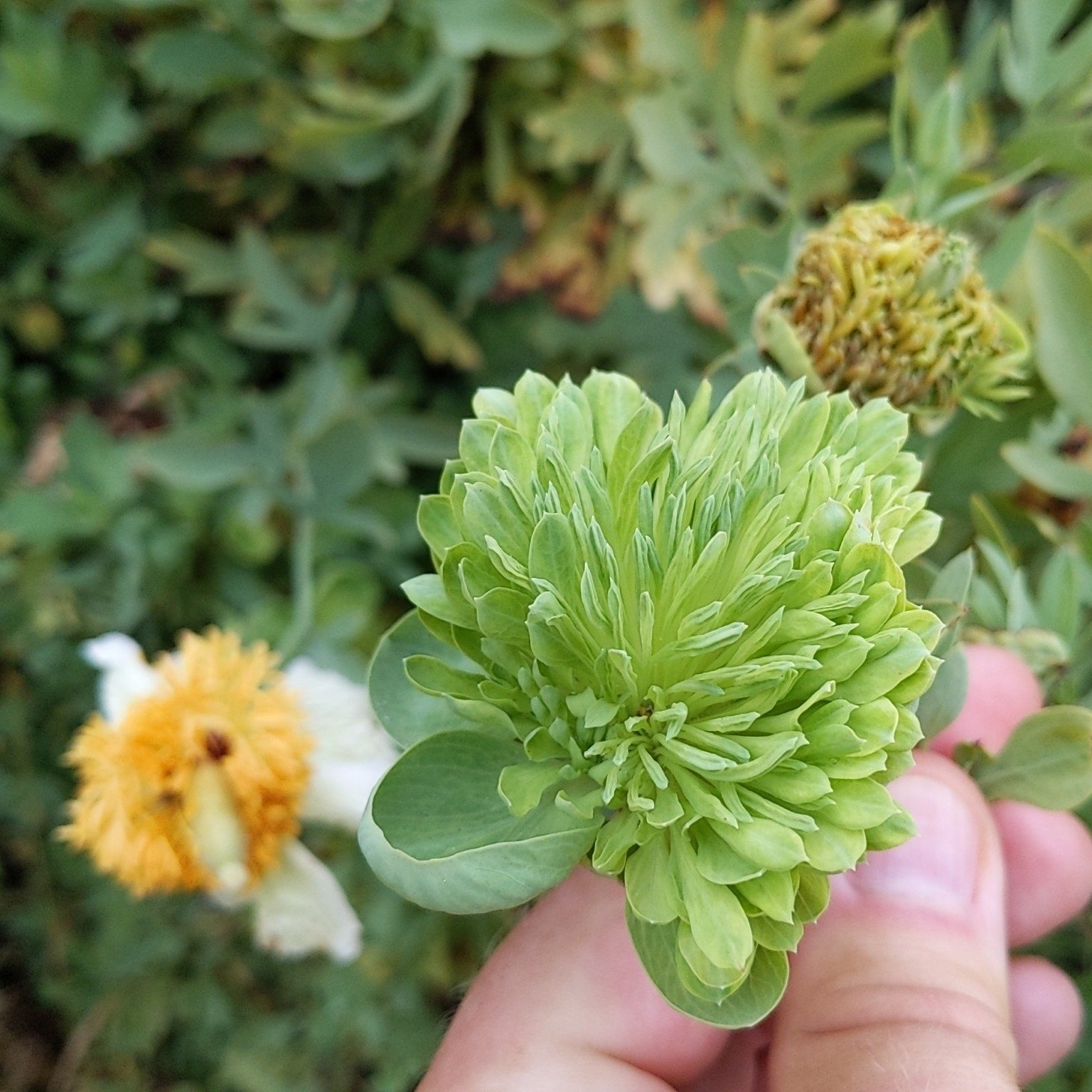
At a glance
- Sun
- Full sun; choose a warm, sheltered position in cooler climates.
- Water
- Water deeply but infrequently while establishing, allowing the soil to dry between waterings. Established plants usually need little additional water in dry-summer climates.
- Soil
- Well-drained sandy, gravelly or loamy soil; tolerates poor soil and some clay if drainage is good. Avoid sites that remain wet in winter.
- Height
- 6-8 ft (1.8-2.4 m)
- Spread
- 6-10 ft (1.8-3 m), eventually wider where underground stems are not contained
- Flowers
- Late spring through summer; large white flowers with prominent golden-yellow centres.
- Foliage
- Deeply lobed, blue-grey leaves on upright stems; deciduous in colder areas and partly evergreen in mild climates.
- Growth
- Often slow to establish, then vigorous and spreading.
- Care needed
- Medium
The year at a glance
- Pollinators
- Deer resistant
- Drought tolerant
- Heat tolerant
- Low allergen
- Fragrant
| J | F | M | A | M | J | J | A | S | O | N | D | |
|---|---|---|---|---|---|---|---|---|---|---|---|---|
| Flowers | ||||||||||||
| Plant |
Northern hemisphere months. In Australia, shift them by six.
- Difficulty
- Hard
- Toughness
- Needs looking after
Will it suit your garden?
Pick your zone, country, light and whether you have pets.
Full sun is 6 or more hours of direct sun a day, part shade 3 to 6 hours, shade under 3.
How it grows
Planting day
1 ft (0.3 m)
After 1 year
3 ft (0.9 m)
After 2 years
5 ft (1.5 m)
After 3 years
7 ft (2.1 m)
full size
About 3 years to full size.
From a typical nursery size, at an average rate for this kind of plant. A rule of thumb, not a forecast.
Good to know
- Cats and dogs
- Toxic
- Native to
- the US
- In the garden
- Spreads vigorously: plan to contain it.
- Growth rate
- Moderate
Care
Jobs through the year
- WaterApr–May, Sep, every 21 days
- For established plants, water only during prolonged drought; young plants need closer moisture checks.
- WaterJun–Aug, every 14 days
- Water deeply only in prolonged drought, letting soil dry between soakings; avoid frequent watering.
- PruneMar–Apr
- As new shoots appear, cut old stems to 15–30 cm without damaging emerging growth.
- PruneMay–Sep
- Remove unwanted suckers and connecting underground stems without disturbing the main rootball.
- MulchApr–May
- Use gravel on damp sites and keep the crown clear of moisture-retaining mulch.
- ProtectOct–Nov
- Not reliably hardy in zones 6–7; overwinter a container frost-free or use a milder sheltered site.
- ProtectJan–Feb, Nov–Dec
- Keep drainage excellent, leave old stems standing and insulate outdoor roots; severe frost may still kill plants.
- Plant small, container-grown plants without breaking up or teasing out the rootball; roots resent disturbance.
- Water deeply during establishment, then reduce watering as new growth becomes strong.
- Avoid routine feeding, especially high-nitrogen fertiliser, which encourages excessive leafy growth.
- Keep mulch away from the crown; use gravel rather than a thick, moisture-retaining organic layer on damp sites.
- Remove unwanted suckers promptly, digging out their connecting underground stems where practical.
Pruning. In late winter or early spring, cut old stems back to about 6-12 in (15-30 cm), taking care not to damage emerging shoots. In frost-prone gardens, leave old stems standing through winter and prune as new growth begins.
Through the year
- Late winter
- Check that winter rain drains freely and remove debris resting against the crown.
- Early spring
- Cut back old stems as fresh shoots appear.
- Spring
- Plant in cooler climates after severe frost has passed, keeping the rootball intact.
- Late spring
- Check the edges of the clump and remove suckers growing into paths or neighbouring plants.
- Summer
- Water young plants deeply during prolonged dry weather; avoid frequent watering of established clumps.
- Autumn
- Plant in mild, dry-summer climates once rain returns, provided the soil drains well.
In the garden
- Use at the back of a broad, sunny border, where tall stems and large white flowers rise above lower planting.
- Plant on a dry bank or spacious informal slope where spreading colonies are welcome.
- Combine with lavender, sage and low ornamental grasses for a silver-leaved, dry-garden planting.
- Use as a bold seasonal feature in a California-native garden, away from small plants it could overwhelm.
Garden styles it suits: California native, Mediterranean, Dry gravel garden, Desert / xeriscape, Coastal and White garden.
Plant it with: California sagebrush, Purple sage, California buckwheat, Lavender, Santolina and Deer grass.
Wildlife: The pollen-rich flowers attract bees and other pollen-feeding insects. They offer little or no nectar.
Problems to watch for
- Poor establishment after planting: use a young plant, leave its roots undisturbed and water carefully through its first growing season.
- Crown or root rot in wet soil: improve drainage or replant on a raised mound; do not keep the crown constantly damp.
- Unwanted spreading: remove suckers and their connecting underground stems repeatedly; avoid planting beside delicate borders.
- Frost-damaged stems: leave them until early spring, then cut back to healthy growth; protect the root zone in colder gardens.
Safety
Not a food plant: its alkaloid-containing tissues may be harmful if eaten, and sap may irritate skin. Reliable species-specific information on poisoning severity in people, cats, dogs and horses is limited; prevent ingestion and wear gloves when cutting stems.
Where it spreads. Can spread aggressively by underground stems in gardens in California and other mild regions, including parts of the UK and southern Australia. Allow substantial space and keep it away from boundaries where suckers would be difficult to remove; this garden-spreading behaviour does not by itself indicate an official invasive listing.
Easily confused with
Bristly Matilija poppy (Romneya trichocalyx)
Very similar in flower and habit, but its flower buds have conspicuously bristly sepals; those of Romneya coulteri are essentially hairless.
Crested prickly poppy (Argemone polyanthemos)
Also has crinkled white flowers and grey-green leaves, but the leaves, stems and seed capsules are conspicuously prickly.
Oriental poppy (Papaver orientale)
Forms a lower clump of hairy leaves with individual flower stalks, rather than tall, branching, woody-based stems with smooth blue-grey foliage.
The name
Romneya honours Irish astronomer Thomas Romney Robinson, while coulteri honours Irish botanist Thomas Coulter.
Propagation. Take root cuttings during dormancy, using healthy root sections and a free-draining medium. Rooted suckers can also be lifted carefully, but transplanting is unreliable because the roots dislike disturbance. Seed germination is erratic and may require specialist smoke or heat treatment.
Checked against open data
- Accepted botanical name
- Romneya coulteri
- In the US and Canada
- Native in the lower 48 states.
- Native range
- California and Mexico Northwest.
Sources: GBIF (CC BY 4.0), USDA PLANTS and Trefle (CC BY 4.0). The care and design notes are LandscapeGPT's own.
See it in your own yard.
Upload a photo of your yard and see it redesigned with plants that suit your climate, each checked against your zone.