Pin cherry
Prunus pensylvanica. Family Rosaceae. Tree.
Also called Fire cherry, Bird cherry.
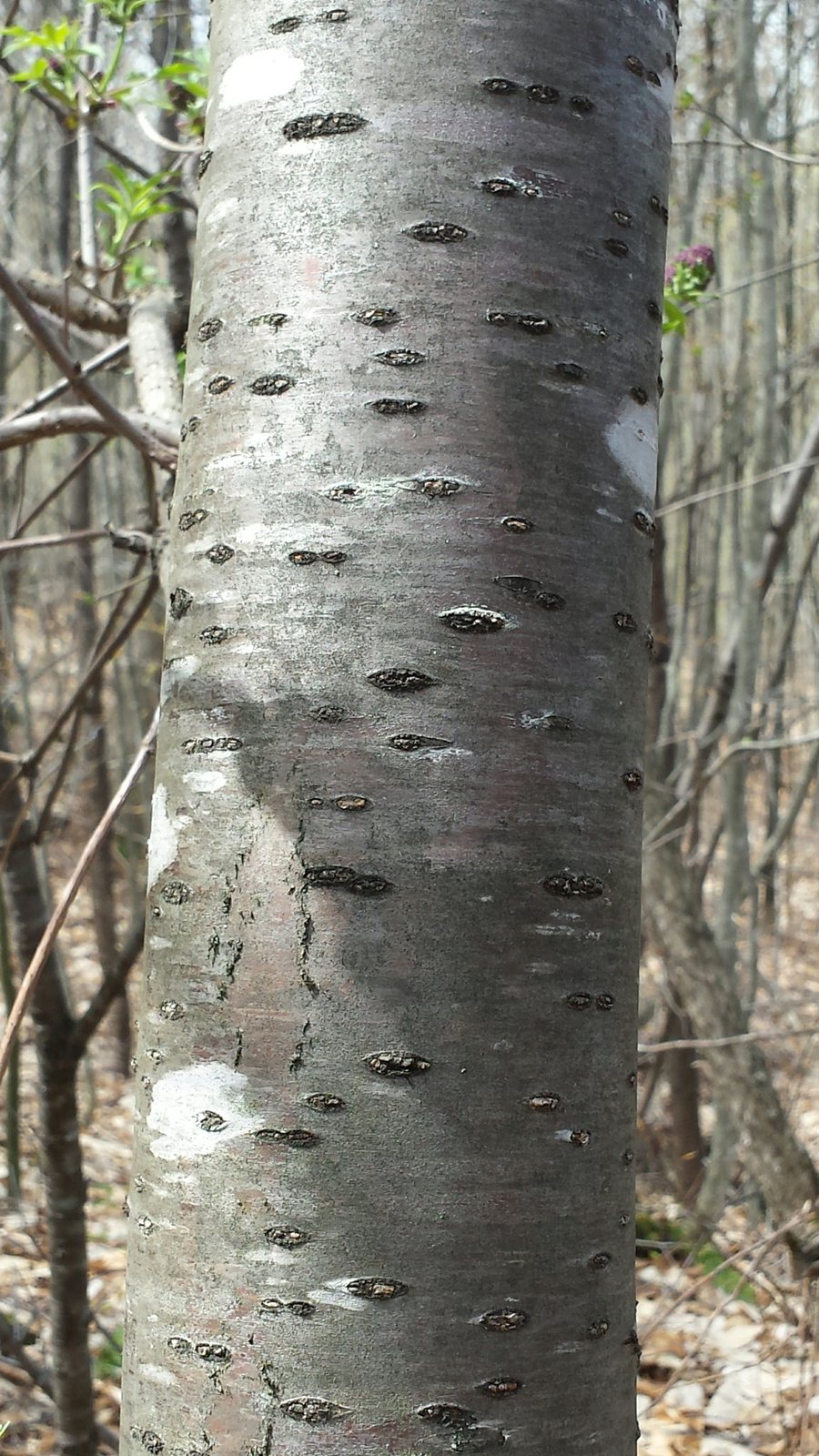
Pin cherry is a fast-growing, short-lived North American tree with white spring flowers, small red cherries and yellow to reddish autumn foliage. Grow it for birds, pollinators and naturalistic planting where its spreading suckers have room; its tart fruit can also be used for jelly.
At a glance
- Sun
- Full sun; tolerates light shade but flowers and fruits less well.
- Water
- Moderate; water regularly while establishing, then during prolonged dry spells.
- Soil
- Well-drained sandy, gravelly or loamy soil; tolerates poor, acidic ground but not prolonged waterlogging.
- Height
- 20-40 ft (6-12 m)
- Spread
- 15-30 ft (4.5-9 m), with suckers potentially forming a wider thicket
- Flowers
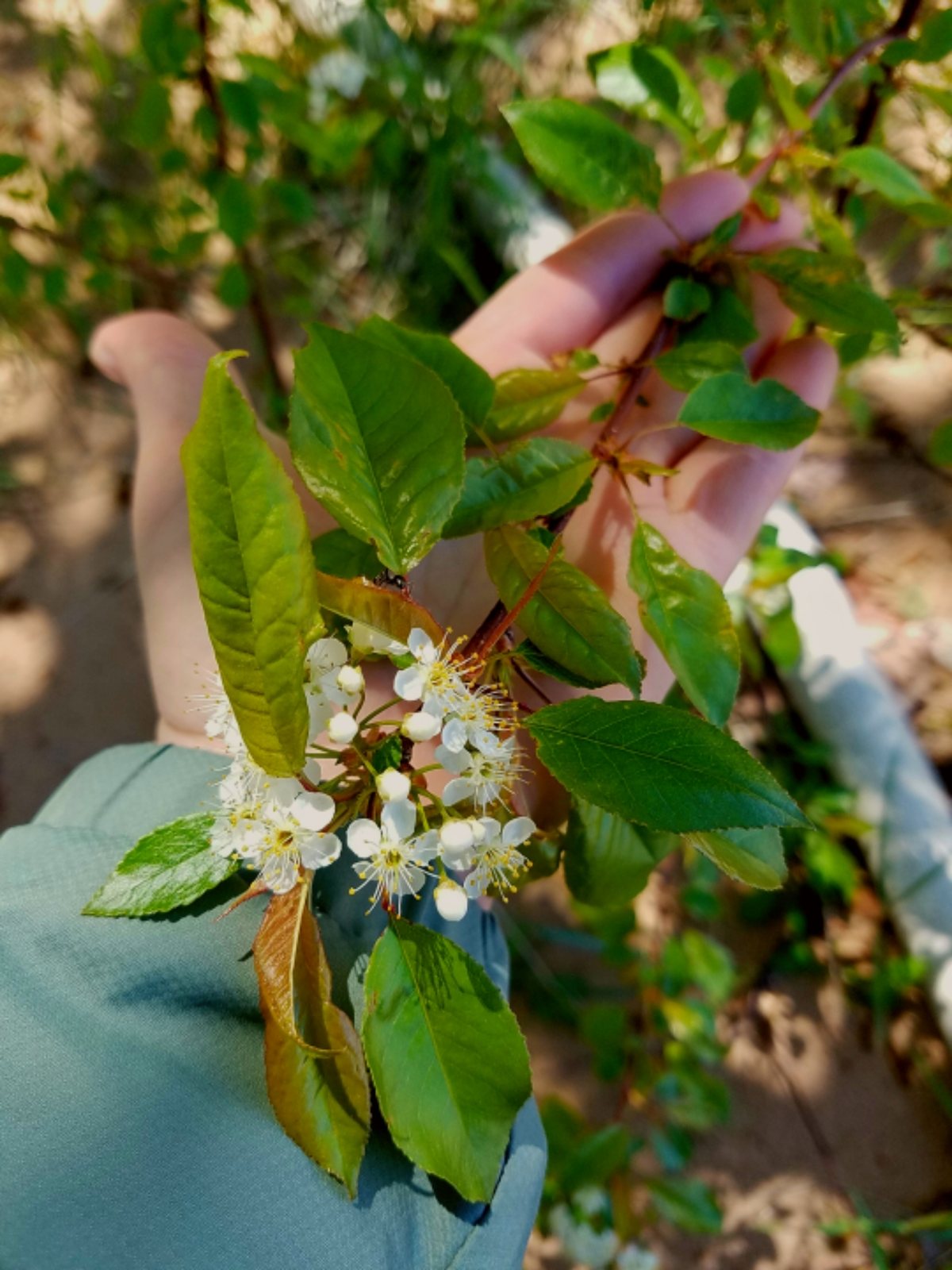
- Mid- to late spring; small white flowers in rounded clusters, appearing with the leaves.
- Foliage
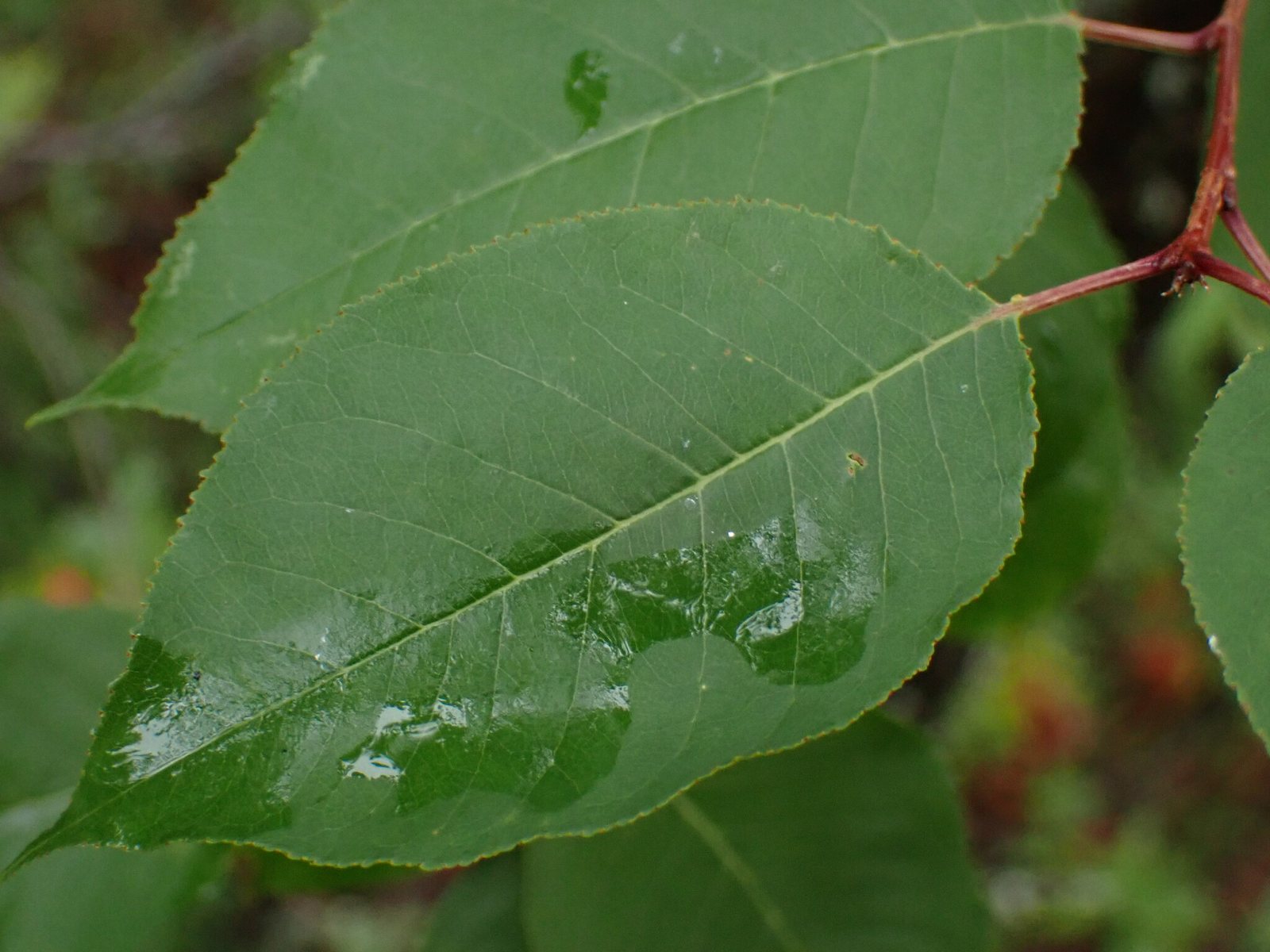
- Deciduous, narrow oval leaves with finely toothed edges and pointed tips; green in summer, turning yellow, orange or red in autumn.
- Growth
- Fast; often lives only 20-40 years.
- Care needed
- Medium
The year at a glance
- Pollinators
- Cold hardy
- Wildlife
- Low allergen
| J | F | M | A | M | J | J | A | S | O | N | D | |
|---|---|---|---|---|---|---|---|---|---|---|---|---|
| Flowers | ||||||||||||
| Fruit | ||||||||||||
| Plant |
Northern hemisphere months. In Australia, shift them by six.
- Difficulty
- Moderate
- Toughness
- Fairly tough
Will it suit your garden?
Pick your zone, country, light and whether you have pets.
Full sun is 6 or more hours of direct sun a day, part shade 3 to 6 hours, shade under 3.
How it grows
Planting day
7 ft (2 m)
After 1 year
8 ft (2.5 m)
After 2 years
10 ft (3.1 m)
After 3 years
12 ft (3.6 m)
After 5 years
15 ft (4.7 m)
About 13 years to full size.
From a typical nursery size, at an average rate for this kind of plant. A rule of thumb, not a forecast.
Good to know
- Cats and dogs
- Toxic
- Native to
- the US and Canada
- In the garden
- Spreads vigorously: plan to contain it.
- Growth rate
- Fast
Care
Jobs through the year
- WaterApr–May, Sep–Oct, every 21 days
- Water established trees deeply only during prolonged drought; water regularly for the first two growing seasons.
- WaterJun–Aug, every 14 days
- During prolonged dry spells, soak the established root zone deeply; young trees may need weekly watering.
- MulchMar–Apr
- Maintain 5–8 cm of organic mulch over the root zone, clear of the trunk.
- PruneMay–Aug
- Prune sparingly in dry weather; remove crossing branches and cut black knot 15–20 cm below swellings.
- PruneApr–Sep, every 30 days
- Remove unwanted suckers while small to prevent thicket formation.
- ProtectApr–Jun
- Inspect young trees for tent caterpillars and remove accessible nests by hand; never burn them.
- ProtectOct–Nov
- Collect diseased fallen leaves and fruit, and protect the trunk from mower damage.
- Water deeply during dry weather for the first two growing seasons.
- Apply 2-3 in (5-8 cm) of organic mulch, keeping it clear of the trunk.
- Avoid routine fertilizer; feed only if poor growth and a soil test indicate a deficiency.
- Remove unwanted suckers promptly if you want a single tree rather than a thicket.
- Keep grass and mower blades away from the trunk to prevent bark injury.
Pruning. Prune sparingly in dry weather in late spring or summer, removing crossing branches and unwanted suckers. Remove black-knot growth at least 6-8 in (15-20 cm) below the visible swelling, cleaning tools between cuts.
Harvest
Pick fully red, slightly translucent cherries in summer when they come away easily; they remain tart even when ripe and are usually strained for jelly or juice. A young tree may produce its first worthwhile crop about 3-5 years after planting, depending on its age and growing conditions. Remove the stones without crushing them.
Through the year
- Early spring
- Plant while dormant if the soil is workable, then water thoroughly and mulch.
- Spring
- Check young growth for aphids and caterpillar nests; leave flowers accessible to pollinators.
- Late spring
- Prune on a dry day if needed and inspect branches for black knot.
- Summer
- Harvest ripe red cherries if wanted, leaving some for birds.
- Summer
- Water establishing trees during dry spells and remove unwanted suckers.
- Autumn
- Collect seed for outdoor sowing and remove fallen diseased leaves or fruit.
In the garden
- Use as a small flowering tree at a sunny woodland edge, backed by taller trees.
- Plant in a wildlife thicket with serviceberry and elderberry for seasonal flowers and bird food.
- Use in a large naturalistic garden where suckering and eventual replacement by longer-lived trees are acceptable.
- Combine with native grasses and goldenrods at the edge of a meadow for contrasting height and autumn colour.
Garden styles it suits: Woodland, Wildlife garden, Pollinator garden, Rewilded, Native hedgerow and New England.
Plant it with: Serviceberry, American elderberry, Gray dogwood, Little bluestem, Wild bergamot and Canada goldenrod.
Wildlife: Spring flowers feed bees and other insects. Birds and small mammals eat the cherries, while the foliage supports moth and butterfly caterpillars; dense colonies provide cover and nesting habitat.
Problems to watch for
- Black knot causes hard, black branch swellings: prune well below each knot in dry weather and dispose of infected wood.
- Tent caterpillars can strip young trees: remove accessible nests and caterpillars by hand early in an infestation; do not burn nests on the tree.
- Cherry leaf spot can cause spotting and early leaf drop: collect fallen leaves, avoid overhead watering and keep the crown open to air.
- Unwanted suckering can create a dense colony: remove shoots while small or give the tree a dedicated naturalistic area.
Safety
Leaves, twigs, bark and seeds contain cyanogenic compounds and can cause serious or fatal poisoning in people, cats, dogs and horses if enough is eaten. Wilted foliage is particularly hazardous to livestock, so keep trees and prunings away from paddocks. Ripe fruit flesh is edible, but do not chew or crush the stones.
Where it spreads. Spreads readily by root suckers and bird-dispersed seed, sometimes forming dense colonies on disturbed ground within its native range in Canada and the northern and eastern United States. This native colonizing habit is not the same as being a listed invasive alien plant.
Easily confused with
Chokecherry (Prunus virginiana)
Chokecherry bears flowers and fruit along elongated hanging clusters; pin cherry has small rounded clusters on long individual stalks and ripe red fruit.
Black cherry (Prunus serotina)
Black cherry has elongated flower clusters, dark purple-black ripe fruit and can become a much larger tree; pin cherry has rounded flower clusters and red ripe fruit.
Bird cherry (Prunus padus)
This European and Asian species, commonly called bird cherry in the UK, has long hanging flower clusters and black fruit rather than pin cherry's rounded clusters and red fruit.
The name
The botanical epithet pensylvanica refers to Pennsylvania, while the common name pin cherry refers to its small, pin-sized fruit.
Propagation. Sow cleaned fresh seed outdoors in autumn in a protected seedbed or pots; germination may take two springs because dormancy can be prolonged. Small rooted suckers can also be lifted and replanted while dormant.
Checked against open data
- Accepted botanical name
- Prunus pensylvanica
- In the US and Canada
- Native in Canada, the lower 48 states and St. Pierre and Miquelon.
- Native range
- Alberta, British Columbia, Colorado, Connecticut, Georgia, Illinois, Indiana, Iowa, Labrador, Maine, Manitoba and Maryland.
- Measured
- Soil pH 4.3 to 7.3. Average height 762 cm.
Sources: GBIF (CC BY 4.0), USDA PLANTS and Trefle (CC BY 4.0). The care and design notes are LandscapeGPT's own.
See it in your own yard.
Upload a photo of your yard and see it redesigned with plants that suit your climate, each checked against your zone.