Purple-stemmed aster
Symphyotrichum puniceum. Family Asteraceae. Perennial.
Also called Swamp aster, Purplestem aster, Bristly aster.
Purple-stemmed aster is a tall, spreading perennial native to wet meadows, marsh edges and damp woodland openings in eastern and central North America. Gardeners grow it for its loose sprays of pale violet flowers in late summer and autumn, when bees and butterflies are still feeding. Give it consistently moist ground and room to form a colony.
At a glance
- Sun
- Full sun to partial shade; flowers best in sun if the soil stays moist.
- Water
- High; keep the root zone consistently moist. Established plants tolerate wet soil and occasional flooding but perform poorly in prolonged drought.
- Soil
- Moist to wet, humus-rich soil, including clay and loam; tolerates a range of soil pH.
- Height
- 3-6 ft (0.9-1.8 m)
- Spread
- 2-3 ft (0.6-0.9 m) initially, widening further through creeping rhizomes
- Flowers
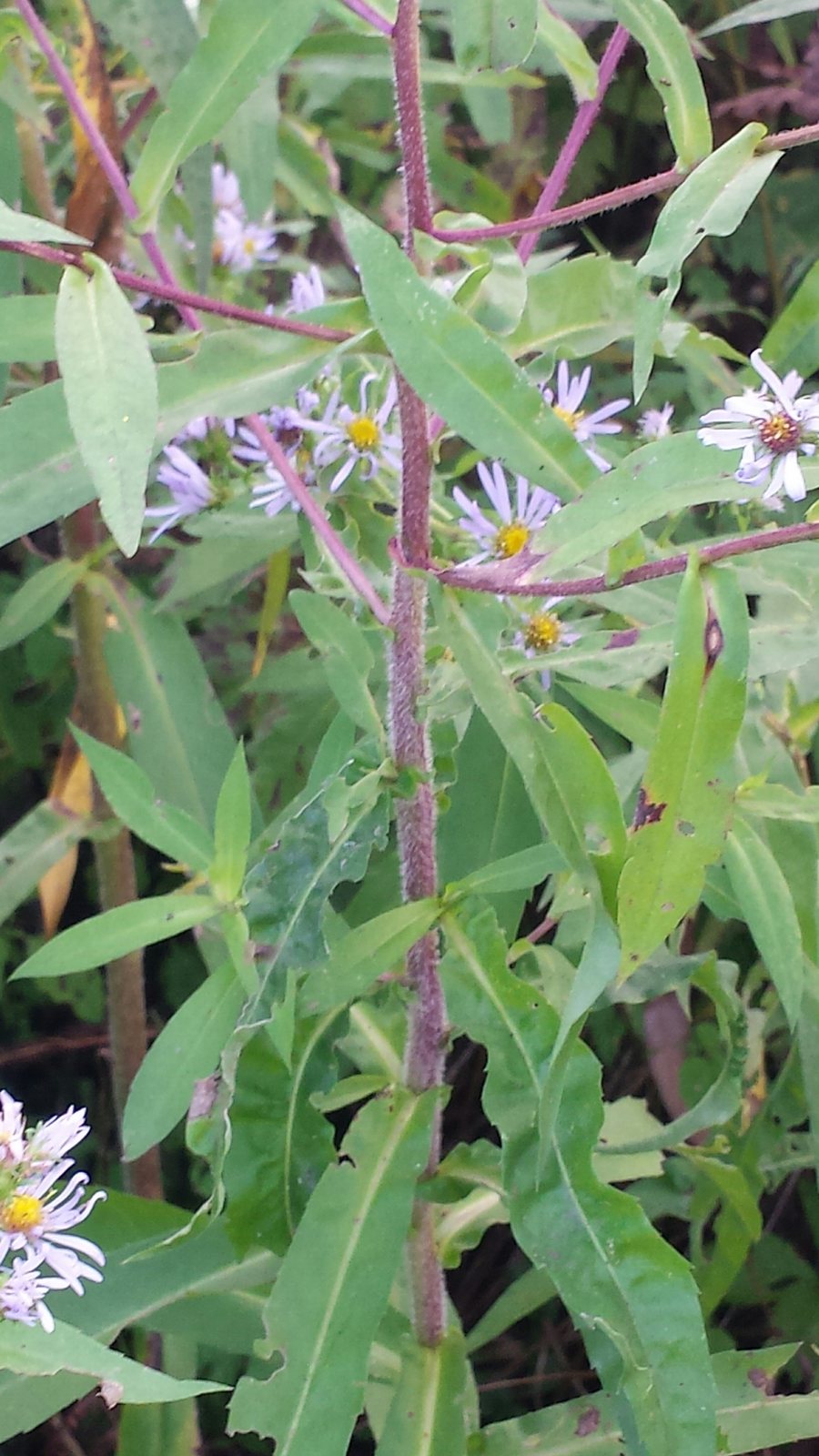
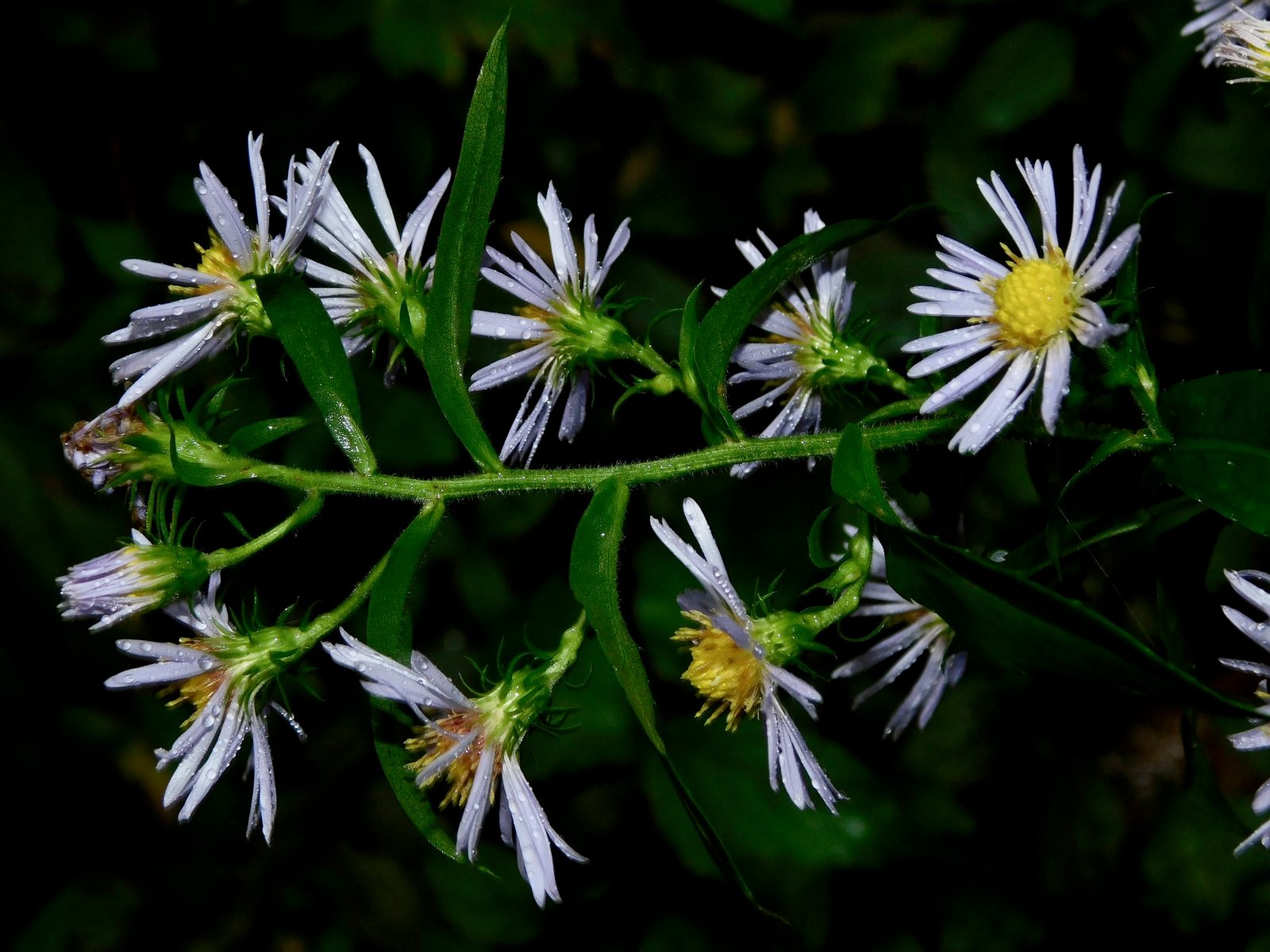
- Late summer through autumn; pale lavender to violet rays around yellow centres that darken with age, occasionally with nearly white rays.
- Foliage
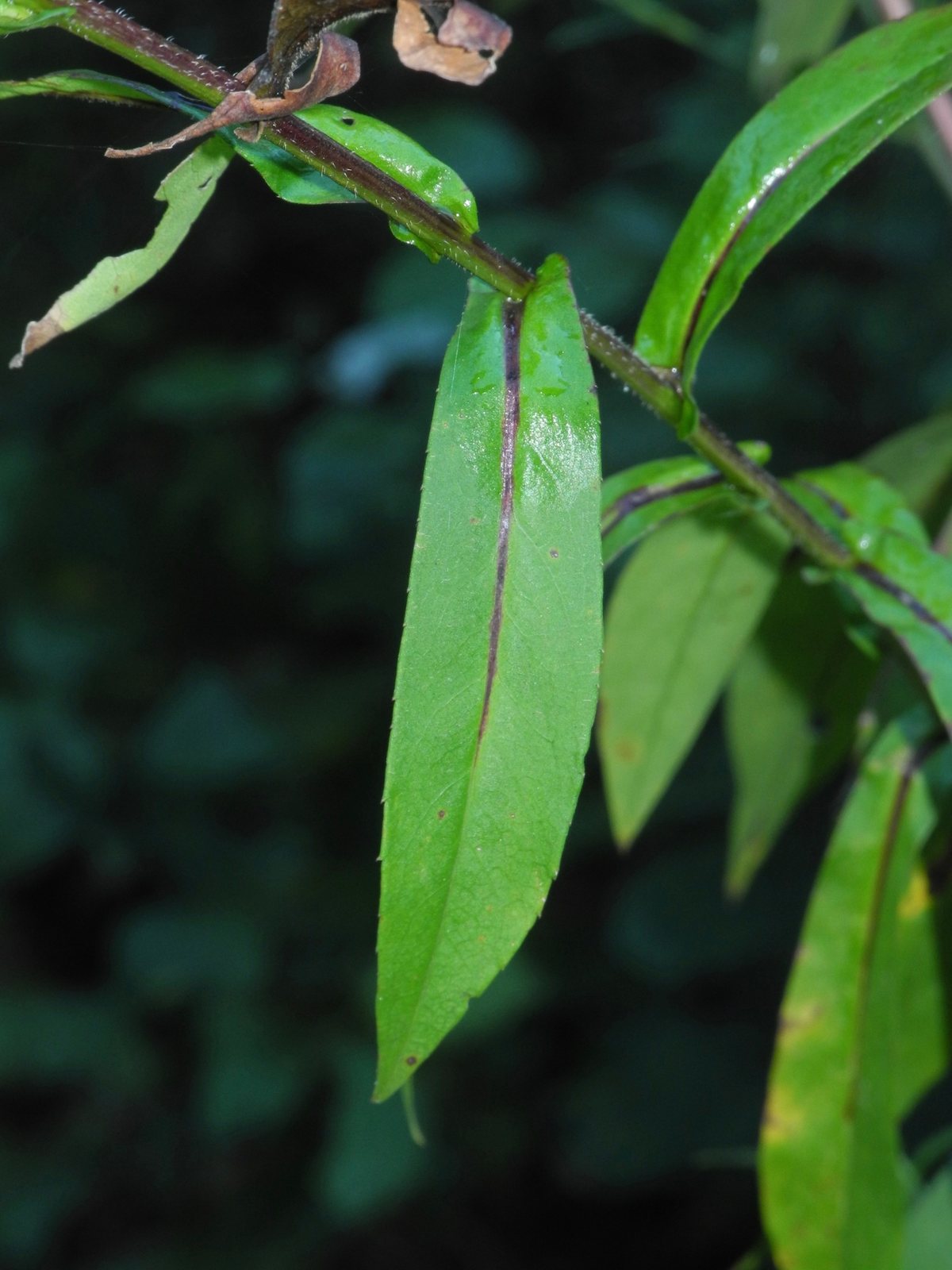
- Deciduous, lance-shaped green leaves with toothed edges and clasping bases. Stems are often reddish purple and bear stiff hairs; stem colour alone is not a reliable identification feature.
- Growth
- Moderate to fast in moist, fertile soil
- Care needed
- Medium
The year at a glance
- Pollinators
- Cold hardy
- Wildlife
- Low allergen
| J | F | M | A | M | J | J | A | S | O | N | D | |
|---|---|---|---|---|---|---|---|---|---|---|---|---|
| Flowers | ||||||||||||
| Fruit | ||||||||||||
| Plant |
Northern hemisphere months. In Australia, shift them by six.
- Difficulty
- Moderate
- Toughness
- Fairly tough
Will it suit your garden?
Pick your zone, country, light and whether you have pets.
Full sun is 6 or more hours of direct sun a day, part shade 3 to 6 hours, shade under 3.
How it grows
Planting day
1 ft (0.3 m)
After 1 year
2.4 ft (0.74 m)
After 2 years
4 ft (1.2 m)
After 3 years
4 ft (1.4 m)
full size
About 2 years to full size.
From a typical nursery size, at an average rate for this kind of plant. A rule of thumb, not a forecast.
Good to know
- Cats and dogs
- Safe
- Native to
- the US and Canada
- Growth rate
- Fast
Care
Jobs through the year
- WaterApr–May, Oct, every 7 days
- Water established clumps if rain is insufficient; keep new plants consistently moist.
- WaterJun–Sep, every 4 days
- In dry weather, water established clumps deeply enough to keep the root zone moist.
- FeedMar–Apr
- Top-dress lightly with compost; avoid high-nitrogen feeds.
- MulchMar–Apr
- Apply leaf mould or composted bark, keeping crowns clear.
- PruneFeb–Mar
- Cut last year's stems close to ground level before new growth.
- PruneMay–Jun
- Optionally shorten stems by one-third for bushier growth and slightly later flowers.
- DivideMar–Apr
- Divide congested clumps every three or four years and remove unwanted spreading shoots.
- ProtectMay–Jun
- Install twiggy supports or a plant ring before tall stems become heavy.
- DeadheadSep–Oct
- Remove fading heads only to prevent seedlings; otherwise retain them for wildlife.
- Water deeply during dry spells; do not let newly planted roots dry out.
- Apply a thin layer of compost in spring; avoid heavy nitrogen feeding, which encourages floppy growth.
- Mulch with leaf mould or composted bark to conserve moisture, keeping mulch away from the crowns.
- Support tall clumps with twiggy stakes or a discreet ring before flower stems become heavy.
- Divide congested clumps every three or four years in spring, removing unwanted spreading shoots.
Pruning. For shorter, bushier plants, shorten stems by about one-third in late spring, accepting slightly later flowering. Leave dry stems standing for winter wildlife, then cut them close to ground level in late winter or early spring before new growth develops.
Through the year
- Late winter
- Cut down last year's stems before new shoots emerge.
- Spring
- Plant or divide clumps, water thoroughly and apply compost and mulch.
- Late spring
- Shorten stems if a more compact plant is needed, and install supports.
- Summer
- Water during dry weather and remove shoots spreading beyond the allotted space.
- Late summer
- Check supports as flowers open and watch lower leaves for mildew.
- Autumn
- Leave seedheads for wildlife, or remove them before seed disperses if seedlings are unwanted.
In the garden
- Plant in groups along a pond margin, above the permanently submerged zone, for late-season colour.
- Use at the back of a moist border with Joe-Pye weed and cardinal flower for layered height and contrasting flowers.
- Combine with moisture-loving grasses in a wet meadow planting, where its spreading habit has room.
- Place along a sunny woodland edge with turtlehead and ferns to bridge the transition between open and shaded planting.
Garden styles it suits: Native meadow, Wildlife garden, Pollinator garden, Bog garden, New perennial (prairie) and Cottage garden.
Plant it with: Joe-Pye weed, Cardinal flower, White turtlehead, Blue vervain, Tussock sedge and Royal fern.
Wildlife: Flowers provide late-season nectar and pollen for bees, butterflies and other insects. Like other native North American asters, it also supports caterpillars; retained seedheads and stems provide food and shelter for wildlife.
Problems to watch for
- Powdery mildew can coat leaves, especially in crowded or drought-stressed clumps; improve airflow, maintain soil moisture and remove badly affected debris.
- Lace bugs may cause pale stippling on leaves; inspect leaf undersides and use insecticidal soap on affected foliage if damage is substantial, avoiding open flowers.
- Tall stems may flop in shade or heavily fertilised soil; provide more sun, reduce feeding and support stems early.
- Rhizomes and seedlings can crowd nearby plants; divide regularly, lift unwanted shoots and remove seedheads before they shed.
Safety
Not known to be toxic to people, cats, dogs or horses. No particular plant part is recognised as poisonous, but species-specific safety information is limited; it is not a food plant, and eating it may cause digestive upset.
Easily confused with
Smooth swamp aster (Symphyotrichum firmum)
Very similar and sometimes treated within the same species complex. Its stems are generally smooth below the flower clusters, whereas purple-stemmed aster usually has conspicuous stiff hairs, often arranged in lines.
New England aster (Symphyotrichum novae-angliae)
Usually has deeper purple flowers and densely hairy leaves and stems. The small bracts beneath its flower heads bear conspicuous glandular hairs and can feel sticky.
The name
The epithet puniceum means reddish purple, referring to the often purple-tinged stems that also give purple-stemmed aster its common name.
Propagation. Divide rooted clumps in spring for the simplest method. Sow ripe seed outdoors in autumn, or give spring-sown seed a period of cold, moist stratification; seedlings may vary in flower colour and height.
Checked against open data
- Accepted botanical name
- Symphyotrichum puniceum
- In the US and Canada
- Native in Canada, the lower 48 states and St. Pierre and Miquelon.
- Native range
- Alabama, Alberta, British Columbia, Connecticut, Delaware, Georgia, Illinois, Indiana, Iowa, Labrador, Louisiana and Maine.
- Measured
- Average height 52 cm.
Sources: GBIF (CC BY 4.0), USDA PLANTS and Trefle (CC BY 4.0). The care and design notes are LandscapeGPT's own.
See it in your own yard.
Upload a photo of your yard and see it redesigned with plants that suit your climate, each checked against your zone.