White turtlehead
Chelone glabra. Family Plantaginaceae. Perennial.
Also called Turtlehead, Balmony.
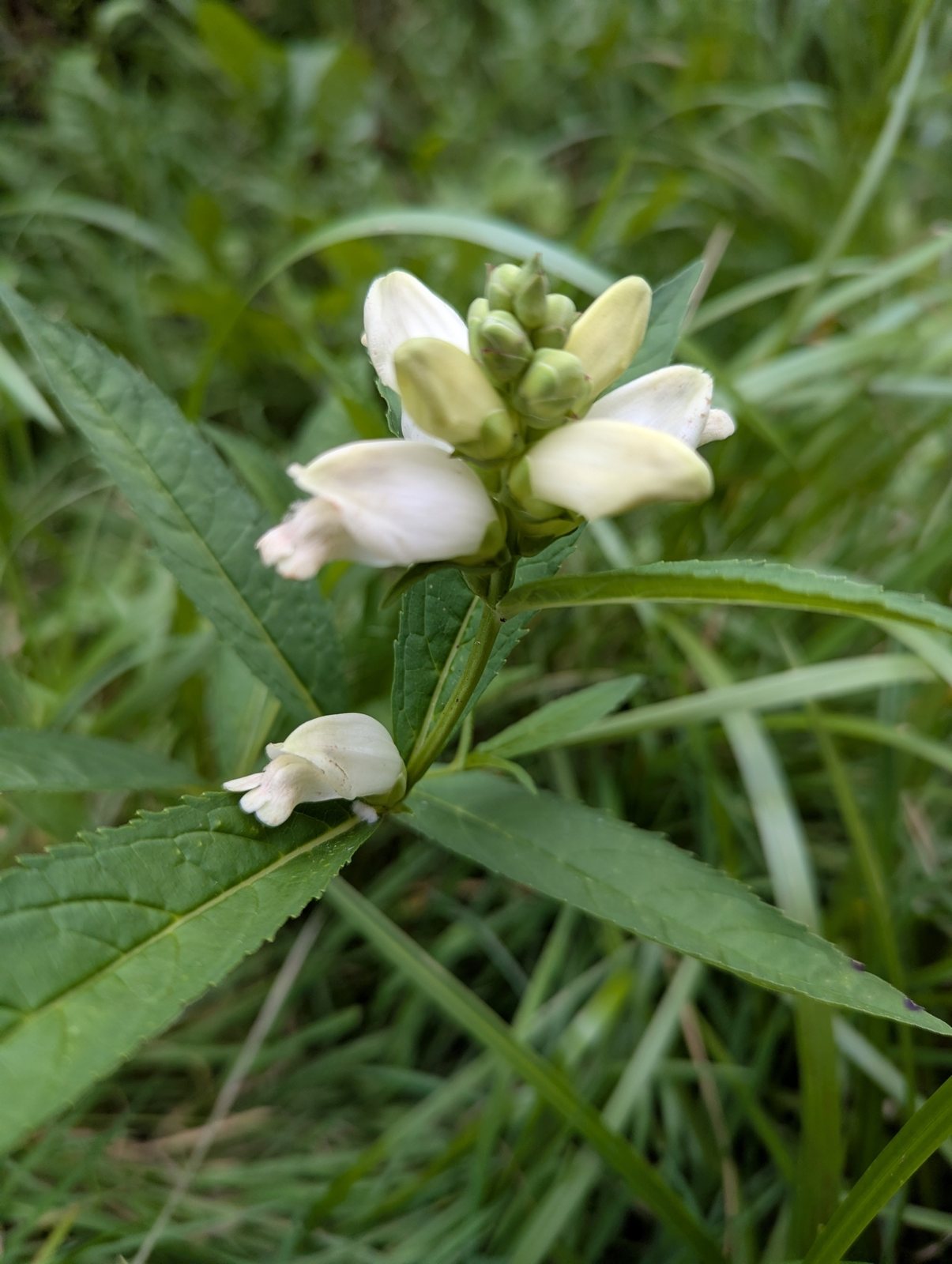
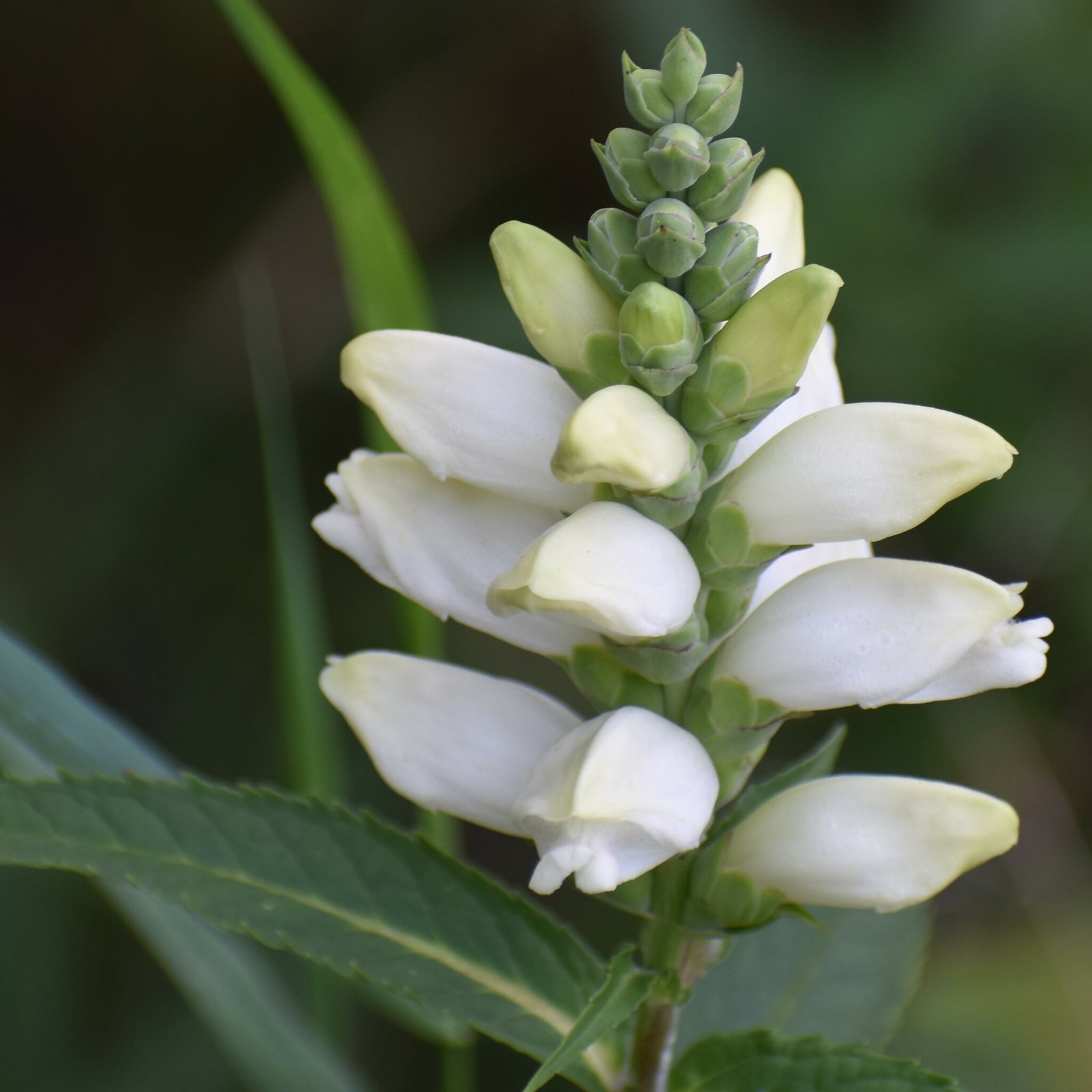
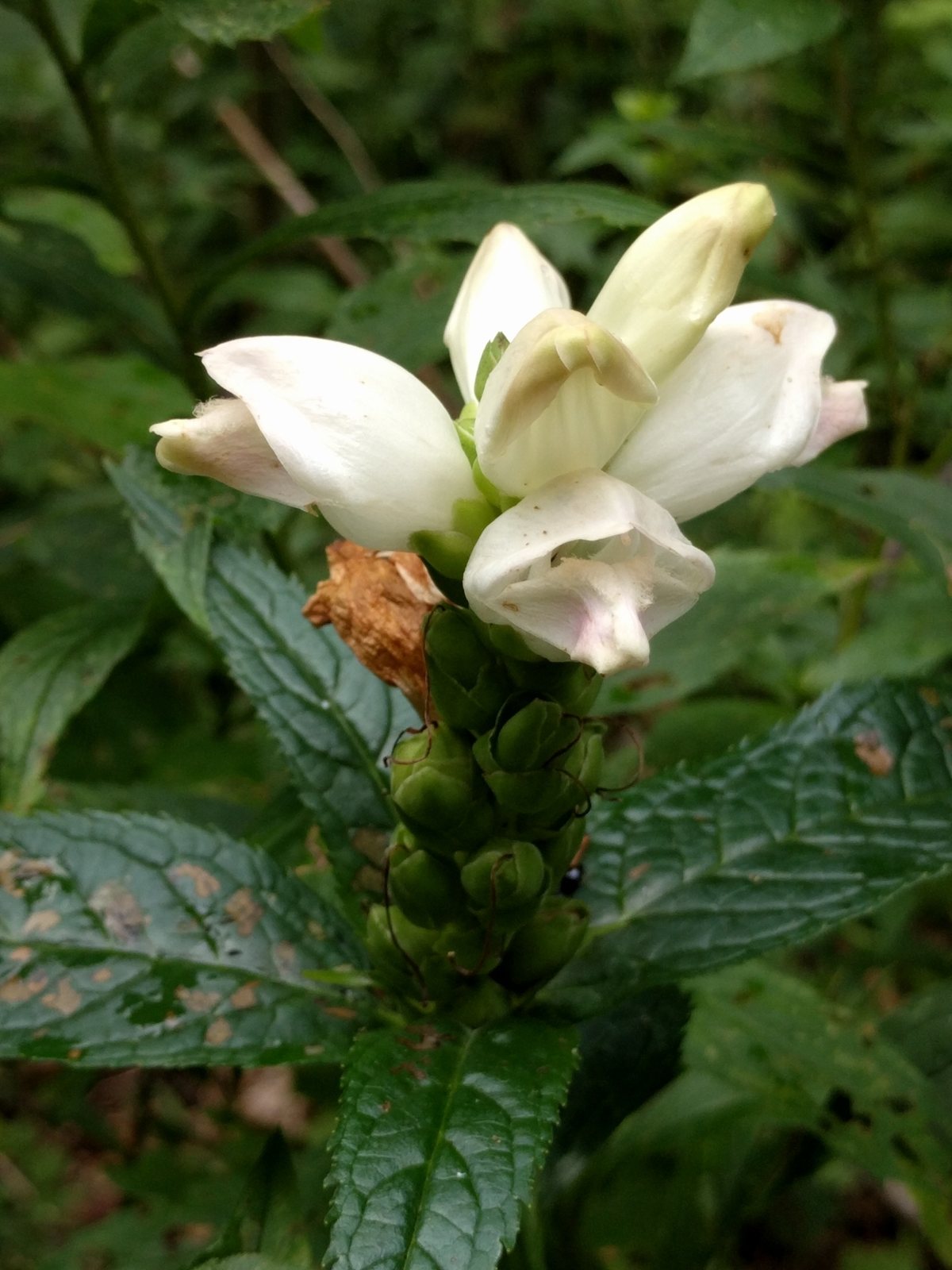
White turtlehead is a clump-forming perennial native to eastern North America, grown for its late-season spikes of white, turtlehead-shaped flowers. It suits damp borders, rain gardens and pond margins, where its upright stems provide structure and its flowers attract bumblebees.
At a glance
- Sun
- Partial shade; full sun where the soil stays consistently moist. Give it afternoon shade in hotter climates.
- Water
- Keep the soil consistently moist to wet. Water deeply during dry spells; this is not a drought-tolerant plant.
- Soil
- Humus-rich, moisture-retentive soil, including clay; prefers slightly acidic to neutral conditions. Tolerates seasonal flooding, but do not plant the crown permanently underwater.
- Height
- 2-4 ft (0.6-1.2 m)
- Spread
- 1.5-2.5 ft (0.45-0.75 m), gradually widening through short rhizomes
- Flowers
- Late summer to autumn; white flowers, sometimes flushed pale pink, held in dense terminal spikes.
- Foliage
- Opposite pairs of dark green, narrow, pointed leaves with toothed edges; stems die back for winter.
- Growth
- Moderate
- Care needed
- Low
The year at a glance
- Pollinators
- Deer resistant
- Cold hardy
- Wildlife
- Low allergen
| J | F | M | A | M | J | J | A | S | O | N | D | |
|---|---|---|---|---|---|---|---|---|---|---|---|---|
| Flowers | ||||||||||||
| Fruit | ||||||||||||
| Plant |
Northern hemisphere months. In Australia, shift them by six.
- Difficulty
- Easy
- Toughness
- Fairly tough
Will it suit your garden?
Pick your zone, country, light and whether you have pets.
Full sun is 6 or more hours of direct sun a day, part shade 3 to 6 hours, shade under 3.
How it grows
Planting day
1 ft (0.3 m)
After 1 year
1.6 ft (0.5 m)
After 2 years
2.3 ft (0.7 m)
After 3 years
3 ft (0.9 m)
full size
About 3 years to full size.
From a typical nursery size, at an average rate for this kind of plant. A rule of thumb, not a forecast.
Good to know
- Cats and dogs
- Safe
- Native to
- the US and Canada
- Growth rate
- Moderate
Care
Jobs through the year
- WaterApr–May, Sep–Oct, every 7 days
- Keep established plants consistently moist; skip watering in wet soil and check new plants more often.
- WaterJun–Aug, every 3 days
- Water established plants before roots dry out; check moisture more often during heat or establishment.
- MulchApr
- Apply 5–8 cm of leaf mould or compost, keeping emerging shoots clear.
- PruneFeb–Mar
- Cut dead stems to ground level before new growth starts.
- PruneMay
- Optionally pinch shoot tips for bushier growth; flowering may be delayed.
- DivideMar–Apr
- Divide when clumps become crowded, outgrow their space or flower less.
- ProtectMar–May
- Inspect emerging shoots for slugs and snails and hand-pick pests.
- ProtectMay–Jun
- Add discreet supports if tall stems begin to lean.
- Water during dry spells before the soil dries out around the roots.
- Apply a 2-3 in (5-8 cm) layer of leaf mould or compost in spring, keeping it clear of emerging shoots.
- Avoid heavy feeding; rich soil and excess fertiliser can encourage floppy stems.
- Support tall stems early if they lean, particularly in shade.
- Divide crowded clumps in spring when flowering declines or they outgrow their space.
Pruning. Cut dead stems to ground level in late winter or early spring before new growth starts. For shorter, bushier plants, optionally pinch back shoot tips in late spring; this can delay flowering.
Through the year
- Late winter
- Cut down old stems before new shoots appear.
- Spring
- Plant or divide clumps and water thoroughly while roots establish.
- Mid-spring
- Mulch with compost or leaf mould to conserve moisture.
- Late spring
- Pinch shoot tips if a more compact habit is needed, or add discreet supports.
- Summer
- Check soil moisture regularly and water deeply during dry weather.
- Autumn
- Leave seedheads and stems standing for seasonal structure, or remove them if they are diseased.
In the garden
- Plant in groups along a pond edge, with the crowns above the permanent water level.
- Use in the damp lower part of a rain garden for late-season flowers.
- Combine with cardinal flower and blue flag iris in an eastern North American native planting.
- Set among ferns and sedges in a moist woodland border for contrasting upright flowers.
- Repeat through a white garden where reliable moisture supports its late display.
Garden styles it suits: Bog garden, Woodland, Wildlife garden, Pollinator garden, White garden and Cottage garden.
Plant it with: Cardinal flower, Great blue lobelia, Blue flag iris, Cinnamon fern, Tussock sedge and Joe-Pye weed.
Wildlife: Bumblebees are well suited to opening the tightly lipped flowers. In its native range, white turtlehead is an important larval host for the Baltimore checkerspot butterfly; caterpillar feeding is a reason to tolerate some damaged leaves.
Problems to watch for
- Wilting and scorched leaf edges in dry soil: water deeply, mulch and move plants away from hot, dry sites.
- Powdery mildew: maintain soil moisture, improve air circulation and avoid crowding; remove affected fallen foliage.
- Slugs and snails on young shoots: inspect emerging growth and use hand-picking or an appropriately labelled iron-phosphate bait if needed.
- Leaning stems in deep shade or over-rich soil: provide more light, reduce fertiliser and support stems early.
Safety
Not known to be toxic to people, cats, dogs or horses, although species-specific safety information is limited. No particular part is established as poisonous, but it is not a food plant and should not be eaten.
Easily confused with
Pink turtlehead (Chelone lyonii)
Usually has pink flowers and broader leaves with conspicuous stalks and rounded to heart-shaped bases; white turtlehead has narrower leaves with little or no stalk.
Foxglove beardtongue (Penstemon digitalis)
Also has upright stems and white tubular flowers, but blooms earlier, usually in late spring or early summer, with more open, branching flower clusters rather than dense turtlehead spikes.
The name
Chelone comes from the Greek word for tortoise, referring to the flower's shape, while glabra means hairless and describes the plant's smooth surfaces.
Propagation. Divide clumps in spring, keeping roots moist during replanting. Sow fresh seed outdoors in autumn, or give stored seed a period of cold, moist stratification before spring sowing; seedlings may take more than one season to flower.
Checked against open data
- Accepted botanical name
- Chelone glabra
- In the US and Canada
- Native in Canada, the lower 48 states and St. Pierre and Miquelon.
- Native range
- Alabama, Arkansas, Connecticut, Delaware, District of Columbia, Georgia, Illinois, Indiana, Iowa, Kentucky, Maine and Manitoba.
Sources: GBIF (CC BY 4.0), USDA PLANTS and Trefle (CC BY 4.0). The care and design notes are LandscapeGPT's own.
See it in your own yard.
Upload a photo of your yard and see it redesigned with plants that suit your climate, each checked against your zone.