Royal palm
Roystonea regia. Family Arecaceae. Tree.
Also called Cuban royal palm, Florida royal palm.
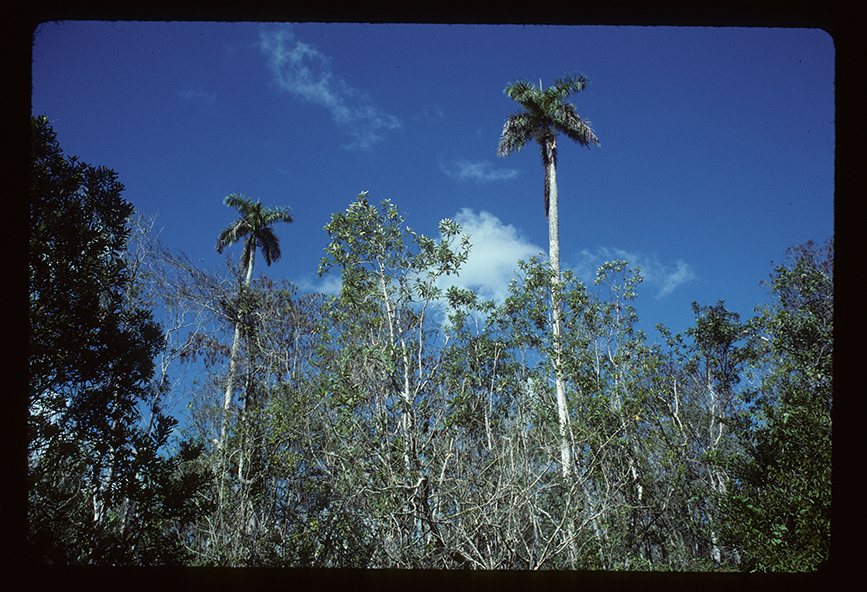
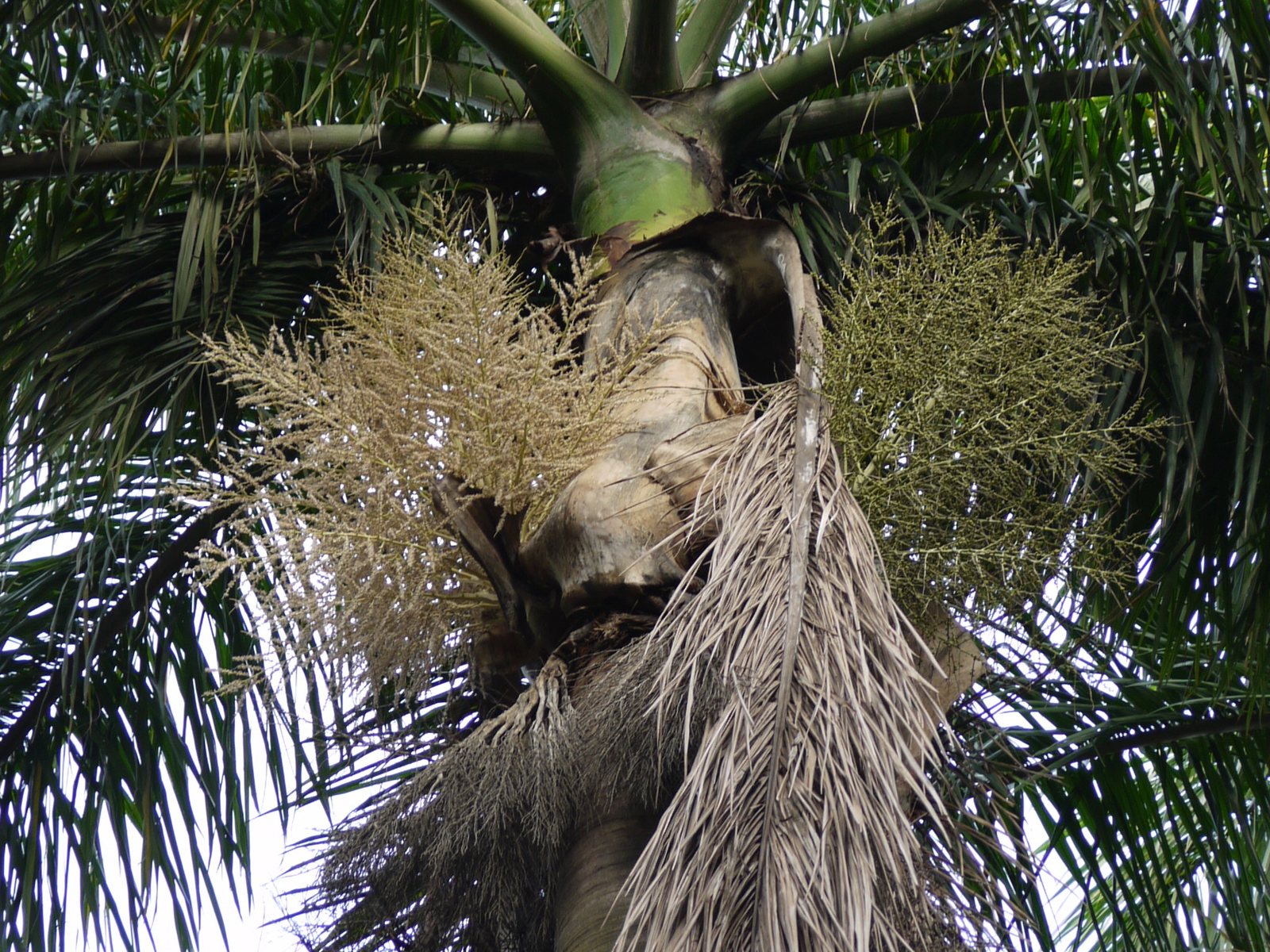
Royal palm is a tall tropical palm with a smooth, pale grey trunk, a green crownshaft and a broad crown of arching fronds. Gardeners grow it for its strong vertical shape and formal avenue effect, but it needs a large, warm garden: falling fronds are heavy, and established trees are impractical to protect from frost. It is not suitable for permanent outdoor planting in the United Kingdom or Canada.
At a glance
- Sun
- Full sun; young palms tolerate partial shade.
- Water
- Moderate to high; water deeply during dry weather. Established palms tolerate brief dry spells but grow best with consistent moisture.
- Soil
- Deep, fertile soil that holds moisture without remaining stagnant; tolerates sandy and limestone soils if adequately watered and fed.
- Height
- 50-80 ft (15-24 m), occasionally taller
- Spread
- 15-25 ft (4.6-7.6 m)
- Flowers
- Branched clusters of small creamy-white flowers appear below the crownshaft, mainly in warm months; timing varies with climate.
- Foliage
- Evergreen. Large, arching, feather-shaped green fronds, often 10-15 ft (3-4.6 m) long, with leaflets arranged in several planes.
- Growth
- Moderate to fast in warm, moist conditions.
- Care needed
- Medium
The year at a glance
- Pollinators
- Heat tolerant
- Wildlife
| J | F | M | A | M | J | J | A | S | O | N | D | |
|---|---|---|---|---|---|---|---|---|---|---|---|---|
| Flowers | ||||||||||||
| Fruit | ||||||||||||
| Plant |
Northern hemisphere months. In Australia, shift them by six.
- Difficulty
- Hard
- Toughness
- Needs looking after
Will it suit your garden?
Pick your zone, country, light and whether you have pets.
Full sun is 6 or more hours of direct sun a day, part shade 3 to 6 hours, shade under 3.
How it grows
Planting day
8 ft (2.3 m)
After 1 year
11 ft (3.4 m)
After 2 years
15 ft (4.5 m)
After 3 years
18 ft (5.6 m)
After 5 years
25 ft (7.7 m)
About 16 years to full size.
From a typical nursery size, at an average rate for this kind of plant. A rule of thumb, not a forecast.
Good to know
- Cats and dogs
- Safe
- Native to
- the US
- Growth rate
- Fast
Care
Jobs through the year
- WaterApr–May, Sep–Oct, every 7 days
- For container culture locally, water when the surface starts drying; young palms need closer checks.
- WaterJun–Aug, every 3 days
- Water container root balls thoroughly as needed and drain freely; do not leave standing in water.
- WaterJan–Mar, Nov–Dec, every 14 days
- Under heated cover, check moisture and water as needed without letting the root ball dry completely.
- FeedApr, Jul
- Use complete slow-release palm fertiliser at the container rate and label interval.
- ProtectJan–May, Sep–Dec
- Requires a large heated conservatory locally; outdoor overwintering is impossible and flowering or fruiting unlikely.
- ProtectJun–Aug
- Move outside only in warm weather and keep any mature crown away from people because heavy fronds fall.
- Plant in warm weather with the root ball at its original depth; do not bury the trunk.
- Water newly planted palms regularly, keeping the root ball moist but not continuously saturated.
- During active growth, use a slow-release palm fertiliser containing potassium, magnesium and micronutrients, following the label.
- Apply a 2-3 in (5-8 cm) mulch layer over the root area, keeping it clear of the trunk.
- Keep the area beneath the crown away from seating, play spaces and parked cars because entire heavy fronds fall naturally.
Pruning. This palm sheds its own old fronds and normally needs no leaf pruning; never remove healthy green fronds or cut the growing point. Have a qualified arborist remove hazardous hanging material or unwanted flower and fruit stalks when necessary.
Through the year
- Spring
- Apply palm fertiliser as growth resumes, following local recommendations and the product label.
- Late spring
- Plant or transplant once the soil is warm, allowing ample room for the mature crown and falling fronds.
- Summer
- Water deeply during rainless periods and check new foliage for stippling or distortion.
- Late summer
- Inspect older leaves for nutrient-deficiency symptoms; adjust the feeding programme rather than cutting off affected green leaves.
- Autumn
- Collect fallen fruit near paths and check for loose or hanging fronds before stormy weather.
- Winter
- Reduce irrigation when growth slows, but do not let newly planted root balls dry out; protect small specimens from exceptional cold.
In the garden
- Plant in widely spaced rows along broad drives to create a formal avenue.
- Use as a single vertical focal point in a large tropical lawn.
- Group several palms with lower tropical foliage for a layered, resort-style landscape.
- Frame distant views or large buildings, keeping the crowns and falling-frond zones clear of occupied areas.
Garden styles it suits: Architectural minimal, Formal, Modern tropical, Luxury resort, Florida subtropical and Caribbean.
Plant it with: Croton, Hibiscus, Ixora, Philodendron, Shell ginger and Bird of paradise.
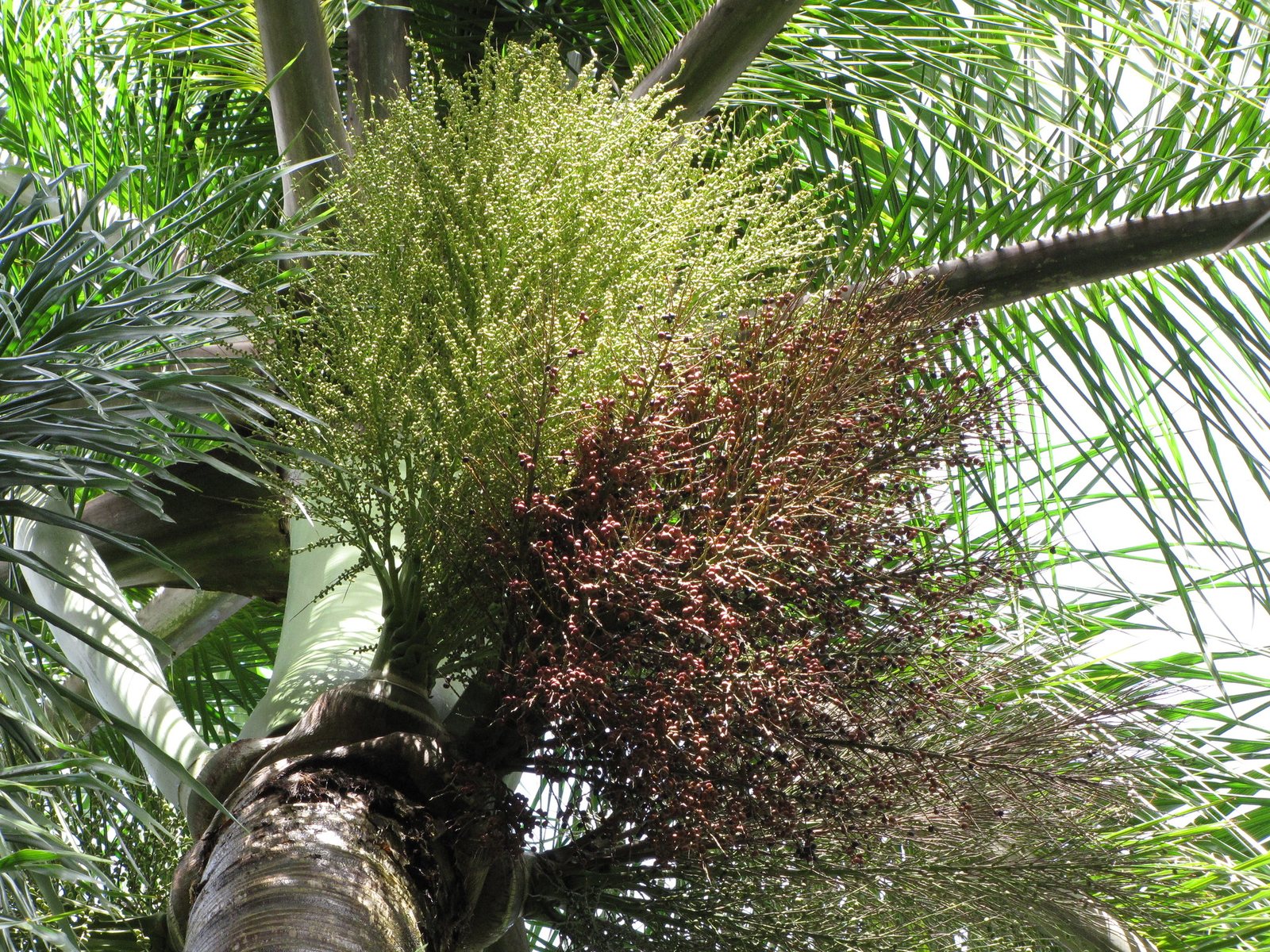
Wildlife: Flowers attract bees and other insects, and ripe fruits feed birds and some mammals. Fruit-eating wildlife may disperse seeds beyond the garden.
Problems to watch for
- Royal palm bugs cause pale stippling and damaged young foliage. Seek a diagnosis before treatment; large palms require professional assessment and equipment.
- Potassium deficiency causes spotting and premature death of older fronds. Use a balanced palm fertiliser with adequate potassium and magnesium; retain living affected leaves.
- Manganese deficiency can produce small, frizzled new leaves, especially in alkaline soils. Confirm the cause and apply an appropriate manganese treatment; ordinary magnesium supplements will not fix it.
- Ganoderma butt rot can cause decline and a shelf-like fungal growth at the trunk base. There is no cure; have the palm assessed and removed if affected, and avoid replanting another palm in the same spot.
Safety
Not known to be toxic to people, cats, dogs or horses, although specific safety information is limited and the fruit should not be treated as food. Fallen fruits can be swallowed by pets, and heavy falling fronds are a more significant physical hazard.
Easily confused with
Caribbean royal palm (Roystonea oleracea)
Usually has a more upright crown, with most leaves held at or above horizontal; royal palm commonly has conspicuously drooping lower fronds.
Alexandra palm (Archontophoenix alexandrae)
Has a much slimmer, distinctly ringed trunk and leaflets with silvery undersides, rather than the royal palm's massive, smooth pale trunk.
Foxtail palm (Wodyetia bifurcata)
Has densely bushy, foxtail-like fronds and remains substantially shorter, with a slimmer trunk.
The name
Roystonea honours the American engineer Roy Stone, while regia means royal, referring to the palm's stately appearance.
Propagation. Grow from fresh ripe seed. Remove the fruit pulp, clean the seed and sow in a moist, free-draining medium at about 77-86°F (25-30°C); germination can take several weeks to several months.
Checked against open data
- Accepted botanical name
- Roystonea regia
- In the US and Canada
- Native in the lower 48 states. Introduced in Pacific Basin, Puerto Rico and US Virgin Islands.
- Native range
- Bahamas, Belize, Cayman Is., Cuba, Dominican Republic, Florida, Haiti, Honduras, Mexico Gulf and Mexico Southeast.
- Measured
- Average height 3000 cm.
Sources: GBIF (CC BY 4.0), USDA PLANTS and Trefle (CC BY 4.0). The care and design notes are LandscapeGPT's own.
See it in your own yard.
Upload a photo of your yard and see it redesigned with plants that suit your climate, each checked against your zone.