Royal poinciana
Delonix regia. Family Fabaceae. Tree.
Also called Flamboyant tree, Flame tree, Gulmohar.
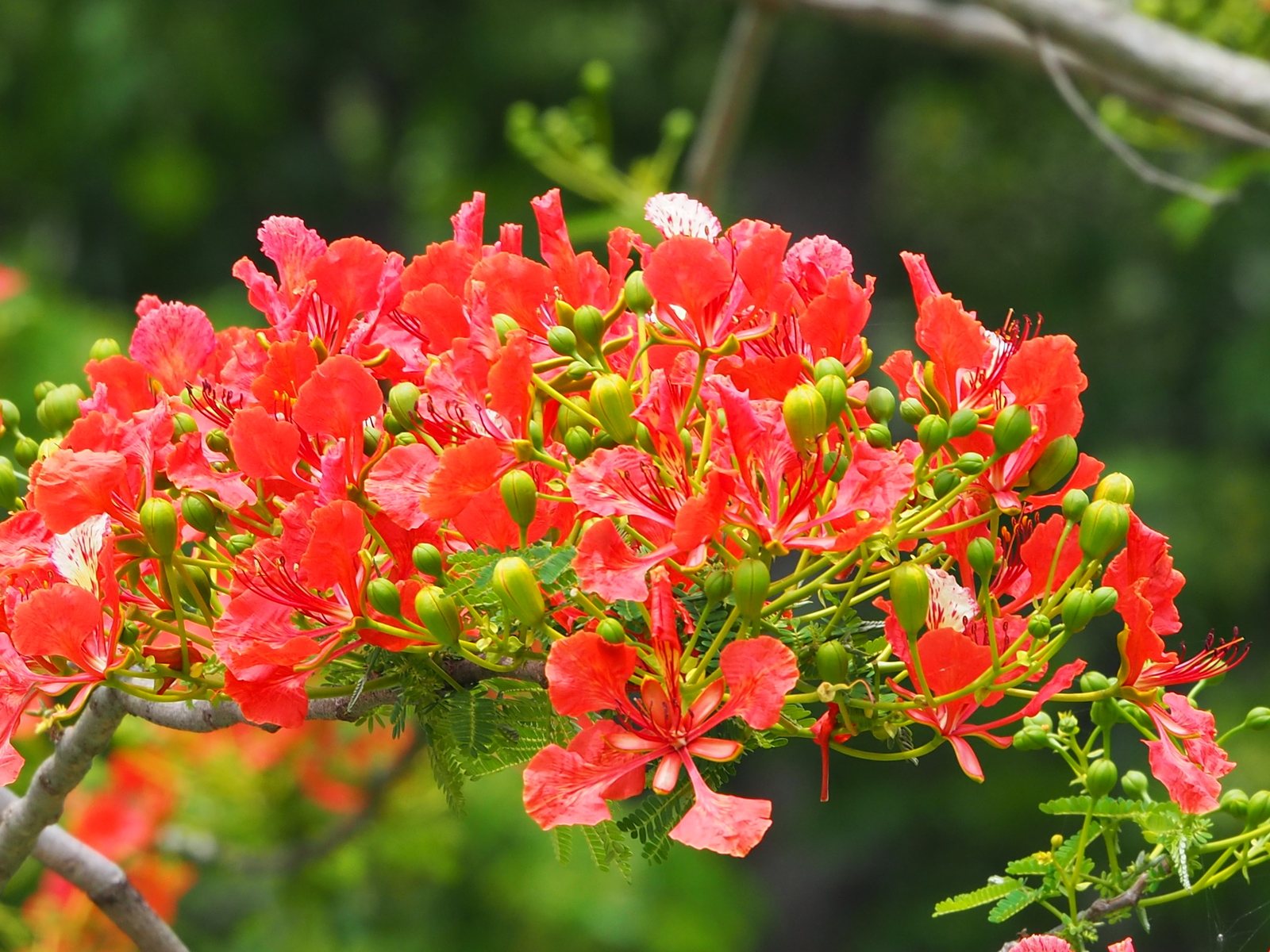
Royal poinciana (Delonix regia) is a broad, spreading tropical tree grown for its brilliant scarlet-orange flowers and fern-like foliage. Its umbrella-shaped crown gives generous summer shade, but its large surface roots and brittle branches need plenty of space. It suits frost-free gardens; in the United Kingdom and most of Canada, it needs a heated conservatory or greenhouse.
At a glance
- Sun
- Full sun; flowering is poor in shade.
- Water
- Water regularly while establishing. Established trees tolerate seasonal drought, but need occasional deep watering during prolonged hot, dry weather.
- Soil
- Well-drained sandy, loamy or gravelly soil; tolerates a range of soil pH but dislikes waterlogged ground.
- Height
- 30-40 ft (9-12 m)
- Spread
- 40-60 ft (12-18 m)
- Flowers
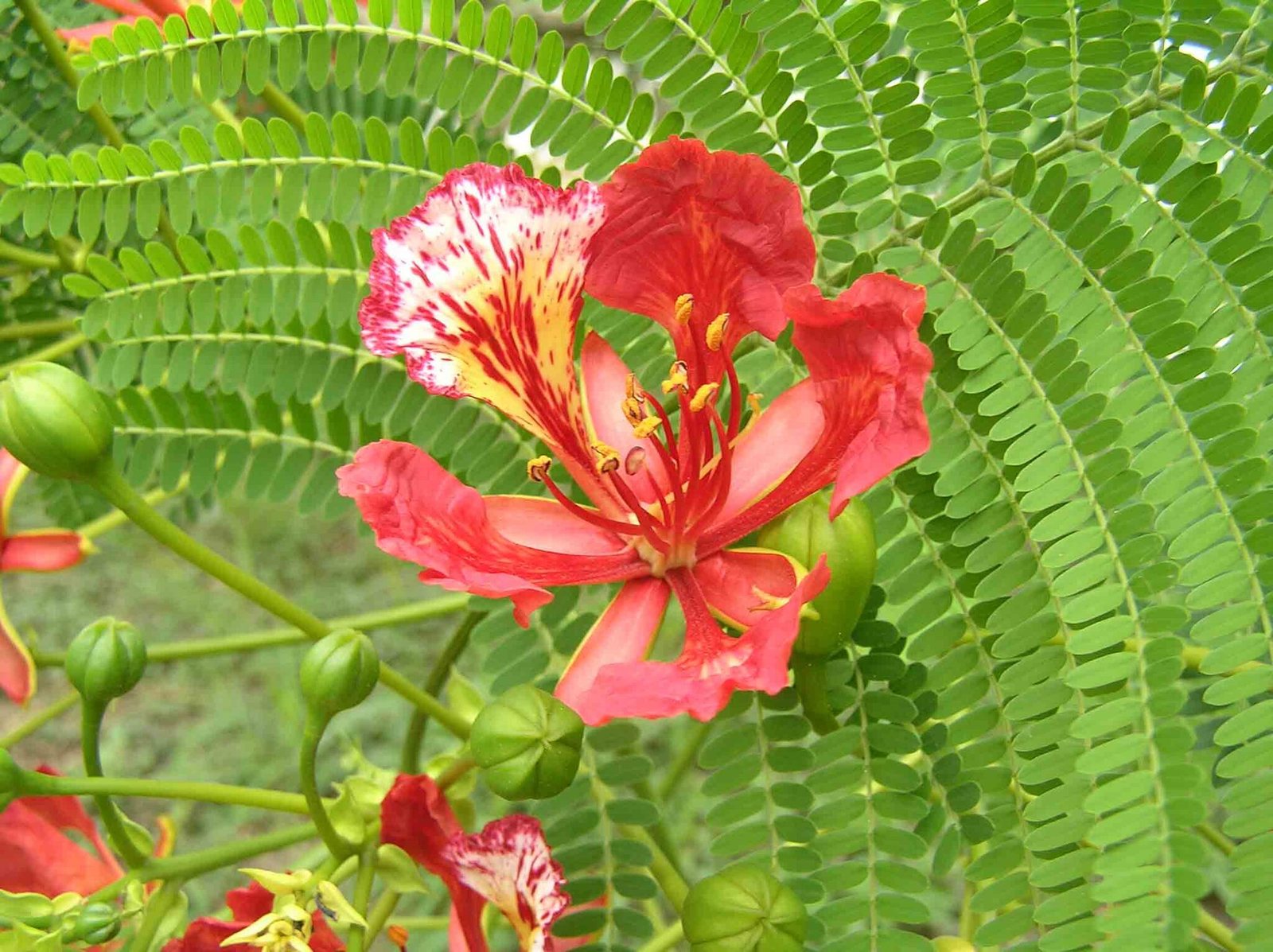
- Late spring through summer, sometimes extending into early autumn; large scarlet to orange-red flowers, with one petal marked in white and yellow.
- Foliage
- Large, finely divided leaves with many small green leaflets. Often loses its leaves during the dry season or cool weather.
- Growth
- Fast in warm conditions.
- Care needed
- Medium
The year at a glance
- Pollinators
- Drought tolerant
- Heat tolerant
- Wildlife
- Low allergen
| J | F | M | A | M | J | J | A | S | O | N | D | |
|---|---|---|---|---|---|---|---|---|---|---|---|---|
| Flowers | ||||||||||||
| Fruit | ||||||||||||
| Plant |
Northern hemisphere months. In Australia, shift them by six.
- Difficulty
- Hard
- Toughness
- Needs looking after
Will it suit your garden?
Pick your zone, country, light and whether you have pets.
Full sun is 6 or more hours of direct sun a day, part shade 3 to 6 hours, shade under 3.
How it grows
Planting day
7 ft (2 m)
After 1 year
9 ft (2.7 m)
After 2 years
11 ft (3.3 m)
After 3 years
13 ft (4 m)
After 5 years
17 ft (5.3 m)
About 13 years to full size.
From a typical nursery size, at an average rate for this kind of plant. A rule of thumb, not a forecast.
Good to know
- Cats and dogs
- Toxic
- Invasive in
- the US
- Growth rate
- Fast
Care
Jobs through the year
- ProtectJan–May, Sep–Dec
- Cannot overwinter outdoors in zones 6–7; grow in a movable container under warm, bright cover.
- ProtectJun
- Acclimatise to outdoor sun after frost risk passes; flowers and pods are unlikely in this climate.
- WaterApr–May, Sep–Oct, every 7 days
- Container exception: check moisture and water when the surface dries; do not leave standing in water.
- WaterJun–Aug, every 3 days
- Container exception: check frequently and soak when the surface dries; hot weather may require more.
- WaterJan–Mar, Nov–Dec, every 14 days
- Under warm cover, water sparingly as growth slows, only when the compost has partly dried.
- FeedApr–May
- Give a light balanced feed if growth is weak; avoid heavy nitrogen feeding.
- PruneFeb–Mar
- Remove small competing leaders and weak forks gradually; avoid heavy pruning.
- Plant in a warm, frost-free position sheltered from strong winds, with room for the full crown.
- Keep well away from buildings, drains and paving; large surface roots can lift hard surfaces.
- Water young trees deeply, allowing the soil surface to dry between waterings.
- Apply a broad layer of organic mulch, keeping it clear of the trunk.
- Feed young trees lightly in spring if growth is weak; avoid heavy nitrogen feeding.
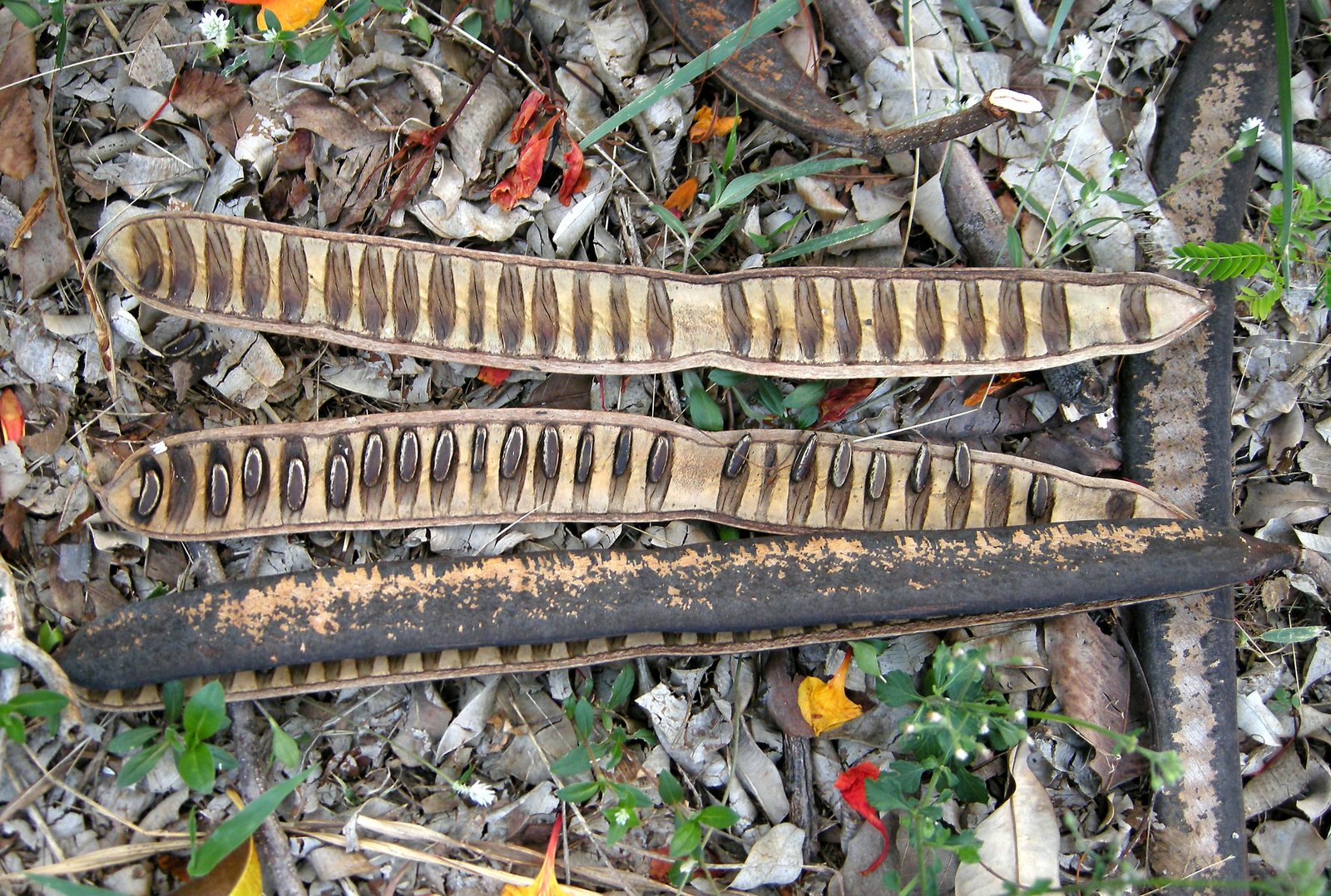
- Collect fallen woody pods from lawns and paths.
Pruning. Train young trees during the dormant or leafless period, retaining a strong trunk and well-spaced main branches; remove competing leaders and narrow, weak forks gradually. Avoid topping or heavy pruning of mature trees, and use a qualified arborist for large branches.
Through the year
- Late winter
- Inspect the branch structure and remove dead wood or small competing leaders before active growth.
- Spring
- Plant once the soil is warm and any risk of frost has passed.
- Spring
- Refresh mulch and give young trees a light feed only if needed.
- Summer
- Deep-water establishing trees during dry spells; check beneath the mulch before watering again.
- Autumn
- Collect fallen pods and check paths for lifting caused by surface roots.
- Winter
- Keep container-grown plants under warm, bright cover and reduce watering as growth slows.
In the garden
- Use as a flowering specimen in a large lawn where its full umbrella-shaped crown can develop.
- Create high summer shade beside a generous garden seating area, keeping roots away from paving.
- Pair with palms and bold-leaved tropical plants for contrasting foliage textures.
- Use as a focal tree in a large tropical courtyard with ample open soil and no overhead obstructions.
Garden styles it suits: Tropical, Modern tropical, Luxury resort, Caribbean, Florida subtropical and Architectural minimal.
Plant it with: Frangipani, Bird of paradise, Croton, Cordyline, Bromeliads and Cast-iron plant.
Wildlife: Flowers attract bees, butterflies and nectar-feeding birds where these occur. The broad crown provides shelter and perching sites, although this Madagascan species is not a substitute for locally native habitat trees.
Problems to watch for
- Frost injury: leaves and young shoots blacken in cold weather. Choose a frost-free site; protect small trees temporarily, and wait until warm growth resumes before removing damaged wood.
- Weak forks and storm breakage: train young trees for well-spaced branches and have mature trees inspected after major storms.
- Root rot in wet soil: improve drainage before planting and avoid frequent watering of established trees.
- Scale insects and sooty mould: check stems and leaf undersides, control associated ants, and treat reachable infestations with horticultural oil according to the label.
Safety
Seeds and pods are reported to be poisonous if eaten and may cause vomiting, diarrhoea and abdominal discomfort. Keep them away from children, cats, dogs and grazing horses; species-specific evidence and safe quantities are not well established. Seek medical or veterinary advice after ingestion.
Where it spreads. Reported invasive in parts of Hawaii and the Galápagos Islands, where escaped seedlings can establish outside gardens. Check local guidance before planting in tropical island regions.
Easily confused with
Dwarf poinciana (Caesalpinia pulcherrima)
A shrub or small tree with smaller leaves, often prickly stems, and upright flower clusters with conspicuously long projecting stamens.
Yellow poinciana (Peltophorum pterocarpum)
Has similar finely divided foliage but upright clusters of yellow flowers rather than large scarlet-orange flowers.
Illawarra flame tree (Brachychiton acerifolius)
Has broad, sometimes lobed leaves rather than feathery foliage, and masses of small red bell-shaped flowers.
The name
Delonix comes from Greek words meaning conspicuous claw, referring to the narrow bases of the petals, while regia means royal.
Propagation. Grow from seed in warm conditions. Carefully nick the hard seed coat away from the embryo, soak in warm water for about 24 hours, then sow in a free-draining mix. Seed-grown trees can take several years to flower.
Checked against open data
- Accepted botanical name
- Delonix regia
- Native range
- Madagascar.
- Measured
- Soil pH 4 to 7. Average height 1000 cm.
Sources: GBIF (CC BY 4.0) and Trefle (CC BY 4.0). The care and design notes are LandscapeGPT's own.
See it in your own yard.
Upload a photo of your yard and see it redesigned with plants that suit your climate, each checked against your zone.