Salal
Gaultheria shallon. Family Ericaceae. Shrub.
Also called Shallon, Shallon bush.
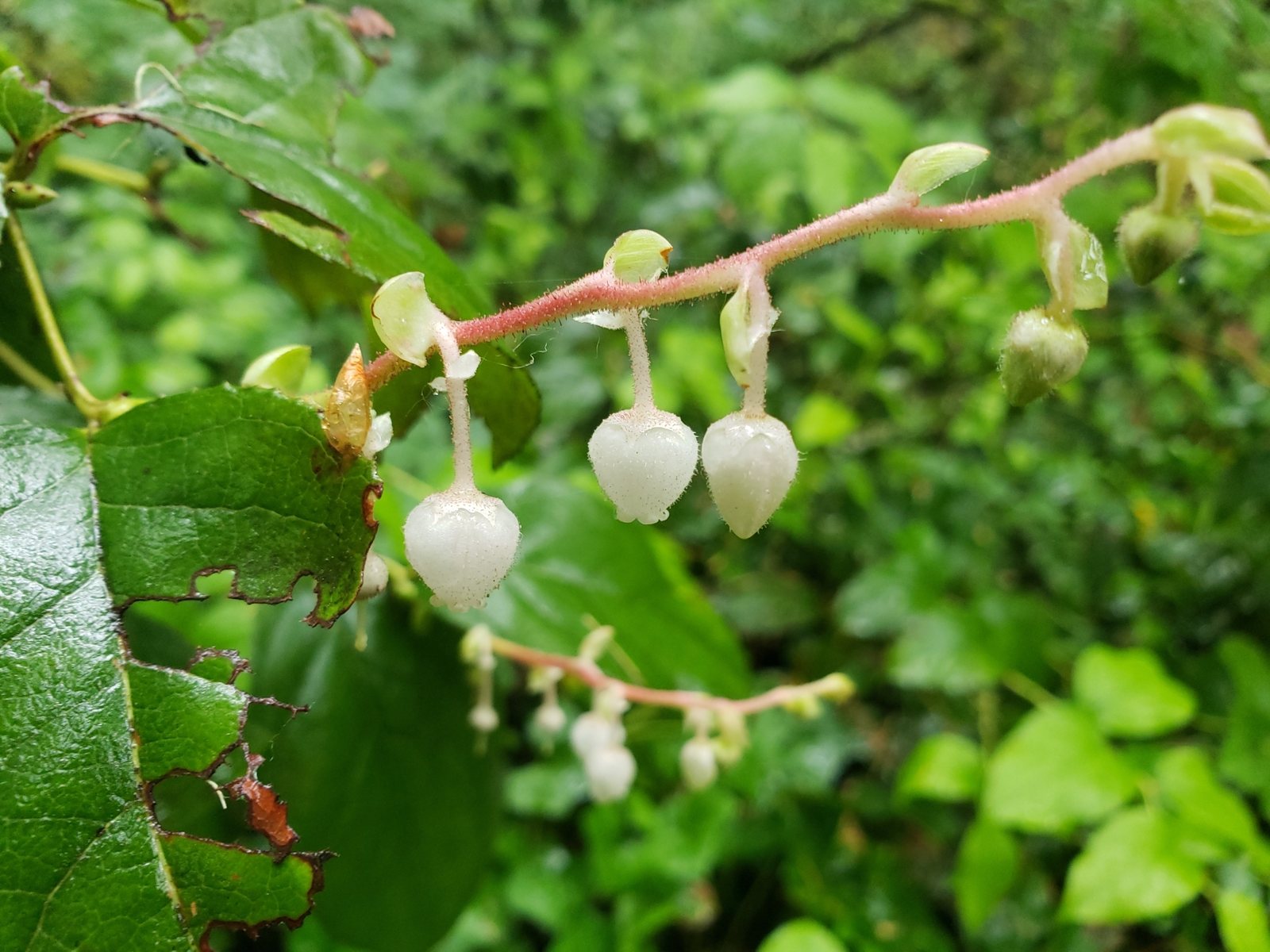
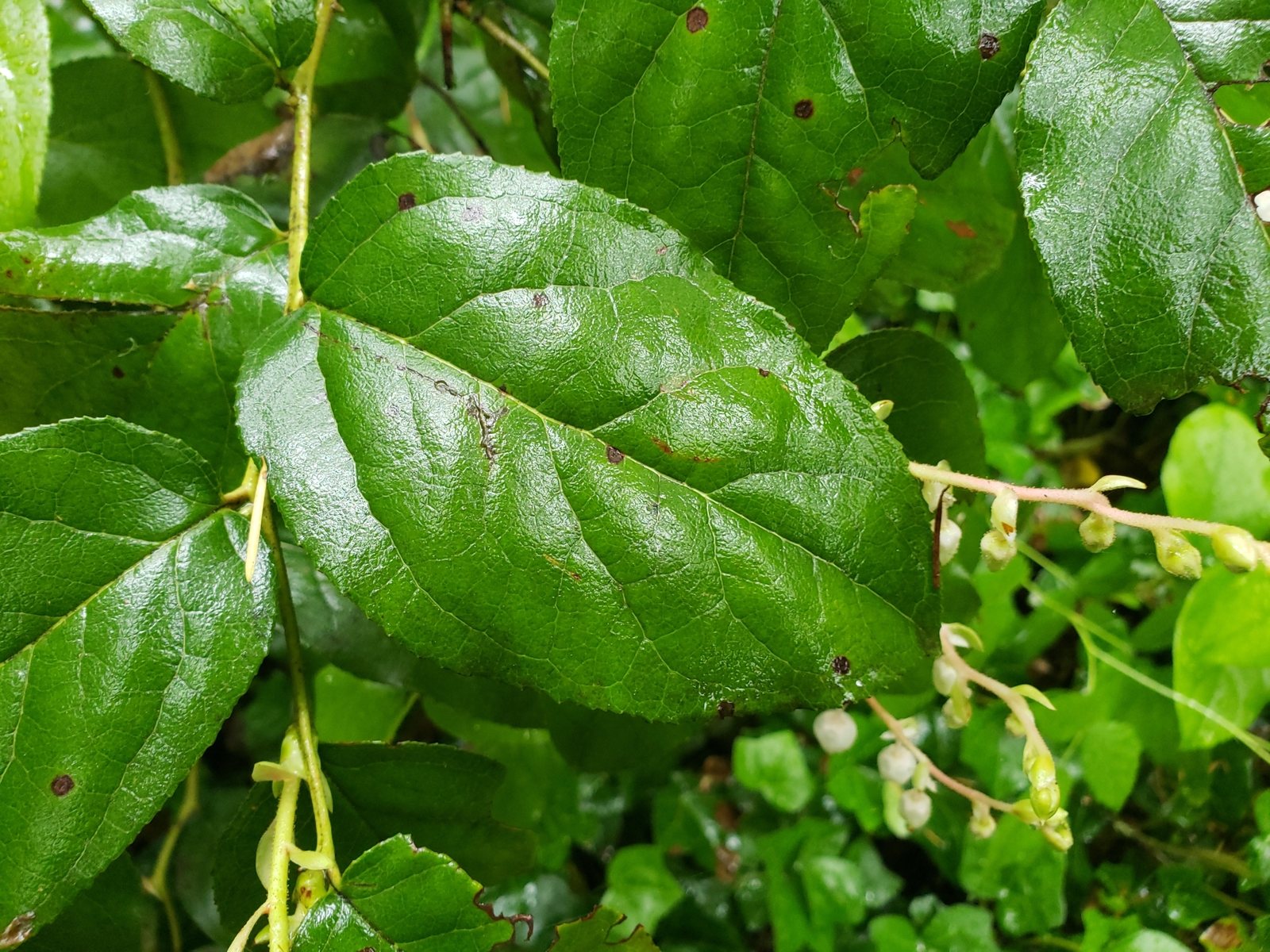
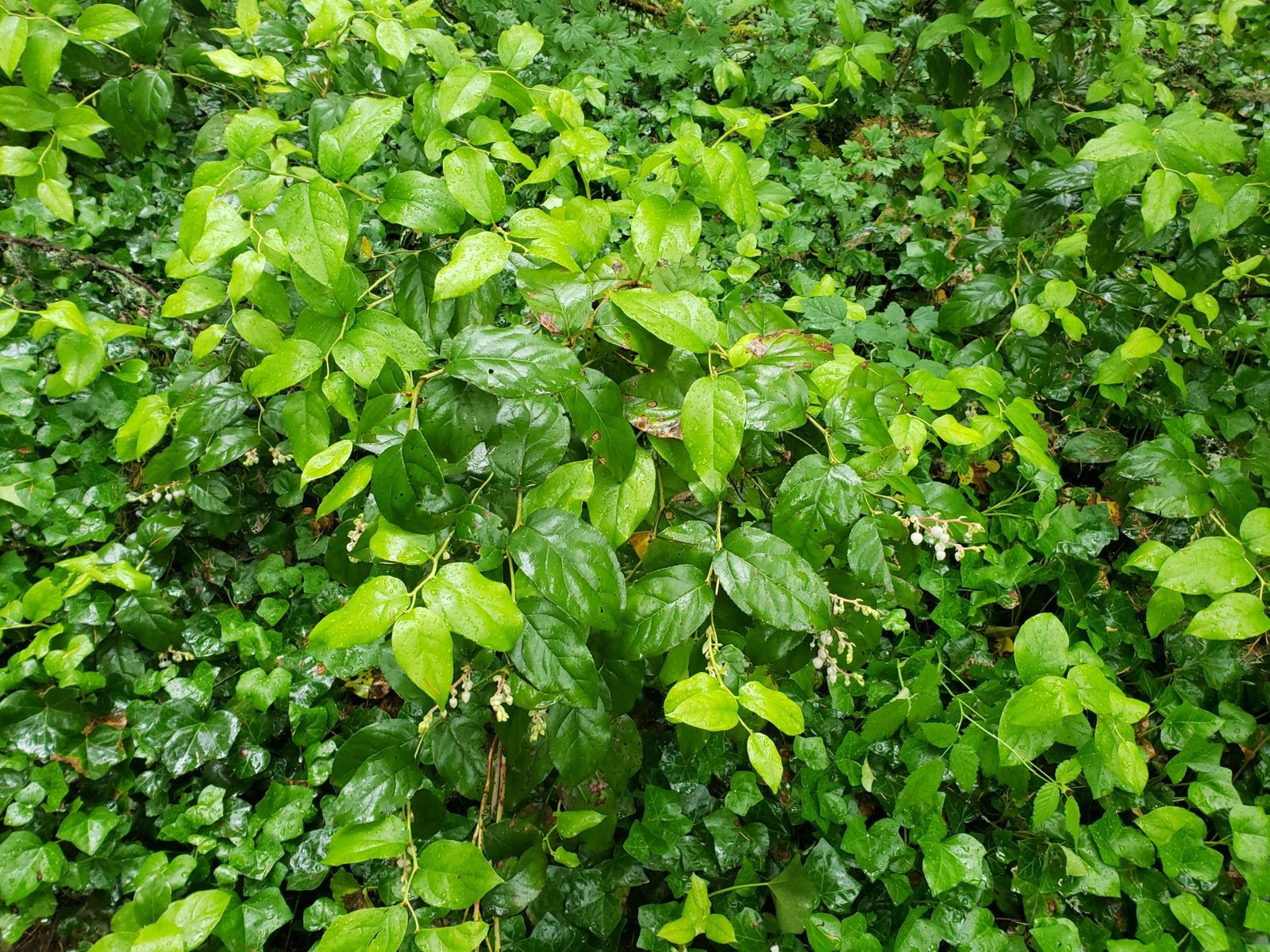
Salal is an evergreen shrub native to western North America, grown for its leathery leaves, small bell-shaped flowers and edible dark berries. It spreads into dense colonies and works well beneath trees in acidic woodland gardens, especially in cool coastal climates.
At a glance
- Sun
- Partial shade is ideal; tolerates deep shade and full sun in cool climates if the soil stays moist.
- Water
- Water regularly while establishing. Established plants tolerate some summer drought in shade, but need extra water during prolonged dry weather.
- Soil
- Acidic, humus-rich, well-drained soil; sandy or loamy woodland soils suit it well. Avoid chalky soil and standing water.
- Height
- 3-6 ft (0.9-1.8 m), occasionally reaching 10 ft (3 m) in sheltered woodland
- Spread
- 3-6 ft (0.9-1.8 m) initially; underground stems can eventually form much wider colonies
- Flowers
- Late spring to early summer; small white to pale pink bells hang in loose clusters.
- Foliage
- Evergreen. Broad, glossy, leathery dark green leaves with finely toothed edges; young growth is often bronze-tinted.
- Growth
- Slow to moderate initially; established colonies spread steadily.
- Care needed
- Low
The year at a glance
- Pollinators
- Drought tolerant
- Wildlife
- Low allergen
| J | F | M | A | M | J | J | A | S | O | N | D | |
|---|---|---|---|---|---|---|---|---|---|---|---|---|
| Flowers | ||||||||||||
| Fruit | ||||||||||||
| Plant |
Northern hemisphere months. In Australia, shift them by six.
- Difficulty
- Easy
- Toughness
- Very tough
Will it suit your garden?
Pick your zone, country, light and whether you have pets.
Full sun is 6 or more hours of direct sun a day, part shade 3 to 6 hours, shade under 3.
How it grows
Planting day
1.6 ft (0.5 m)
After 1 year
2.1 ft (0.63 m)
After 2 years
2.5 ft (0.76 m)
After 3 years
2.9 ft (0.89 m)
After 5 years
4 ft (1.2 m)
About 7 years to full size.
From a typical nursery size, at an average rate for this kind of plant. A rule of thumb, not a forecast.
Good to know
- Cats and dogs
- Safe
- Native to
- the US and Canada
- Invasive in
- the UK
- In the garden
- Spreads vigorously: plan to contain it.
- Growth rate
- Slow
Care
Jobs through the year
- WaterApr–May, Sep–Oct, every 14 days
- Water established plants deeply if soil is dry; water more often for the first two growing seasons.
- WaterJun–Aug, every 14 days
- Water established plants during dry spells; check young plants weekly and water sooner if needed.
- MulchMar–Apr
- Apply leaf mould or composted bark, keeping it clear of stems.
- FeedApr
- Feed lightly with ericaceous fertiliser only if growth is weak; check soil acidity first.
- PruneMar
- Remove damaged stems, thin the oldest growth and dig out unwanted rooted shoots.
- Water deeply during dry spells for the first two growing seasons.
- Mulch with leaf mould or composted bark, keeping mulch clear of the stems.
- Feed only if growth is weak, using a light application of fertiliser for acid-loving plants in spring.
- Remove unwanted shoots at the edge of the planting before they establish a wider colony.
- In hot inland gardens, provide afternoon shade and shelter from drying winds.
Pruning. In early spring, remove dead or damaged stems and thin congested growth at ground level. To renovate an overgrown patch, cut back a portion of the oldest stems each year rather than shearing the whole shrub.
Harvest
Pick berries in late summer to autumn when they are fully dark purple-black and slightly soft; ripe berries should detach readily. Eat fresh or use in preserves, allowing for their sometimes dry, seedy texture. Expect a first worthwhile crop roughly 2-4 years after planting a healthy nursery-grown shrub, though deep shade can delay or reduce cropping.
Through the year
- Early spring
- Remove damaged stems, thin old growth and check the edges for unwanted spreading shoots.
- Spring
- Plant in prepared acidic soil, water thoroughly and apply an organic mulch.
- Late spring
- Check new leaves for yellowing and assess soil acidity if growth looks pale.
- Summer
- Water young plants during dry spells, especially beneath thirsty trees.
- Late summer
- Harvest fully ripe berries, leaving some for birds.
- Autumn
- Plant or transplant rooted offsets while the soil is moist and weather is mild.
In the garden
- Mass beneath conifers or other open-canopied trees for a durable evergreen woodland understorey.
- Combine with ferns and rhododendrons for contrasting leaf shapes in acidic shade.
- Use on shaded banks where its spreading stems help cover bare ground.
- Plant along informal woodland paths for year-round structure, allowing room for its eventual spread.
- Include in a woodland edible garden where berries can be harvested without sacrificing evergreen cover.
Garden styles it suits: Woodland, Pacific Northwest woodland, Wildlife garden, Low-maintenance, Food forest and Edible landscape.
Plant it with: Western sword fern, Western redcedar, Vine maple, Evergreen huckleberry, Pacific rhododendron and Red huckleberry.
Wildlife: Flowers attract bees and other pollinating insects. Birds and mammals eat the berries, and dense evergreen colonies provide shelter for small wildlife.
Problems to watch for
- Yellow leaves with greener veins often indicate alkaline soil: test the soil and move the plant to an acidic bed if necessary; repeated feeding will not correct unsuitable soil.
- Leaf scorch and browning can follow hot sun or drought: provide afternoon shade, mulch and water deeply during prolonged dry spells.
- Root rot can develop in waterlogged soil: improve drainage or replant on a raised site, and avoid frequent shallow watering.
- Unwanted colonies can develop from underground stems: dig out rooted shoots and connecting stems, checking the boundary of the planting each year.
Safety
The ripe berries are edible for people. Salal is not known to be toxic to cats, dogs or horses, but specific safety information for these animals is limited; do not use the foliage as feed, and discourage pets from eating large quantities.
Where it spreads. Spreads strongly by underground stems, including within its native western North American range. It is locally invasive in parts of Britain, particularly on acidic heathland and in woodland, and has also naturalised in Ireland. Avoid planting near sensitive heathland or woodland where it is non-native.
Easily confused with
Evergreen huckleberry (Vaccinium ovatum)
Has much smaller, narrower leaves and a more twiggy, upright habit; salal has broad, conspicuously leathery leaves and loose, often one-sided flower clusters.
Wintergreen (Gaultheria procumbens)
Forms a very low groundcover with smaller leaves and bright red fruit, rather than salal's taller woody stems and purple-black fruit.
Bearberry (Arctostaphylos uva-ursi)
Trails close to the ground and has smaller, spoon-shaped leaves with smooth edges and red berries.
The name
Gaultheria honours Jean-François Gaultier, an eighteenth-century physician and naturalist who worked in Canada.
Propagation. Separate well-rooted offsets in spring or autumn, retaining as much root as possible. Semi-ripe cuttings in summer are another option, though rooting can be slow; seed-grown plants take longer to establish.
Checked against open data
- Accepted botanical name
- Gaultheria shallon
- In the US and Canada
- Native in Alaska, Canada and the lower 48 states.
- Native range
- Alaska, British Columbia, California, Oregon and Washington.
- Measured
- Soil pH 5.5 to 7. Average height 173 cm.
Sources: GBIF (CC BY 4.0), USDA PLANTS and Trefle (CC BY 4.0). The care and design notes are LandscapeGPT's own.
See it in your own yard.
Upload a photo of your yard and see it redesigned with plants that suit your climate, each checked against your zone.