Sea grape
Coccoloba uvifera. Family Polygonaceae. Tree.
Also called Seagrape, Bay grape.
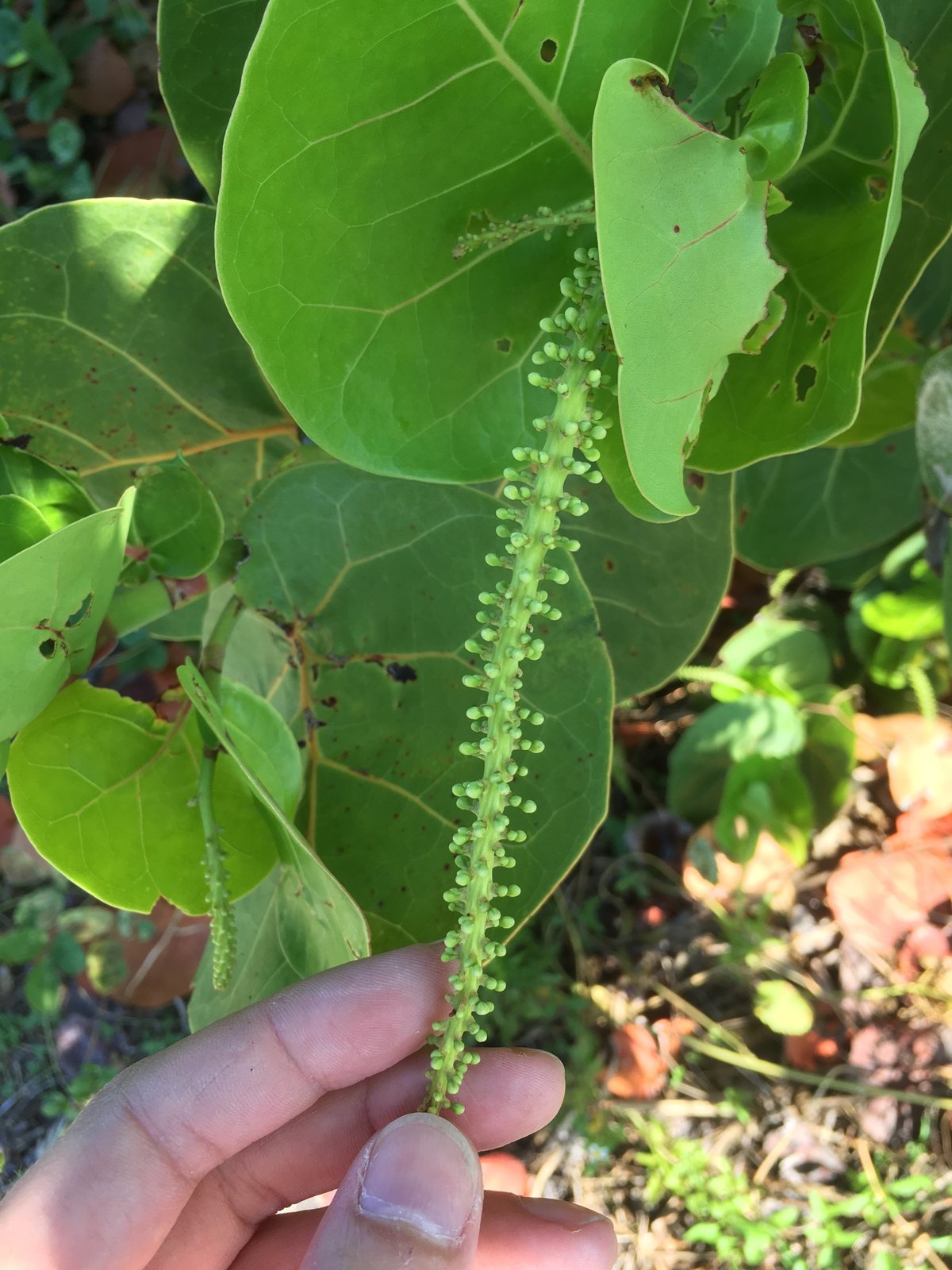
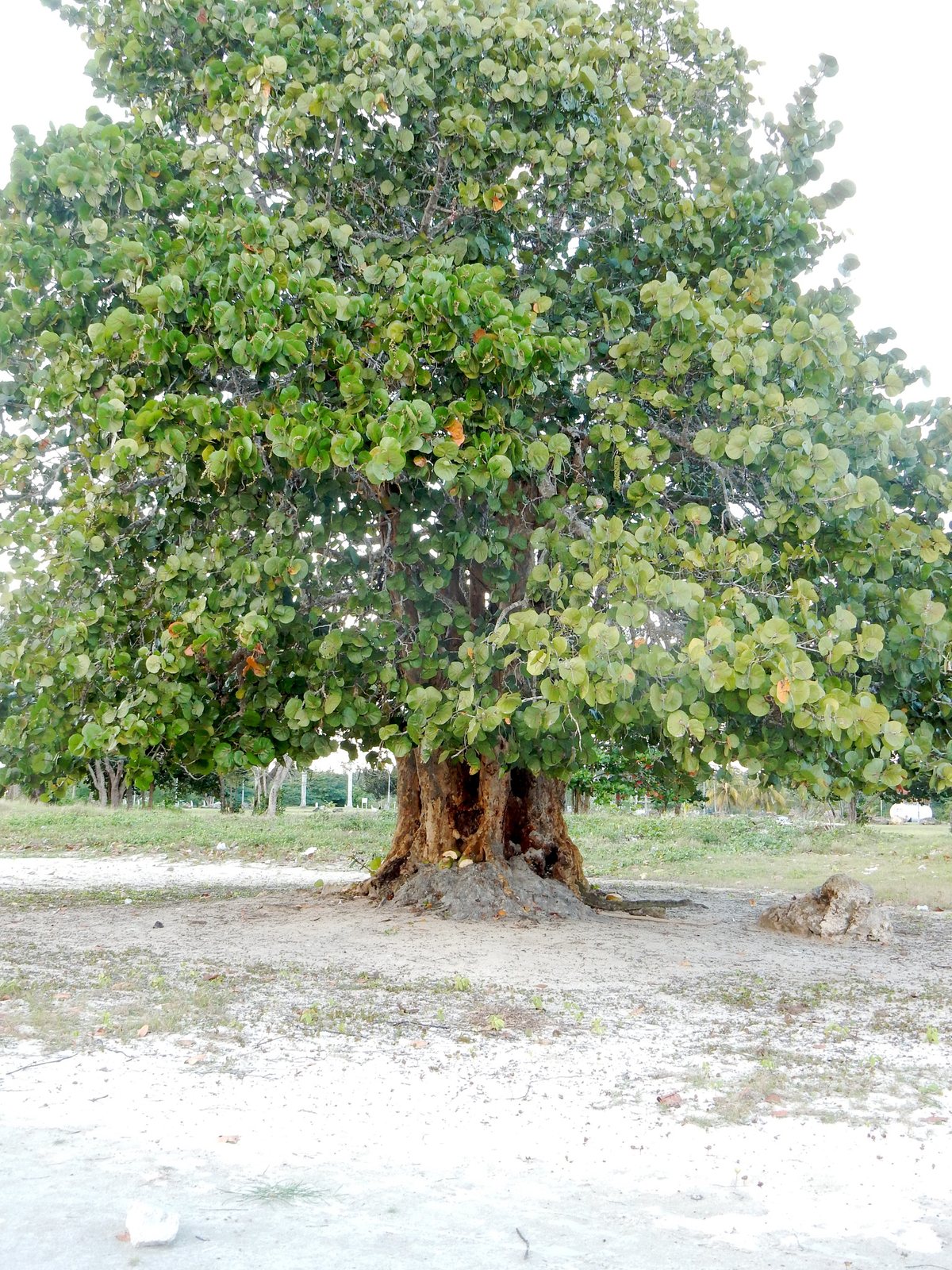
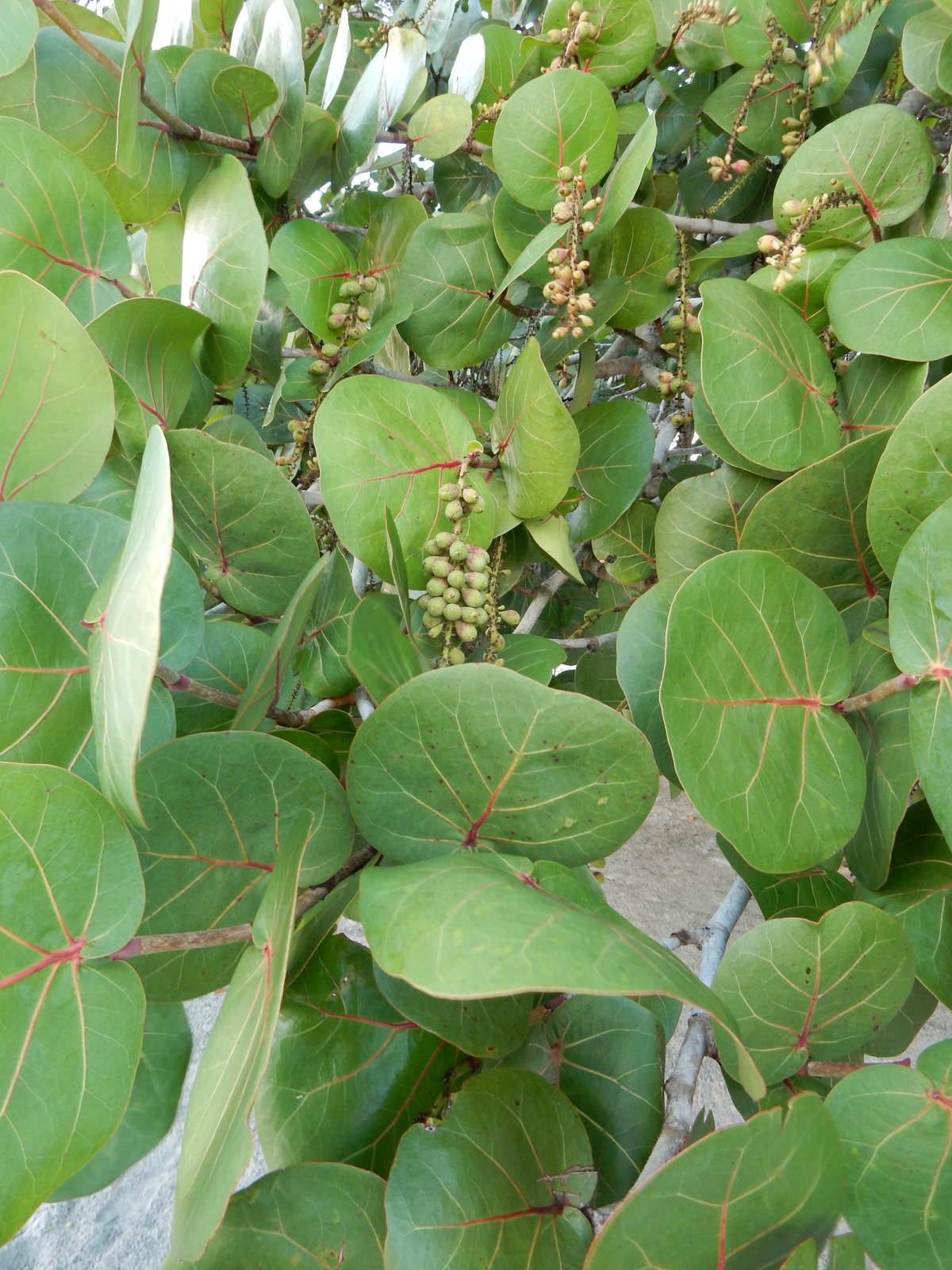
Sea grape is a tropical coastal evergreen grown for its large, rounded leaves, spreading branches and tolerance of salt spray. It makes a substantial screening shrub or small tree in frost-free gardens; in the United Kingdom, Canada and colder parts of the United States and Australia, grow it in a container that can overwinter under cover. Female plants can produce edible, purple fruits when a male plant is nearby.
At a glance
- Sun
- Full sun to partial shade; the densest growth and best fruiting are in full sun.
- Water
- Water regularly while establishing, then during prolonged dry spells. Established plants tolerate drought but not persistently waterlogged roots.
- Soil
- Well-drained sandy, gravelly or loamy soil; tolerates alkaline coastal soils and salt spray.
- Height
- 20-50 ft (6-15 m), often shorter and shrubbier on exposed coasts
- Spread
- 20-35 ft (6-10.7 m)
- Flowers
- Small cream-white flowers in narrow, hanging clusters, mainly in spring and summer; timing varies with climate.
- Foliage
- Evergreen. Large, leathery, almost circular leaves with prominent reddish veins. New leaves are often bronze-red, and older leaves may turn red before falling.
- Growth
- Moderate; faster with warmth and regular moisture.
- Care needed
- Low
The year at a glance
- Pollinators
- Drought tolerant
- Heat tolerant
- Wildlife
- Low allergen
| J | F | M | A | M | J | J | A | S | O | N | D | |
|---|---|---|---|---|---|---|---|---|---|---|---|---|
| Flowers | ||||||||||||
| Fruit | ||||||||||||
| Plant |
Northern hemisphere months. In Australia, shift them by six.
- Difficulty
- Hard
- Toughness
- Needs looking after
Will it suit your garden?
Pick your zone, country, light and whether you have pets.
Full sun is 6 or more hours of direct sun a day, part shade 3 to 6 hours, shade under 3.
How it grows
Planting day
7 ft (2 m)
After 1 year
8 ft (2.5 m)
After 2 years
10 ft (3.1 m)
After 3 years
12 ft (3.6 m)
After 5 years
15 ft (4.7 m)
About 16 years to full size.
From a typical nursery size, at an average rate for this kind of plant. A rule of thumb, not a forecast.
Good to know
- Cats and dogs
- Safe
- Native to
- the US
- Invasive in
- Australia
- Growth rate
- Fast
Care
Jobs through the year
- WaterApr–May, Sep–Oct, every 14 days
- For established outdoor plants in suitable climates, water only when dry; temperate containers need closer checks.
- WaterJun–Aug, every 7 days
- Deep-water established outdoor plants during dry spells; check containers and young plants more frequently.
- WaterJan–Mar, Nov–Dec, every 14 days
- Check overwintering containers and water when the upper soil dries; never leave roots standing in water.
- FeedApr–May
- Feed container plants lightly; feed outdoor plants only if growth is weak.
- PruneApr–May
- Remove dead or crossing branches once healthy growth is evident; avoid hard shearing if fruit is wanted.
- MulchMay–Jun
- Refresh root-zone mulch, keeping it away from the trunk.
- ProtectJan–May, Sep–Dec
- Grow in a movable container; shelter brightly above 10°C before cold nights and return outdoors only in warm weather.
- Plant in freely draining soil with enough space for the broad mature crown.
- Water deeply during establishment, allowing the surface soil to dry between waterings.
- Mulch the root area, keeping mulch clear of the trunk.
- Feed lightly in spring only if growth is weak or a container plant needs nutrients; avoid heavy nitrogen feeding.
- Move containers into a bright, frost-free space before cold weather, ideally keeping temperatures above 50°F (10°C).
- If you want fruit, obtain a known female plant and a male pollinator; seedlings cannot be reliably sexed before flowering.
Pruning. Prune in late winter or early spring, after any risk of cold damage, removing dead, crossing or poorly attached branches. Train a young plant to a few well-spaced main stems or one trunk; avoid repeated hard shearing if you want flowers and fruit.
Through the year
- Late winter
- Inspect branches and remove dead or damaged wood once the risk of cold injury has passed.
- Spring
- Plant or repot as temperatures rise; refresh mulch and feed container plants lightly.
- Late spring
- Check new leaves for scale insects and distorted growth, and inspect flowering plants for pollinator activity.
- Summer
- Water young plants deeply during dry weather and check containers frequently.
- Late summer
- Pick fruit only when fully purple and soft; remove fallen fruit from paths.
- Autumn
- Bring container plants under cover before nights become cold.
- Winter
- Keep sheltered container plants in bright light and reduce watering without letting the root ball dry out completely.
In the garden
- Use as a broad coastal screen or windbreak where salt spray limits other trees.
- Grow as a specimen tree beside an open lawn or terrace, allowing room for its spreading canopy.
- Combine with palms and low coastal groundcovers for contrasting leaf shapes in tropical gardens.
- Keep a young plant in a large container in a sheltered courtyard, with frost-free winter accommodation in cool climates.
Garden styles it suits: Coastal, Tropical, Modern tropical, Architectural minimal, Florida subtropical and Caribbean.
Plant it with: Sabal palm, Saw palmetto, Coontie, Railroad vine, Beach sunflower and Muhly grass.
Wildlife: Flowers attract bees and other insects. Birds and other wildlife eat the ripe fruit, and dense branches provide shelter.
Problems to watch for
- Cold injury causes scorched leaves and branch dieback: protect container plants before cold nights and wait until warm weather reveals living wood before pruning.
- Root rot can follow waterlogging: improve drainage and allow the upper soil to dry between waterings.
- Scale insects can cause sticky honeydew and black sooty mould: treat accessible infestations with horticultural oil according to the label, avoiding hot sun.
- Leaf spots occur in humid conditions: clear fallen affected leaves, avoid wetting foliage unnecessarily and improve airflow; minor spotting rarely needs treatment.
Safety
Ripe fruit pulp is edible to people, although each fruit contains a large, hard seed. Sea grape is not known to be toxic to cats, dogs or horses, but reliable species-specific safety information is limited; do not encourage pets or livestock to eat the leaves, bark or seeds.
Where it spreads. Reported as an environmental weed in parts of Queensland, Australia, where it can escape cultivation in coastal habitats. Check local guidance before planting near natural coastal vegetation.
Easily confused with
Pigeon plum (Coccoloba diversifolia)
Its leaves are smaller and oval rather than broad and almost circular, and its fruits do not form the same conspicuous long, grape-like strings.
Autograph tree (Clusia rosea)
It has thick oval leaves in opposite pairs and large pinkish-white flowers; sea grape has alternate, round leaves and tiny flowers in slender clusters.
The name
The common name refers to its coastal habitat and grape-like fruit clusters, while the Latin epithet uvifera means grape-bearing.
Propagation. Sow fresh seed after removing the fruit pulp; seedlings vary and their sex is unknown until flowering. Cuttings or air layering from a known plant preserve its sex and other characteristics.
Checked against open data
- Accepted botanical name
- Coccoloba uvifera
- In the US and Canada
- Native in the lower 48 states, Puerto Rico and US Virgin Islands. Introduced in Hawaii and Pacific Basin.
- Native range
- Aruba, Bahamas, Belize, Bermuda, Cayman Is., Colombia, Costa Rica, Cuba, Dominican Republic, Ecuador, El Salvador and Florida.
- Measured
- Soil pH 5 to 8. Average height 762 cm.
Sources: GBIF (CC BY 4.0), USDA PLANTS and Trefle (CC BY 4.0). The care and design notes are LandscapeGPT's own.
See it in your own yard.
Upload a photo of your yard and see it redesigned with plants that suit your climate, each checked against your zone.