Swiss cheese plant
Monstera deliciosa. Family Araceae. Climber.
Also called Split-leaf philodendron, Mexican breadfruit, Fruit salad plant.
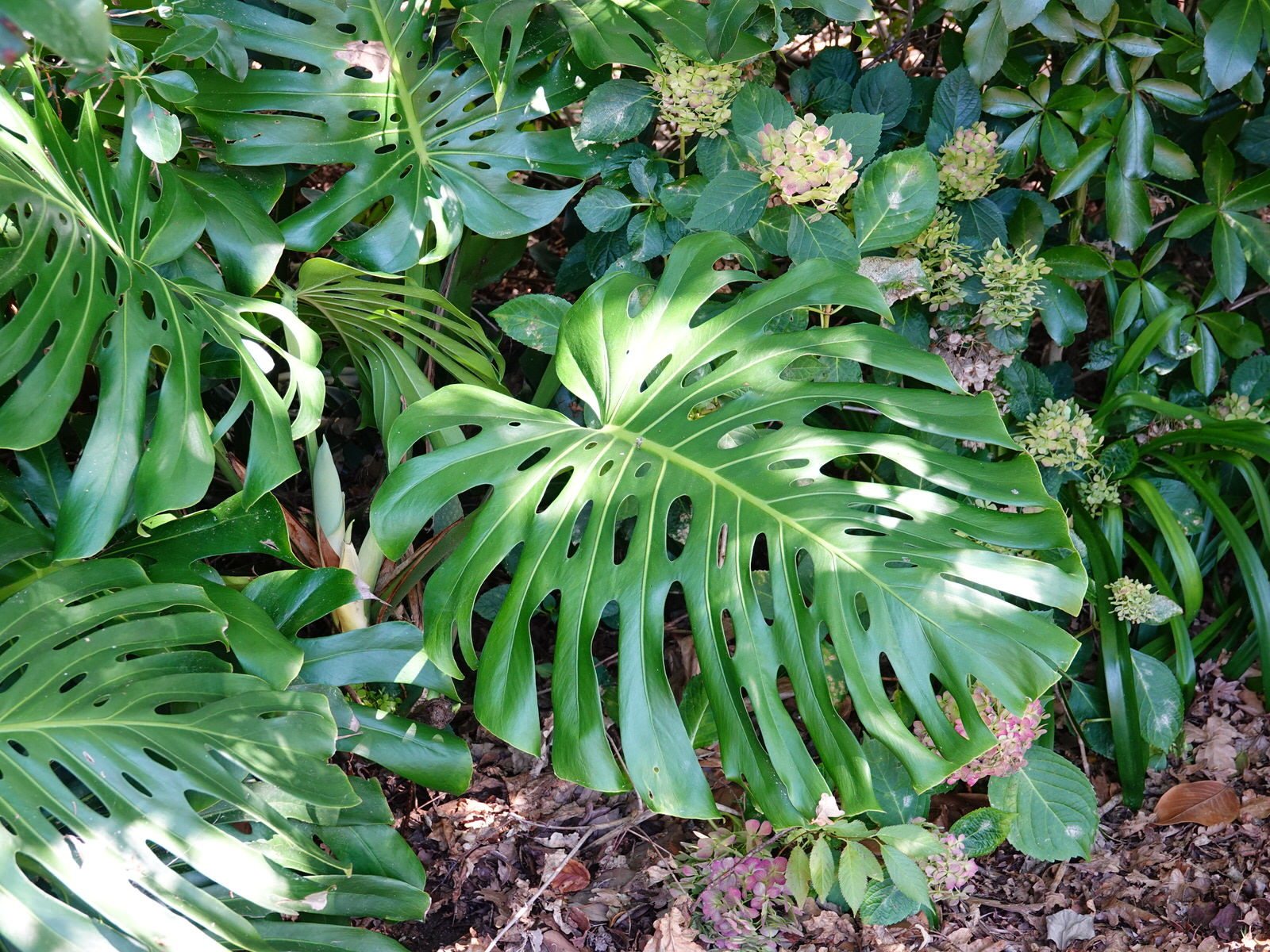
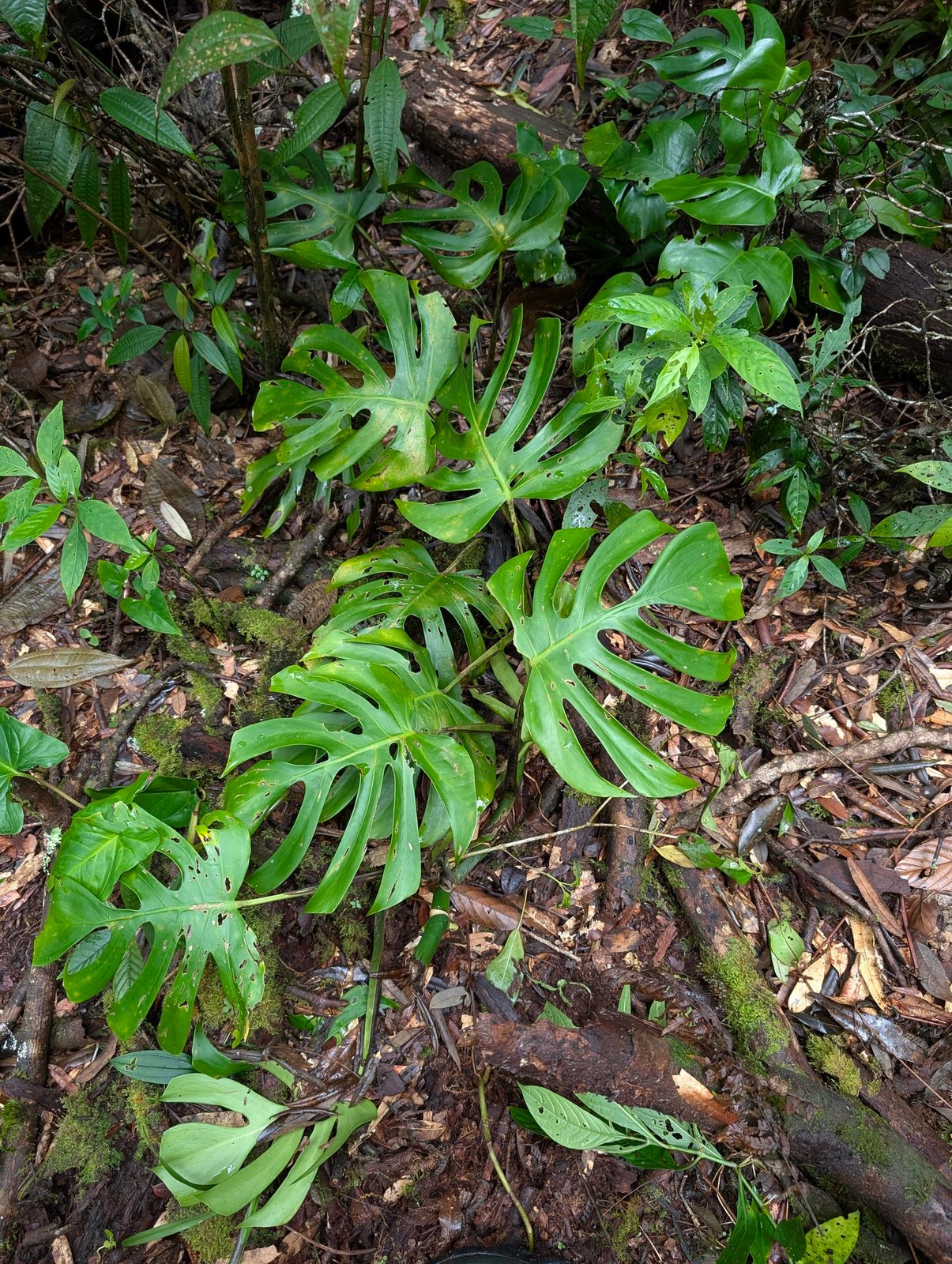
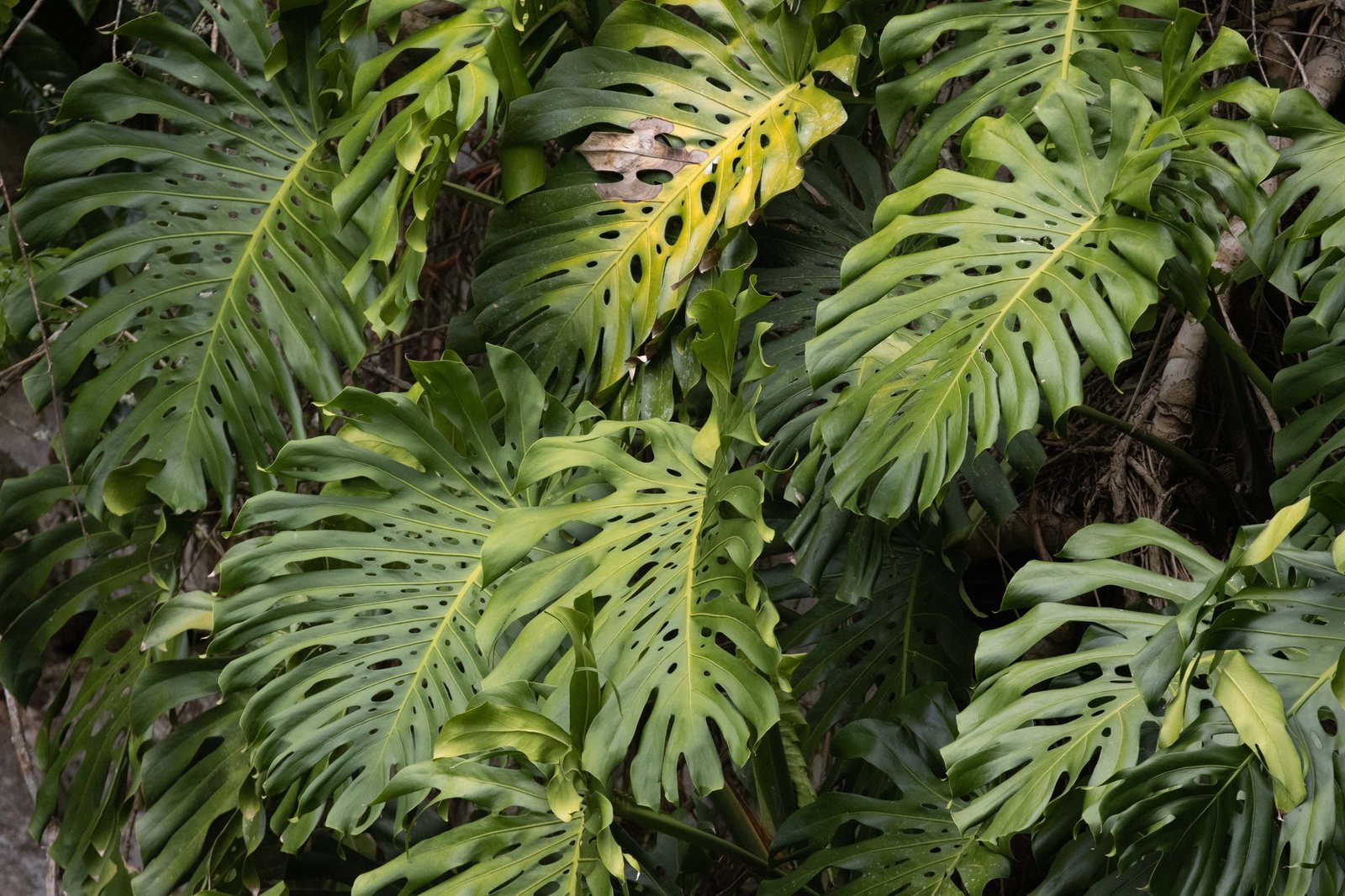
Monstera deliciosa is an evergreen tropical climber grown for its large, glossy leaves, which develop deep splits and enclosed holes as the plant matures. Grow it outdoors only in frost-free gardens; elsewhere, keep it as a houseplant or move a container outdoors for the warm season.
At a glance
- Sun
- Bright, indirect light indoors; sheltered partial shade outdoors. Avoid strong afternoon sun, especially on plants moved outside.
- Water
- Water thoroughly when the top 1-2 in (2.5-5 cm) of compost feels dry, then let excess water drain away. Water less in winter.
- Soil
- A loose, organic, well-drained potting mix or humus-rich garden soil. Avoid compacted soil and containers that retain standing water.
- Height
- 10-20 ft (3-6 m) with support in cultivation; potentially 60 ft (18 m) or more climbing trees in tropical conditions.
- Spread
- 3-8 ft (0.9-2.4 m), depending on maturity and training.
- Foliage
- Evergreen. Large, leathery, dark-green leaves with a heart-shaped outline. Young leaves are usually entire; mature leaves develop deep marginal cuts and internal holes. Thick aerial roots help the stems climb.
- Growth
- Moderate to fast in warm, bright conditions; slow in cool rooms or low light.
- Care needed
- Medium
The year at a glance
- Heat tolerant
- Low allergen
| J | F | M | A | M | J | J | A | S | O | N | D | |
|---|---|---|---|---|---|---|---|---|---|---|---|---|
| Plant |
Northern hemisphere months. In Australia, shift them by six.
- Difficulty
- Easy
- Toughness
- Fairly tough
Will it suit your garden?
Pick your zone, country, light and whether you have pets.
Full sun is 6 or more hours of direct sun a day, part shade 3 to 6 hours, shade under 3.
How it grows
Planting day
2 ft (0.6 m)
After 1 year
3 ft (0.9 m)
After 2 years
4 ft (1.2 m)
After 3 years
5 ft (1.5 m)
After 5 years
6 ft (1.8 m)
full size
About 4 years to full size.
From a typical nursery size, at an average rate for this kind of plant. A rule of thumb, not a forecast.
Good to know
- Cats and dogs
- Toxic
- Invasive in
- the US
- In the garden
- Spreads vigorously: plan to contain it.
- Growth rate
- Moderate
Care
Jobs through the year
- WaterApr–May, Sep–Oct, every 10 days
- Grow in a container here; water when the top 2.5–5 cm of compost dries and empty the saucer.
- WaterJun–Aug, every 7 days
- Water thoroughly when the top 2.5–5 cm dries; check outdoor pots more often in heat.
- WaterJan–Mar, Nov–Dec, every 14 days
- Check indoor compost and water only when the top 2.5–5 cm has dried.
- FeedApr–Aug, every 30 days
- Apply balanced container fertilizer at the label rate while actively growing.
- PruneApr–Jun
- Wear gloves; shorten overlong stems above a node and remove dead leaves at their bases.
- ProtectJun
- If moving outdoors, wait for nights above 10°C and acclimatize to sheltered shade.
- ProtectSep
- Inspect for pests and bring outdoor pots indoors before nights fall below 10°C.
- ProtectJan–May, Oct–Dec
- Keep indoors in bright indirect light, away from cold draughts and drying heater vents.
- Use a pot with drainage holes and empty the saucer after watering.
- Provide a sturdy climbing pole or trellis, securing stems loosely without tying the leaf stalks.
- Feed container plants monthly at the label rate during active spring and summer growth.
- Repot in spring when roots crowd the container, choosing a pot only slightly larger.
- Wipe dusty leaves with a damp cloth and keep the plant away from drying heater vents.
- Acclimatise plants gradually to outdoor shade and bring them indoors before nights fall below 50°F (10°C).
Pruning. In spring or early summer, shorten overlong stems just above a node and remove dead or damaged leaves at their bases. Wear gloves to avoid contact with irritating sap; guide aerial roots towards the support or pot rather than routinely cutting them off.
Through the year
- Spring
- Check roots and repot if crowded; renew or strengthen the climbing support.
- Spring
- Prune overlong stems and take node-bearing cuttings as active growth resumes.
- Late spring
- Move container plants outdoors only once nights stay above 50°F (10°C), introducing them gradually to sheltered shade.
- Summer
- Check moisture regularly, feed monthly and tie new growth loosely to its support.
- Early autumn
- In cool climates, inspect for pests and bring outdoor containers inside before nights become cold.
- Winter
- Reduce watering and pause feeding if growth slows; provide the brightest indirect light available.
In the garden
- Use a large container as a bold foliage feature in a bright room, conservatory or frost-free courtyard.
- Train it up a substantial support to create vertical greenery in a sheltered tropical garden.
- Combine its broad, divided leaves with fine-textured ferns and palms for contrast in partial shade.
- Place a container on a shaded summer terrace, allowing room for the leaves without obstructing paths.
Garden styles it suits: Modern tropical, Mid-century modern, Architectural minimal, Tropical, Balinese and Brazilian tropical modernism.
Plant it with: Cast-iron plant, Bird's nest fern, Parlour palm, Lady palm and Bromeliads.
Wildlife: Mature outdoor plants can provide shelter for small animals, but this is not a dependable pollinator plant in temperate gardens. Indoor specimens offer little wildlife value.
Problems to watch for
- Yellowing leaves and soft, dark roots: check for waterlogging, remove rotten roots and repot into an airy mix with free drainage.
- Mealybugs or scale insects: isolate the plant, remove visible pests and use a labelled treatment suitable for the growing location; repeat as directed.
- Spider mites in dry indoor conditions: wash leaf undersides and use insecticidal soap where labelled, repeating treatment as directed.
- Bleached or brown patches after moving outdoors: protect from direct sun and acclimatise gradually; damaged tissue will not turn green again.
Safety
Leaves, stems, roots and unripe fruit contain irritating calcium oxalate crystals and are toxic if chewed by cats, dogs or people; keep them away from horses as well. Chewing can cause immediate mouth pain, drooling, swelling and difficulty swallowing; sap can irritate skin and eyes. Severe swelling needs urgent medical or veterinary attention. Fully ripe fruit pulp is edible, but unripe portions can cause intense irritation, so do not eat fruit unless you can reliably judge its ripeness.
Where it spreads. Reported as invasive in Hawaii, where it can escape cultivation and spread vegetatively in moist tropical vegetation. Do not dump stems or rooted garden waste in bushland or other natural areas.
Easily confused with
Adanson's monstera (Monstera adansonii)
Usually has smaller, thinner leaves with numerous enclosed holes; the leaf margins generally remain intact rather than developing the deep cuts of mature Monstera deliciosa.
Mini monstera (Rhaphidophora tetrasperma)
Has much smaller leaves with deep cuts from the edges but usually no enclosed holes; it is a separate genus.
Tree philodendron (Thaumatophyllum bipinnatifidum)
Forms a self-supporting, trunk-like base with deeply lobed leaves but no enclosed leaf holes, rather than climbing with long, node-bearing stems.
The name
Monstera refers to the unusually perforated leaves, deliciosa means delicious in reference to the ripe fruit, and Swiss cheese plant describes the holes in mature foliage.
Propagation. Take stem cuttings in spring or summer, each with at least one node and preferably an aerial root, and root them in an airy, lightly moist medium or water. A leaf and stalk without a stem node will not produce a new climbing shoot. Air layering is useful for larger stems.
Checked against open data
- Accepted botanical name
- Monstera deliciosa
- In the US and Canada
- Introduced in the lower 48 states, Puerto Rico and US Virgin Islands.
- Native range
- Guatemala, Mexico Gulf, Mexico Southeast and Mexico Southwest.
Sources: GBIF (CC BY 4.0), USDA PLANTS and Trefle (CC BY 4.0). The care and design notes are LandscapeGPT's own.
See it in your own yard.
Upload a photo of your yard and see it redesigned with plants that suit your climate, each checked against your zone.