Coast redwood
Sequoia sempervirens. Family Cupressaceae. Tree.
Also called Coastal redwood, California redwood.
Coast redwood is an enormous, long-lived evergreen with a straight trunk, soft green foliage and thick, fibrous reddish bark. Gardeners grow it for its height and woodland character in large grounds with mild temperatures and dependable moisture; it is unsuitable for most small gardens.
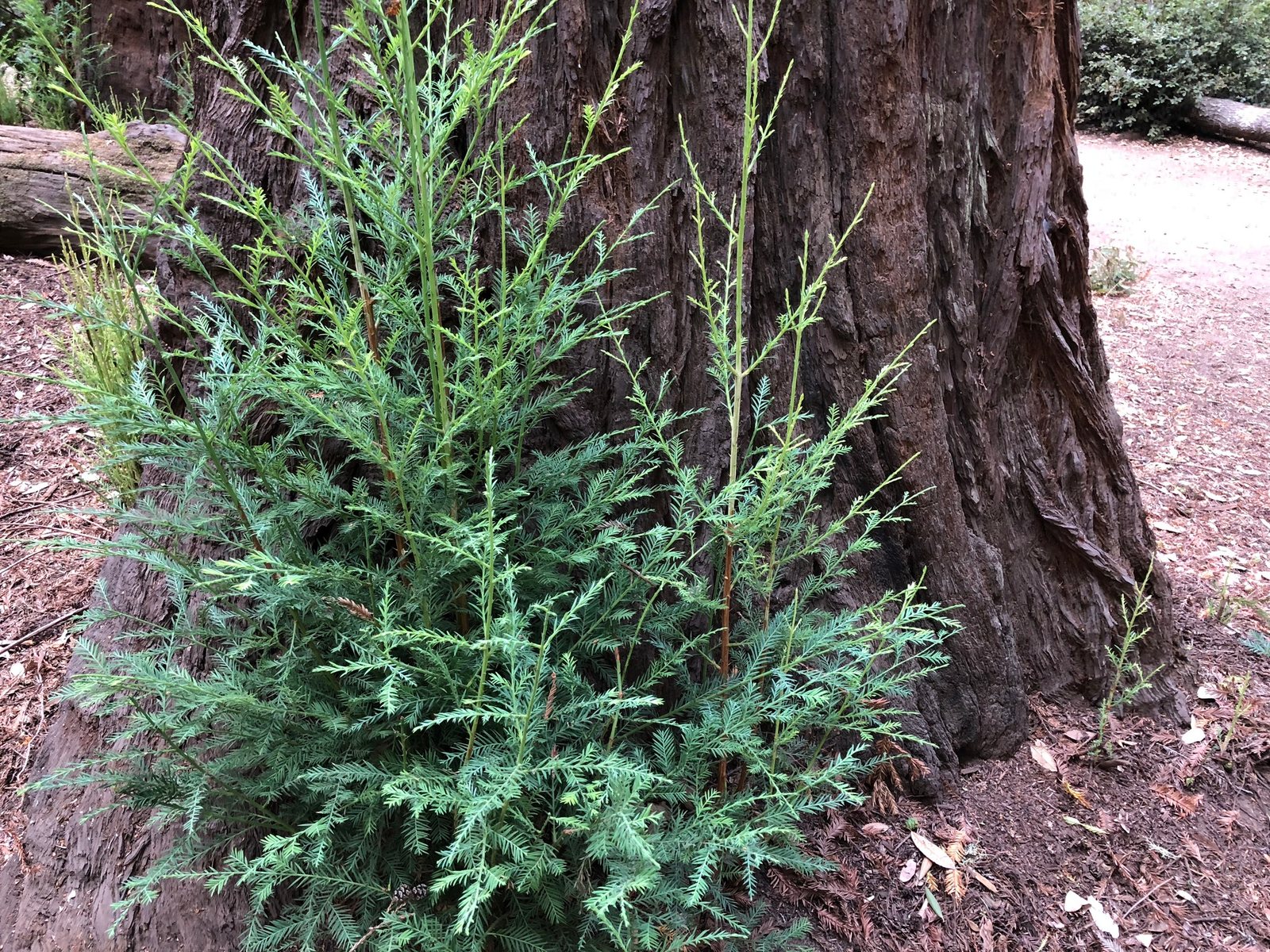
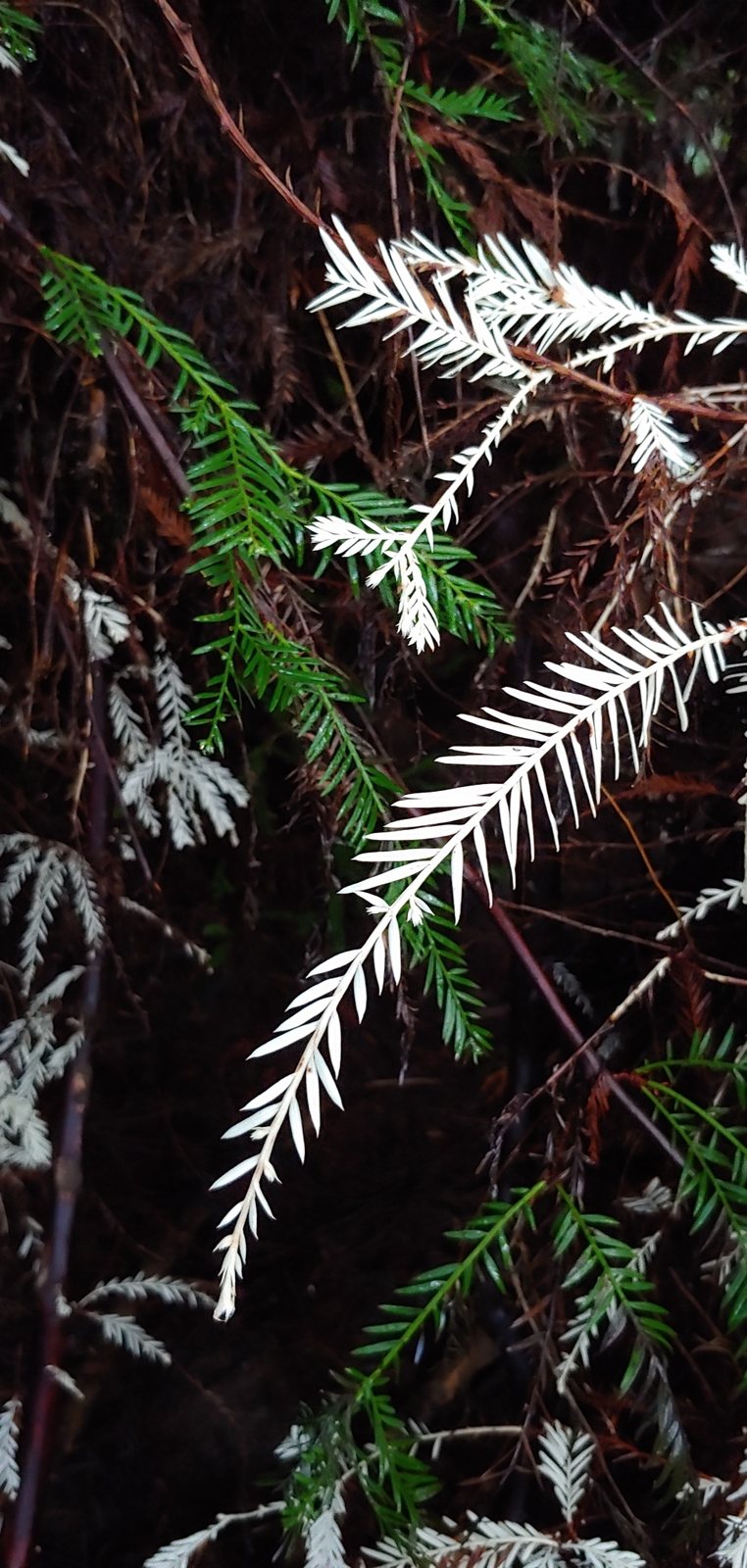
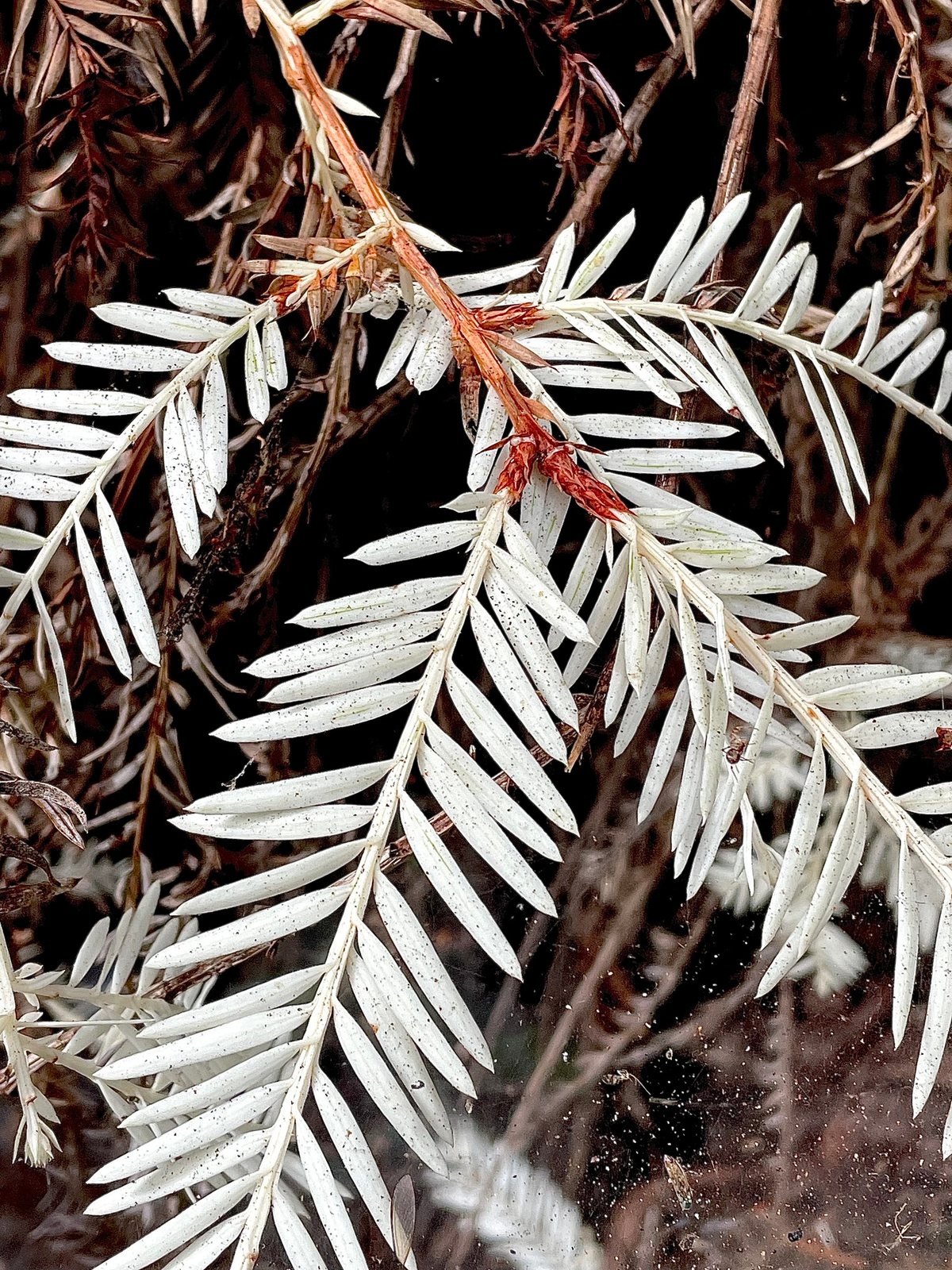
At a glance
- Sun
- Full sun to partial shade; shelter young trees from cold, drying winds.
- Water
- Needs dependable moisture, especially while establishing and during dry summers. Best in cool, humid climates; hot, dry sites require substantial irrigation.
- Soil
- Deep, moist but well-drained soil, preferably slightly acidic. Avoid shallow, compacted, waterlogged or strongly alkaline ground.
- Height
- 70-100 ft (21-30 m) in many planted settings; eventually over 200 ft (61 m) on favourable sites
- Spread
- 20-40 ft (6-12 m), sometimes wider with age
- Foliage
- Evergreen, mostly flat, soft, dark green needles with pale bands beneath, arranged in two ranks on shaded shoots; foliage on exposed upper shoots is shorter and more scale-like. Small woody cones turn brown.
- Growth
- Fast once established, often 2-3 ft (0.6-0.9 m) a year with adequate moisture.
- Care needed
- Medium
The year at a glance
- Wildlife
| J | F | M | A | M | J | J | A | S | O | N | D | |
|---|---|---|---|---|---|---|---|---|---|---|---|---|
| Fruit | ||||||||||||
| Plant |
Northern hemisphere months. In Australia, shift them by six.
- Difficulty
- Moderate
- Toughness
- Fairly tough
Will it suit your garden?
Pick your zone, country, light and whether you have pets.
Full sun is 6 or more hours of direct sun a day, part shade 3 to 6 hours, shade under 3.
How it grows
Planting day
10 ft (3.1 m)
After 1 year
16 ft (4.8 m)
After 2 years
21 ft (6.5 m)
After 3 years
27 ft (8.2 m)
After 5 years
38 ft (11.7 m)
About 13 years to full size.
From a typical nursery size, at an average rate for this kind of plant. A rule of thumb, not a forecast.
Good to know
- Cats and dogs
- Safe
- Growth rate
- Fast
Care
Jobs through the year
- WaterApr–May, Sep–Oct, every 14 days
- Deep-water established trees when rainfall is insufficient; young trees need more frequent checks.
- WaterJun–Aug, every 7 days
- Water deeply in dry weather to maintain dependable moisture; large trees need substantial irrigation.
- MulchApr–May
- Maintain 5–10 cm of organic mulch over roots, keeping the trunk base clear.
- PruneFeb–Mar
- Remove damaged or poorly attached branches lightly; retain one leader and never top.
- ProtectJan–Mar, Nov–Dec
- Shelter young trees from drying winds; zone 6 sites are generally too cold.
- Plant only where there is room for a very tall tree and a wide, shallow root system, well away from buildings, paving and overhead services.
- Water deeply during dry weather for the first several growing seasons; continue watering established trees during prolonged drought.
- Keep a 2-4 in (5-10 cm) layer of organic mulch over the root area, leaving the trunk base clear.
- Avoid digging, paving or compacting soil beneath the canopy.
- Do not feed routinely; investigate poor growth and soil conditions before applying fertiliser.
- Stake only if the root ball moves in wind, and remove supports once the tree is securely rooted.
Pruning. Prune lightly in late winter or early spring to remove dead, damaged or poorly attached branches, retaining a single main leader. Never top the tree; use a qualified arborist for large branches or work at height.
Through the year
- Spring
- Plant container-grown trees once the ground is workable, particularly in colder districts.
- Late winter
- Check the leader and branch structure; arrange any necessary corrective pruning while the tree is young.
- Late spring
- Refresh mulch and remove grass competing around young trees without disturbing their roots.
- Summer
- Check moisture beneath the mulch and water deeply during dry spells; watch for browning shoot tips.
- Autumn
- Plant in mild climates while soil remains warm and rainfall is reliable.
- Winter
- Check young trees after storms and loosen tight ties; protect recently planted specimens from drying winds.
In the garden
- Use as a landmark specimen in a large lawn or estate landscape, allowing for its eventual scale.
- Plant a widely spaced grove on extensive grounds for tall trunks, filtered shade and a woodland atmosphere.
- Combine with ferns, redwood sorrel and other shade plants in a moist woodland garden.
- Use as a tall evergreen backdrop in spacious coastal gardens with mild, humid conditions, away from direct salt spray.
Garden styles it suits: Woodland, Pacific Northwest woodland, California native, Grand estate, Architectural minimal and Green on green.
Plant it with: Western sword fern, Redwood sorrel, Vine maple, Salal and Western azalea.
Wildlife: Provides evergreen shelter and nesting sites for birds, with bark and older trees offering habitat for invertebrates. Fallen needles and woody debris support woodland organisms where they can be left safely.
Problems to watch for
- Drought and heat scorch: browning needles and shoot tips often indicate moisture stress. Water deeply, maintain mulch and avoid hot, exposed planting sites.
- Root rot: persistently saturated soil can cause decline. Improve drainage before planting and avoid frequent watering of already wet ground.
- Canker and branch dieback: drought-stressed trees are more vulnerable. Correct moisture stress, remove affected branches and seek an arborist's diagnosis if dieback spreads.
- Root and space conflicts: shallow roots can lift nearby paving, and basal shoots may form around the trunk. Allow generous space from the outset and remove unwanted shoots while small.
Safety
Not known to be toxic to cats, dogs, horses or people. Needles, bark and cones are not food and may cause digestive upset if eaten; wood dust can irritate skin and airways.
Easily confused with
Giant sequoia (Sequoiadendron giganteum)
Has short, pointed, awl-shaped leaves arranged around the shoots rather than the mostly flat, two-ranked needles of coast redwood; its cones are substantially larger.
Dawn redwood (Metasequoia glyptostroboides)
Loses its foliage in autumn and has opposite leaves and branchlets; coast redwood is evergreen with alternate leaves and branchlets.
Bald cypress (Taxodium distichum)
Usually sheds its soft needles in autumn and may produce woody root knees in wet ground; coast redwood retains its foliage and does not form knees.
The name
The epithet sempervirens means 'evergreen', while the common name refers to its coastal native range and reddish heartwood.
Propagation. Grow from seed, although germination can be low and variable. Cuttings from young shoots or basal sprouts can root under controlled moist conditions; shoots may also layer where they contact damp soil.
Checked against open data
- Accepted botanical name
- Sequoia sempervirens
- Native range
- California and Oregon.
- Measured
- Soil pH 5 to 7. Average height 7620 cm.
Sources: GBIF (CC BY 4.0) and Trefle (CC BY 4.0). The care and design notes are LandscapeGPT's own.
See it in your own yard.
Upload a photo of your yard and see it redesigned with plants that suit your climate, each checked against your zone.