Jojoba
Simmondsia chinensis. Family Simmondsiaceae. Shrub.
Also called Goatnut, Deer nut.
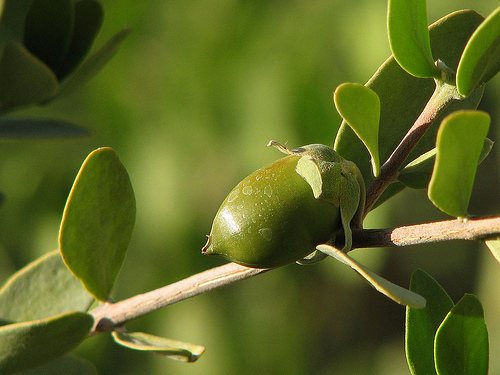
Jojoba is a long-lived evergreen shrub native to the deserts of the southwestern United States and northwestern Mexico. Gardeners grow it for its leathery grey-green foliage, drought tolerance and informal screening; its seeds yield an industrial liquid wax, not an edible oil. It suits hot, dry gardens but struggles in wet soils and cold, damp climates.
At a glance
- Sun
- Full sun; tolerates light shade but grows more loosely.
- Water
- Low once established; water young plants deeply, then allow the soil to dry between waterings.
- Soil
- Very well-drained sandy, gravelly or rocky soil; tolerates alkaline soils but not persistent waterlogging.
- Height
- 6-10 ft (1.8-3 m)
- Spread
- 6-10 ft (1.8-3 m)
- Flowers
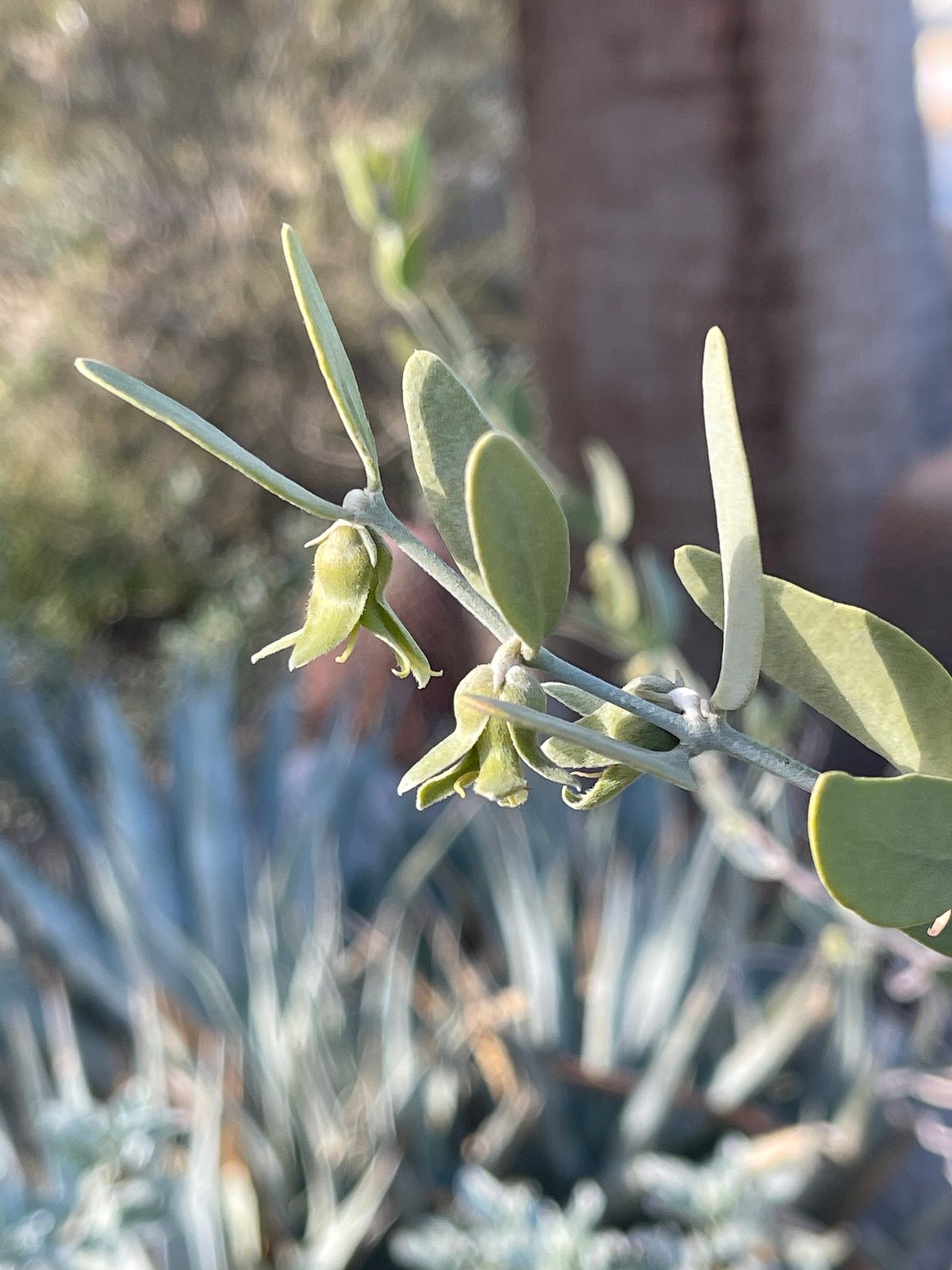
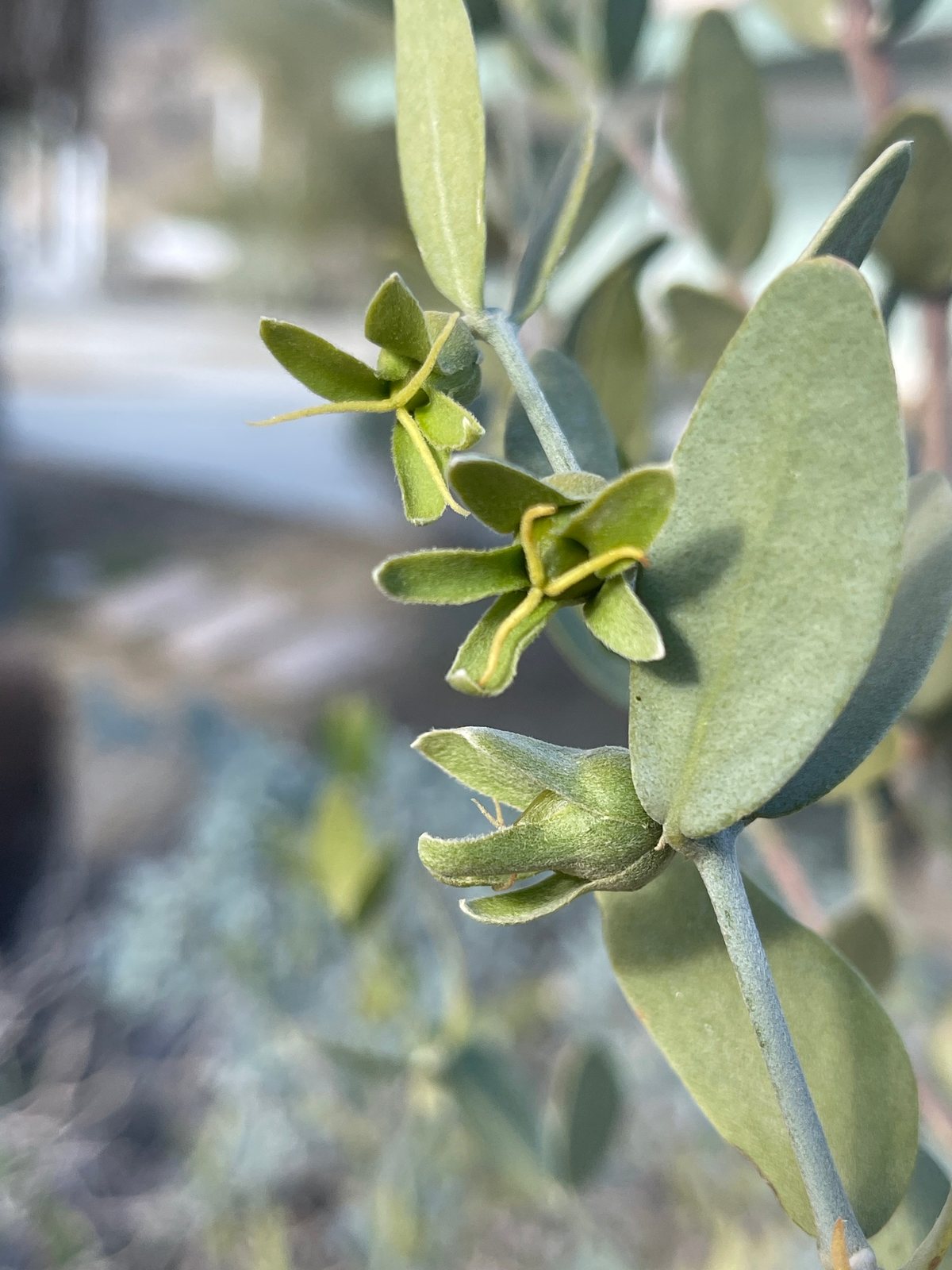
- Late winter to spring; small yellow-green flowers, with male flowers in clusters and female flowers usually solitary.
- Foliage
- Evergreen. Opposite pairs of thick, oval, grey-green leaves, often held nearly upright.
- Growth
- Slow to moderate; slower with little irrigation.
- Care needed
- Low
The year at a glance
- Drought tolerant
- Heat tolerant
- Wildlife
| J | F | M | A | M | J | J | A | S | O | N | D | |
|---|---|---|---|---|---|---|---|---|---|---|---|---|
| Flowers | ||||||||||||
| Fruit | ||||||||||||
| Plant |
Northern hemisphere months. In Australia, shift them by six.
- Difficulty
- Moderate
- Toughness
- Fairly tough
Will it suit your garden?
Pick your zone, country, light and whether you have pets.
Full sun is 6 or more hours of direct sun a day, part shade 3 to 6 hours, shade under 3.
How it grows
Planting day
1.6 ft (0.5 m)
After 1 year
2.6 ft (0.79 m)
After 2 years
4 ft (1.1 m)
After 3 years
5 ft (1.4 m)
After 5 years
6 ft (2 m)
About 7 years to full size.
From a typical nursery size, at an average rate for this kind of plant. A rule of thumb, not a forecast.
Good to know
- Cats and dogs
- Toxic
- Native to
- the US
- Growth rate
- Slow
Care
Jobs through the year
- WaterMay, Sep, every 30 days
- Water established ground plants only during drought; young plants need closer root-ball moisture checks.
- WaterJun–Aug, every 21 days
- During prolonged dry weather, soak deeply only after the root zone dries.
- WaterJan–Apr, Oct–Dec, every 30 days
- For frost-free overwintering pots only, water sparingly when soil is dry.
- MulchMay
- Use a thin gravel mulch, keeping it clear of the main stems.
- PruneMay–Jun
- After frost risk passes, remove dead or crossing branches and lightly shorten individual shoots.
- ProtectJan–Apr, Oct–Dec
- In zone 6–7, grow in a movable container and overwinter somewhere bright and frost-free.
- Plant in full sun with enough space for its broad, branching habit.
- Water deeply during establishment, letting the root zone dry between waterings; reduce irrigation as the plant becomes established.
- Avoid lawn irrigation and sites where winter rain collects around the roots.
- Use gravel mulch, keeping it clear of the main stems.
- Do not feed routinely; excess fertiliser and water encourage unnecessary soft growth.
- In cold or wet climates, grow in a freely draining container and overwinter in a bright, frost-free place.
Pruning. Prune lightly in late spring after frost danger has passed, removing dead, damaged or crossing branches. Shorten individual shoots to shape rather than repeatedly shearing the whole shrub.
Through the year
- Spring
- Plant after frost danger has passed, or in autumn where winters are mild and the soil drains freely.
- Late spring
- Remove frost-damaged growth and lightly shape established shrubs.
- Summer
- Check new plants regularly and water deeply when their root zone has dried.
- Autumn
- Reduce irrigation as temperatures fall and clear debris from around the base.
- Winter
- Protect young plants from unusual freezes and keep container plants sheltered from prolonged cold and rain.
In the garden
- Use as an informal evergreen screen in a sunny, dry boundary.
- Combine with agaves and yuccas for contrasting rounded foliage and strong architectural shapes.
- Plant in gravel gardens with dry-climate perennials, leaving room for its natural spread.
- Use in southwestern native gardens as a durable background shrub and wildlife shelter.
Garden styles it suits: Desert / xeriscape, Desert modern, Southwestern, California native, Dry gravel garden and Low-maintenance.
Plant it with: Desert willow, Red yucca, Desert marigold, Brittlebush, Parry's agave and Blackfoot daisy.
Wildlife: Provides shelter for birds and small animals. Deer and other browsing mammals may eat the foliage, and rodents take the seeds; flowers are wind-pollinated rather than a significant nectar source.
Problems to watch for
- Root rot in wet soil: improve drainage before planting, move plants out of low spots and stop frequent irrigation.
- Frost-damaged leaves and shoots: protect young plants during freezes and wait until spring to remove damaged growth.
- Poor establishment after transplanting: use young container-grown plants, disturb the roots as little as possible and water the original root ball carefully.
- No seed capsules: plants are normally male or female, and females need wind-borne pollen from a nearby male; seedlings may take several years to flower.
Safety
The seeds are not edible and contain simmondsin, which can cause harmful effects if swallowed. Keep seeds away from people, cats, dogs and horses; toxicity information for individual domestic animal species is limited. The foliage is browsed by wildlife and is not generally known to be poisonous.
Easily confused with
Olive (Olea europaea)
Olive usually has narrower, pointed leaves with distinctly silvery undersides and fleshy fruits; jojoba has broader, blunt-ended leaves and dry seed capsules.
Common box (Buxus sempervirens)
Box generally has smaller, greener leaves and denser, finer branching; jojoba has thicker grey-green leaves and a more open desert-shrub habit.
The name
The epithet chinensis means 'of China', reflecting a mistaken origin for a plant native to the southwestern United States and northwestern Mexico.
Propagation. Sow fresh seed in deep pots using a freely draining mix and warmth; seedlings develop a strong taproot and should be planted out while young. Semi-ripe cuttings can be rooted with suitable propagation conditions and preserve the sex of the parent plant, unlike seed.
Checked against open data
- Accepted botanical name
- Simmondsia chinensis
- In the US and Canada
- Native in the lower 48 states.
- Native range
- Arizona, California, Mexico Northeast, Mexico Northwest, New Mexico and Utah.
- Measured
- Soil pH 7 to 8.5. Average height 212 cm.
Sources: GBIF (CC BY 4.0), USDA PLANTS and Trefle (CC BY 4.0). The care and design notes are LandscapeGPT's own.
See it in your own yard.
Upload a photo of your yard and see it redesigned with plants that suit your climate, each checked against your zone.