Thimbleberry
Rubus parviflorus. Family Rosaceae. Shrub.
Also called Western thimbleberry.
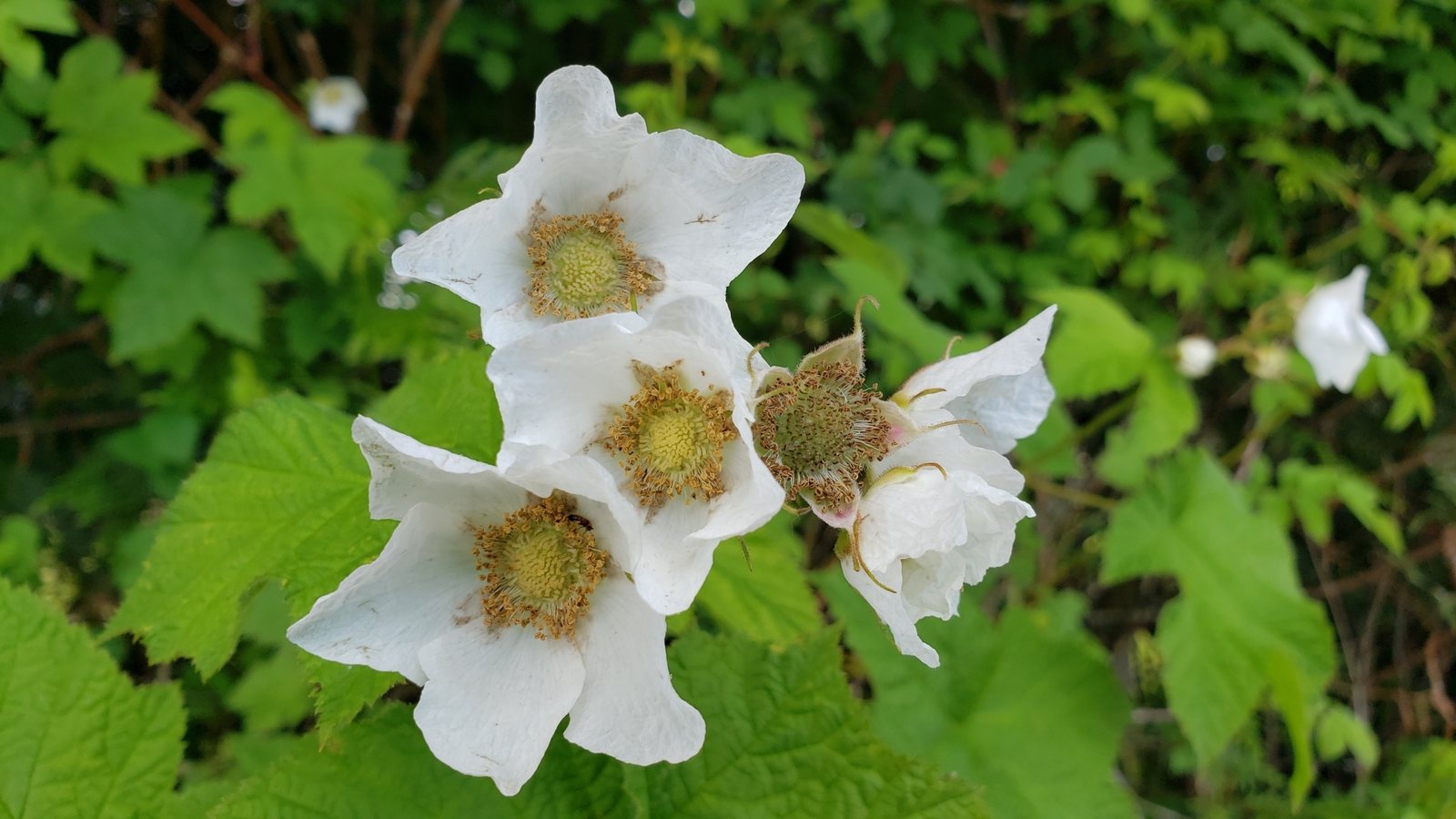
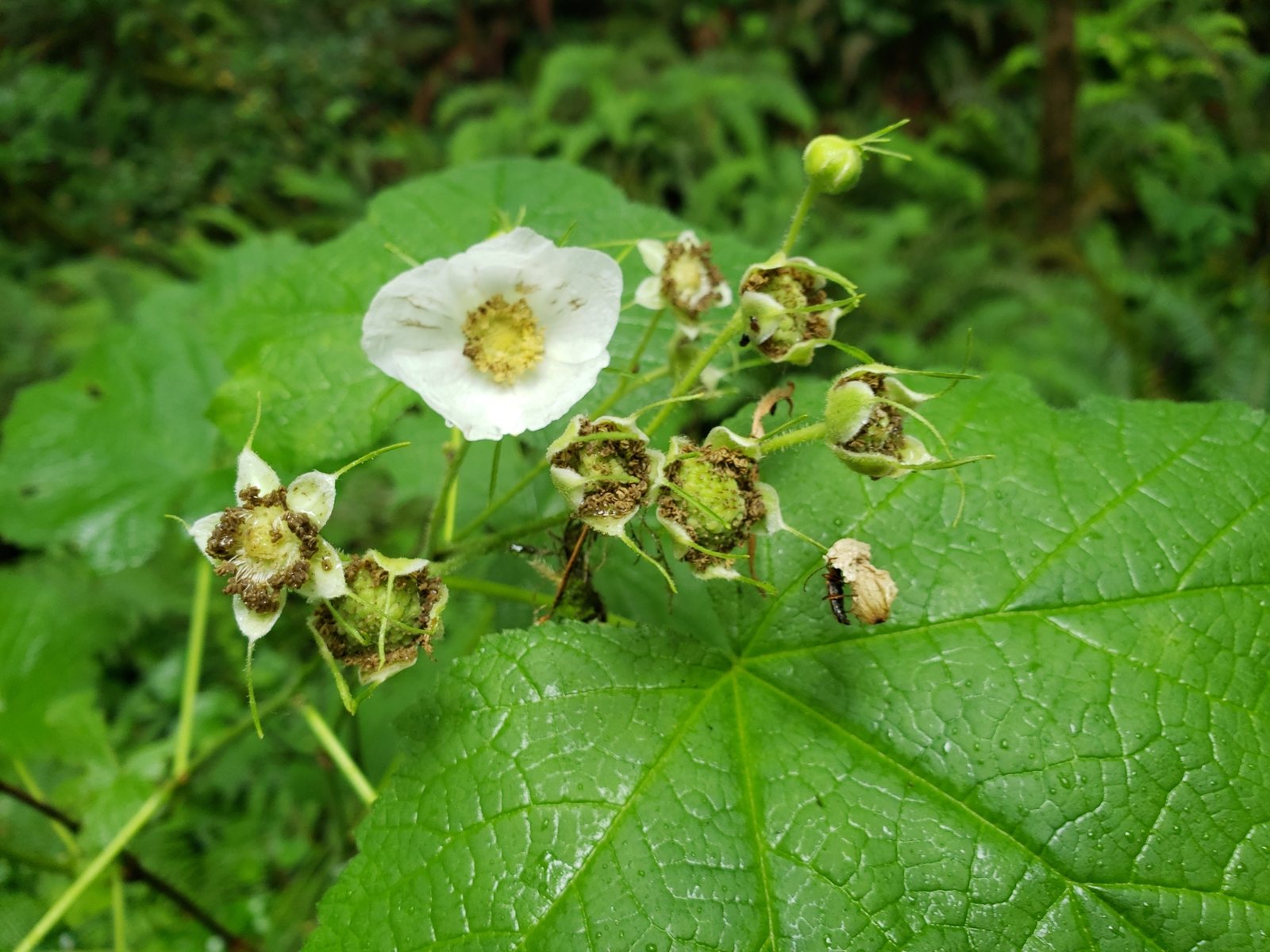
Thimbleberry is a deciduous North American shrub with thornless stems, large, soft leaves, white flowers and edible red berries. Gardeners grow it for informal woodland planting, wildlife cover and small harvests of delicate fruit, but its spreading roots need room.
At a glance
- Sun
- Partial shade to full sun; afternoon shade is helpful in hot or dry gardens.
- Water
- Moderate; keep the root zone evenly moist while establishing and during flowering and fruiting. Established plants tolerate some seasonal dryness, but fruit production suffers.
- Soil
- Humus-rich, well-drained soil that holds moisture; tolerates clay if it is not waterlogged. Slightly acidic to neutral soil is ideal.
- Height
- 3-8 ft (0.9-2.4 m)
- Spread
- 4-8 ft (1.2-2.4 m) initially; spreading colonies can become much wider.
- Flowers
- Late spring to early summer; white, five-petalled flowers in small clusters.
- Foliage
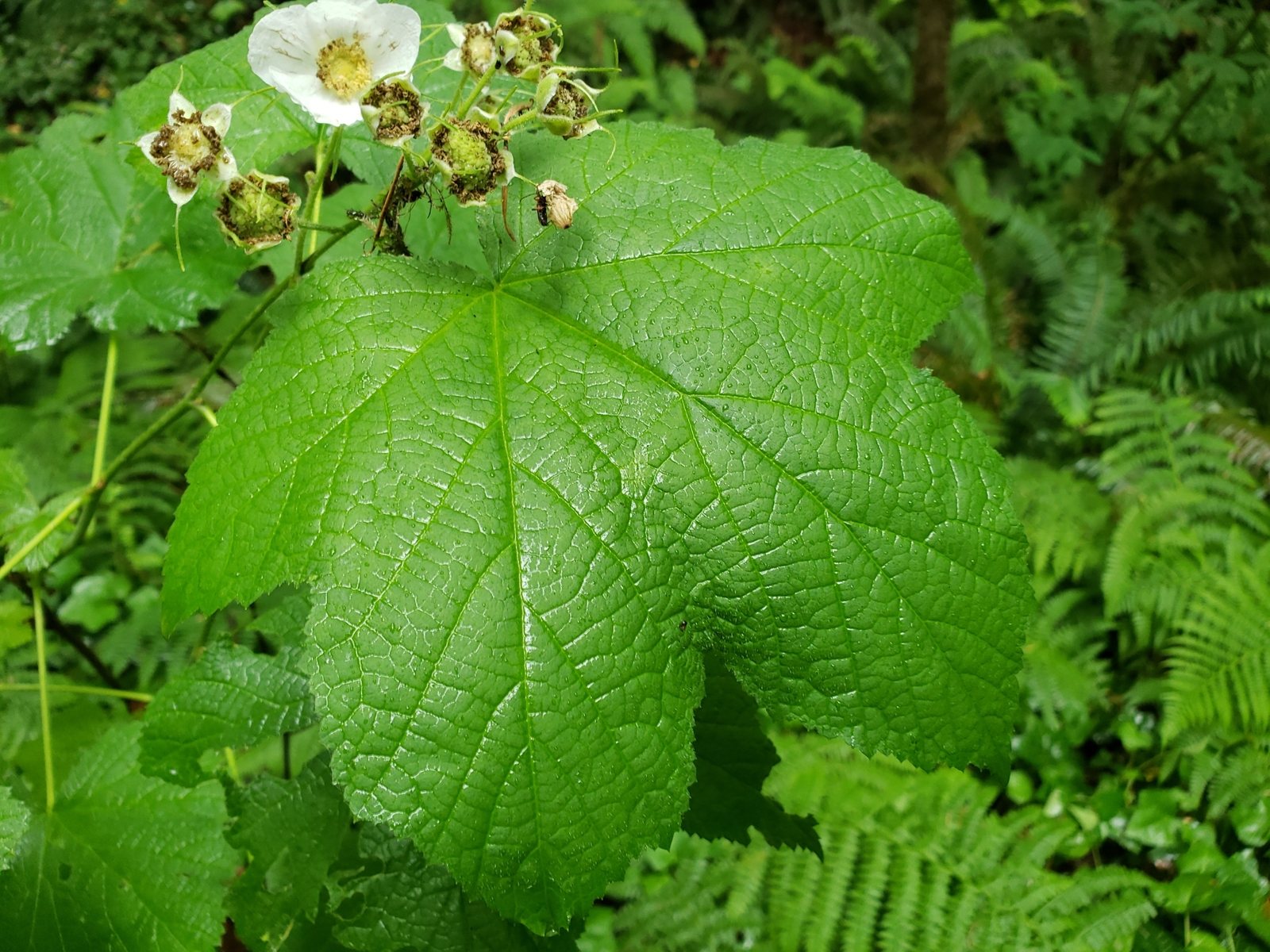
- Large, softly hairy, maple-shaped leaves with three to five lobes; usually yellow in autumn.
- Growth
- Fast once established, with vigorous underground spread.
- Care needed
- Medium
The year at a glance
- Pollinators
- Cold hardy
- Wildlife
- Low allergen
- Edible
| J | F | M | A | M | J | J | A | S | O | N | D | |
|---|---|---|---|---|---|---|---|---|---|---|---|---|
| Flowers | ||||||||||||
| Fruit | ||||||||||||
| Plant |
Northern hemisphere months. In Australia, shift them by six.
- Difficulty
- Moderate
- Toughness
- Very tough
Will it suit your garden?
Pick your zone, country, light and whether you have pets.
Full sun is 6 or more hours of direct sun a day, part shade 3 to 6 hours, shade under 3.
How it grows
Planting day
1.6 ft (0.5 m)
After 1 year
2.8 ft (0.85 m)
After 2 years
4 ft (1.2 m)
After 3 years
5 ft (1.6 m)
After 5 years
5 ft (1.7 m)
full size
About 3 years to full size.
From a typical nursery size, at an average rate for this kind of plant. A rule of thumb, not a forecast.
Good to know
- Cats and dogs
- Safe
- Native to
- the US and Canada
- In the garden
- Spreads vigorously: plan to contain it.
- Growth rate
- Fast
Care
Jobs through the year
- WaterApr, Sep–Oct, every 14 days
- Water established plants when soil is drying; young plants need more consistent moisture.
- WaterMay–Aug, every 7 days
- In dry weather, soak the established root zone to maintain moisture during flowering and fruiting.
- FeedMar–Apr
- Top-dress with compost rather than high-nitrogen fertilizer.
- MulchApr
- Apply 5–8 cm of leaf mould or composted bark, keeping stems clear.
- PruneFeb
- Remove dead or damaged canes and thin crowded growth.
- PruneMar–Apr
- Dig out unwanted suckers with their connecting roots to contain spread.
- HarvestJun–Aug
- Pick fully red, soft berries that slip off the core; eat or process promptly.
- PruneAug–Sep
- After cropping, cut fruited canes to ground level and retain healthy new canes.
- Water deeply during dry spells for the first two growing seasons and whenever fruit is developing.
- Apply 2-3 in (5-8 cm) of leaf mould or composted bark in spring, keeping it clear of the stems.
- On reasonably fertile soil, use an annual compost dressing rather than high-nitrogen fertiliser.
- Remove unwanted suckers with their attached roots before they establish beyond the planting area.
- Give plants space for air movement and avoid planting them in permanently wet ground.
Pruning. After harvest, cut canes that have fruited down to ground level, keeping healthy new canes for next year's crop. In late winter, remove dead, damaged or crowded stems.
Harvest
Pick berries in summer when they are fully red, soft and slip easily from the central core, leaving a hollow, thimble-shaped fruit. Handle gently and eat or process promptly because they crush easily; expect a first worthwhile crop about 2-3 years after planting, although yields vary considerably.
Through the year
- Autumn
- Plant while the soil is workable and moist, allowing room for a spreading colony.
- Late winter
- Remove dead or damaged canes and thin crowded growth.
- Early spring
- Lift rooted suckers for propagation and remove those spreading into unwanted areas.
- Spring
- Apply compost and renew mulch before the soil dries.
- Late spring
- Water during dry weather as flowers open and fruit begins to form.
- Summer
- Harvest ripe berries frequently and cut out spent fruiting canes after cropping.
In the garden
- Plant along a roomy woodland edge, where its broad leaves contrast with ferns.
- Use as an informal deciduous screen beneath widely spaced trees.
- Include in a food forest with currants and other shade-tolerant fruiting shrubs.
- Grow in a North American native wildlife border where suckering growth can form cover.
Garden styles it suits: Woodland, Wildlife garden, Pacific Northwest woodland, Food forest, Edible landscape and Rewilded.
Plant it with: Western sword fern, Vine maple, Red-flowering currant, Oregon grape and Goatsbeard.
Wildlife: Flowers provide pollen and nectar for insects, including native bees. Birds and mammals eat the berries, and established colonies provide shelter.
Problems to watch for
- Unwanted suckering: dig out shoots with their connecting roots and check the planting boundary each spring.
- Powdery mildew: thin crowded canes, maintain soil moisture and avoid very dry, enclosed sites.
- Leaf scorch and poor fruiting in heat or drought: provide afternoon shade, mulch and water deeply.
- Cane dieback: cut affected canes back to healthy tissue or ground level, remove the debris and improve drainage if the soil stays wet.
Safety
Not known to be toxic to people, cats, dogs or horses. The ripe berries are edible; the leaves, stems and roots are not usual foods, and reliable livestock-feeding information is limited.
Where it spreads. Spreads aggressively by underground rhizomes, particularly in moist gardens in its native western and northern United States and Canada. Allow a dedicated patch and remove unwanted suckers; vigorous garden spread does not by itself mean the species is officially listed as invasive.
Easily confused with
Purple-flowering raspberry (Rubus odoratus)
Also has thornless stems and broad, lobed leaves, but its flowers are rose-purple rather than white.
Salmonberry (Rubus spectabilis)
Usually has prickly stems, leaves divided into three leaflets and pink flowers; ripe fruit may be yellow, orange or red.
Red raspberry (Rubus idaeus)
Has compound leaves with three to five separate leaflets, usually pale beneath, rather than one broad, maple-shaped leaf; canes are commonly prickly.
The name
Thimbleberry refers to the hollow, thimble-like ripe fruit, while the Latin name parviflorus means small-flowered.
Propagation. Lift rooted suckers or divide an established clump while dormant, in autumn or early spring. Seed is slower and may need both warm and cold treatment before germination.
Checked against open data
- Accepted botanical name
- Rubus parviflorus
- In the US and Canada
- Native in Alaska, Canada and the lower 48 states.
- Native range
- Alaska, Alberta, Arizona, British Columbia, California, Colorado, Idaho, Illinois, Iowa, Mexico Northeast, Mexico Northwest and Michigan.
- Measured
- Soil pH 4.8 to 7.2. Average height 56 cm.
Sources: GBIF (CC BY 4.0), USDA PLANTS and Trefle (CC BY 4.0). The care and design notes are LandscapeGPT's own.
See it in your own yard.
Upload a photo of your yard and see it redesigned with plants that suit your climate, each checked against your zone.