Velvet mesquite
Prosopis velutina. Family Fabaceae. Tree.
Also called Arizona mesquite, Native mesquite.
Velvet mesquite is a thorny, drought-tolerant tree native to the southwestern United States and northwestern Mexico, grown for its spreading crown, light shade and finely divided foliage. It suits hot, dry gardens with room for its branches and roots; it is not reliably hardy outdoors in most of the United Kingdom or Canada.
At a glance
- Sun
- Full sun; needs summer heat for good growth.
- Water
- Low once established. Water young trees deeply, allowing the soil to dry between soakings; established trees usually need supplemental water only during prolonged drought.
- Soil
- Well-drained sandy, gravelly or loamy soil, including alkaline soil. Tolerates clay if drainage is good; avoid persistently wet ground.
- Height
- 20-30 ft (6-9 m), occasionally taller
- Spread
- 20-40 ft (6-12 m)
- Flowers
- Spring to early summer: pale yellow to greenish-yellow flowers in slender, cylindrical clusters.
- Foliage
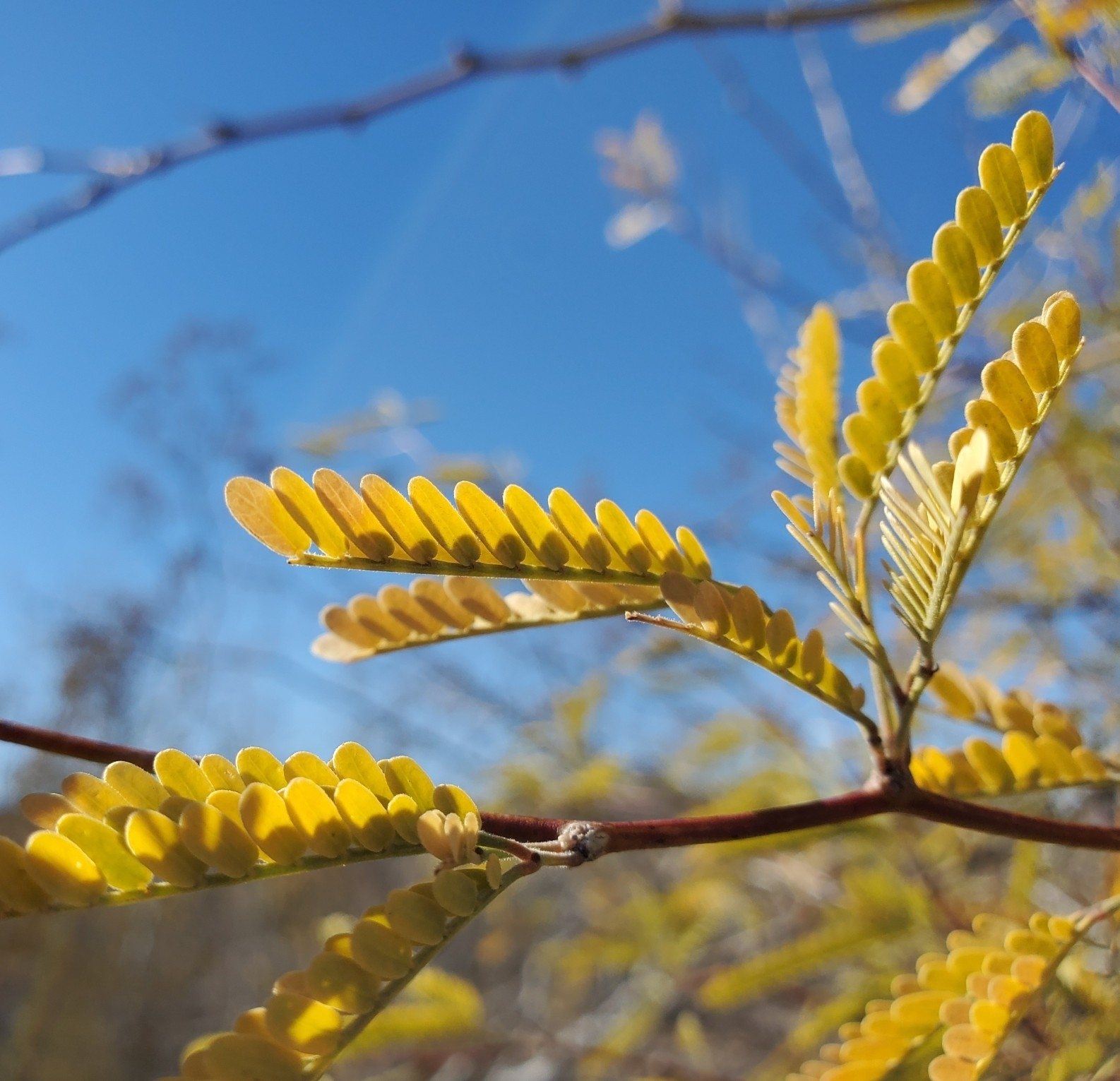
- Fine, twice-divided leaves with small, grey-green leaflets covered in soft hairs; usually deciduous in winter or during drought.
- Growth
- Moderate; faster with irrigation.
- Care needed
- Medium
The year at a glance
- Pollinators
- Drought tolerant
- Heat tolerant
- Wildlife
| J | F | M | A | M | J | J | A | S | O | N | D | |
|---|---|---|---|---|---|---|---|---|---|---|---|---|
| Flowers | ||||||||||||
| Fruit | ||||||||||||
| Plant |
Northern hemisphere months. In Australia, shift them by six.
- Difficulty
- Hard
- Toughness
- Needs looking after
Will it suit your garden?
Pick your zone, country, light and whether you have pets.
Full sun is 6 or more hours of direct sun a day, part shade 3 to 6 hours, shade under 3.
How it grows
Planting day
7 ft (2 m)
After 1 year
8 ft (2.3 m)
After 2 years
9 ft (2.7 m)
After 3 years
10 ft (3 m)
After 5 years
12 ft (3.7 m)
About 16 years to full size.
From a typical nursery size, at an average rate for this kind of plant. A rule of thumb, not a forecast.
Good to know
- Cats and dogs
- Safe
- Native to
- the US
- Invasive in
- Australia
- Growth rate
- Fast
Care
Jobs through the year
- WaterApr–May, Sep, every 30 days
- Established ground-grown trees need deep watering only in prolonged drought; water young trees more often for two growing seasons.
- WaterJun–Aug, every 28 days
- For established ground-grown trees, water deeply only during prolonged drought after the root zone dries.
- PruneMar
- After the worst frost, remove dead, crossing or weak branches gradually; wear protection against thorns.
- ProtectJan–Apr, Oct–Dec
- Not reliably hardy in zones 6–7; use a movable container and bright frost-free winter shelter rather than outdoor wrapping.
- Plant well away from paving, drains and narrow paths, allowing for a broad crown and thorny branches.
- Water deeply through the first two growing seasons, gradually increasing the interval between waterings.
- Avoid lawn-style frequent irrigation, which encourages shallow rooting and excessive shoot growth.
- Do not routinely fertilize; this nitrogen-fixing tree generally grows well in lean soil.
- Keep mulch clear of the trunk and remove seedlings while they are small.
- Stake only if needed for stability, using flexible ties, and remove supports once the roots hold the tree securely.
Pruning. Prune in late winter after the worst frost, removing dead, crossing or poorly attached branches and gradually developing a sound framework while the tree is young. Avoid topping or stripping out the lower and inner canopy in one operation; wear protection against the thorns.
Through the year
- Late winter
- Inspect branch attachments and carry out light structural pruning before new growth.
- Spring
- Plant when the soil is warming and frost risk has passed; water the root ball thoroughly.
- Late spring
- Check new growth for aphids and watch for seedlings after rain.
- Summer
- Water young trees deeply when the root zone dries; avoid frequent shallow watering.
- Late summer
- Collect fallen pods from paths and livestock areas, and remove unwanted seedlings.
- Autumn
- Reduce irrigation as temperatures fall and check that water drains away from the trunk.
In the garden
- Use as a broad-canopied shade tree in a spacious desert garden, keeping thorny branches away from seating and paths.
- Combine with agaves, yuccas and gravel for a layered, drought-tolerant planting.
- Plant above native grasses and desert perennials, using its filtered shade to soften intense summer sun.
- Use in southwestern native habitat gardens where flowers, pods and branching structure support wildlife.
Garden styles it suits: Desert modern, Southwestern, Desert / xeriscape, Wildlife garden, Dry gravel garden and Architectural minimal.
Plant it with: Desert marigold, Brittlebush, Red yucca, Banana yucca, Sideoats grama and Parry's agave.
Wildlife: Flowers attract bees and other insects. Birds use the canopy for nesting and shelter, while mammals and some birds eat the pods or seeds.
Problems to watch for
- Weak branch structure or storm breakage: train young trees gradually, retain a balanced canopy and avoid excessive irrigation or fertilizer.
- Root decline in wet soil: improve drainage and stop frequent watering; do not plant where water stands.
- Aphids and honeydew: tolerate small colonies or wash them off young growth with water; avoid unnecessary insecticides that kill predators.
- Desert mistletoe: monitor established trees and have heavily affected branches assessed by a qualified arborist; repeated removal of shoots alone does not eliminate the parasite.
Safety
Not known to be poisonous to people, cats or dogs; the pods have a history of human food use. Evidence specific to horses and this species is limited, but heavy consumption of mesquite pods can cause livestock feeding and digestive problems, so prevent unrestricted access. Hard seeds and pods can present choking or obstruction risks, and the sharp thorns can cause serious puncture wounds.
Where it spreads. Can spread into grassland and pasture in Arizona and adjoining parts of its native southwestern range, particularly where grazing and altered fire regimes favour woody growth. In Australia, mesquites, including velvet mesquite and hybrids, are regulated invasive weeds; affected regions include Queensland, Western Australia and the Northern Territory.
Easily confused with
Honey mesquite (Prosopis glandulosa)
Usually has longer, more widely spaced leaflets with much less hair. Velvet mesquite has shorter, closely spaced, softly hairy leaflets; hybrids can blur the distinction.
Chilean mesquite (Prosopis chilensis)
Typically has greener, less hairy foliage and fewer, more widely separated leaflets. Nursery trees are often hybrids, so thorniness alone is not a reliable identification feature.
Screwbean mesquite (Prosopis pubescens)
Produces tightly coiled, screw-shaped pods rather than the elongated, relatively straight or gently curved pods of velvet mesquite.
The name
The name velutina means velvety, referring to the soft hairs on the young shoots and foliage.
Propagation. Grow from seed after carefully nicking or abrading the hard seed coat, then sow in a warm, free-draining medium. Use deep containers and transplant young to limit root disturbance; seedlings may be hybrids where other mesquites grow nearby. Do not propagate where planting is prohibited.
Checked against open data
- Accepted botanical name
- Prosopis velutina
- In the US and Canada
- Native in the lower 48 states. Introduced in Hawaii.
Sources: GBIF (CC BY 4.0) and USDA PLANTS. The care and design notes are LandscapeGPT's own.
See it in your own yard.
Upload a photo of your yard and see it redesigned with plants that suit your climate, each checked against your zone.