Common manzanita
Arctostaphylos manzanita. Family Ericaceae. Shrub.
Also called Whiteleaf manzanita.
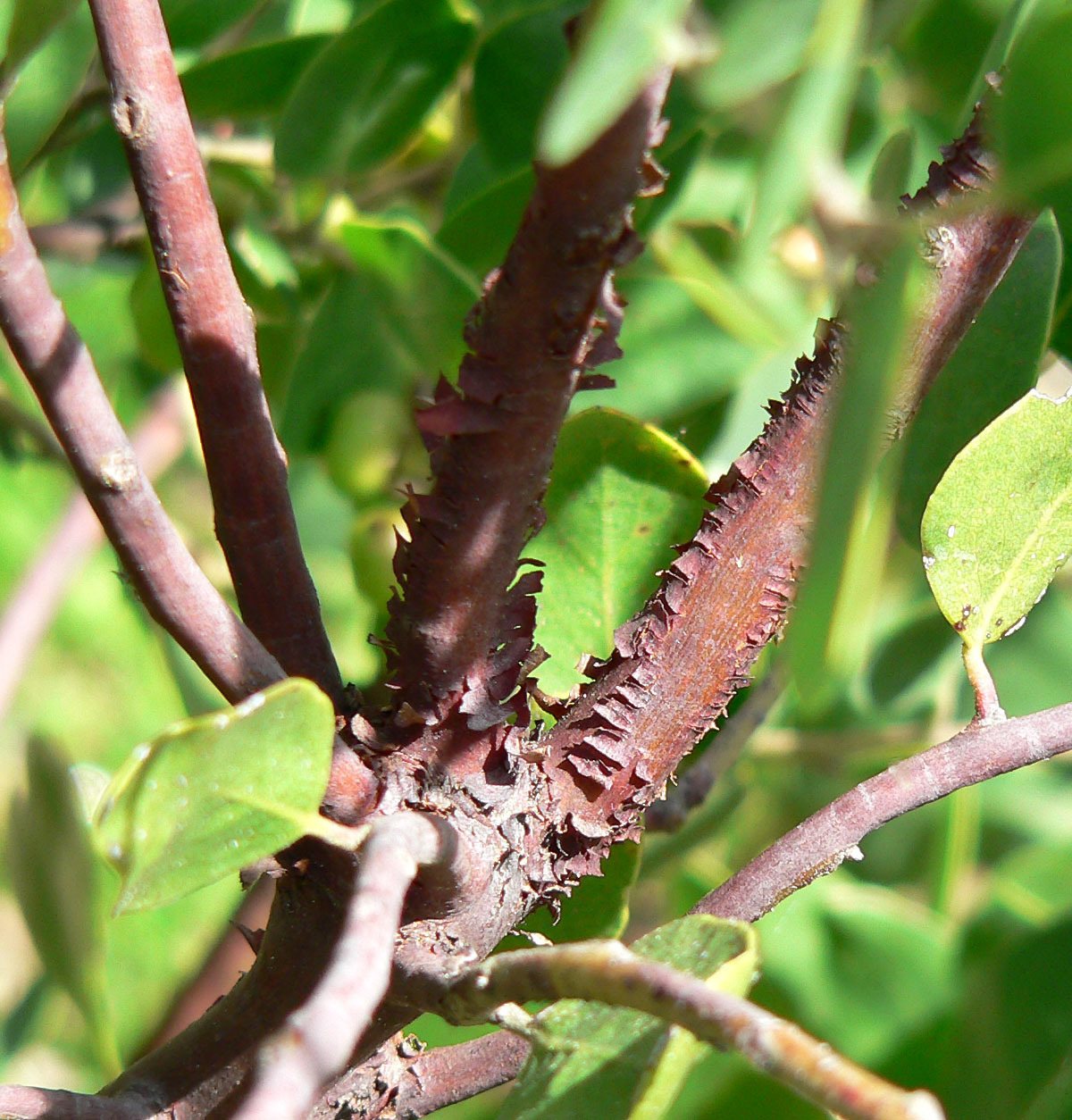
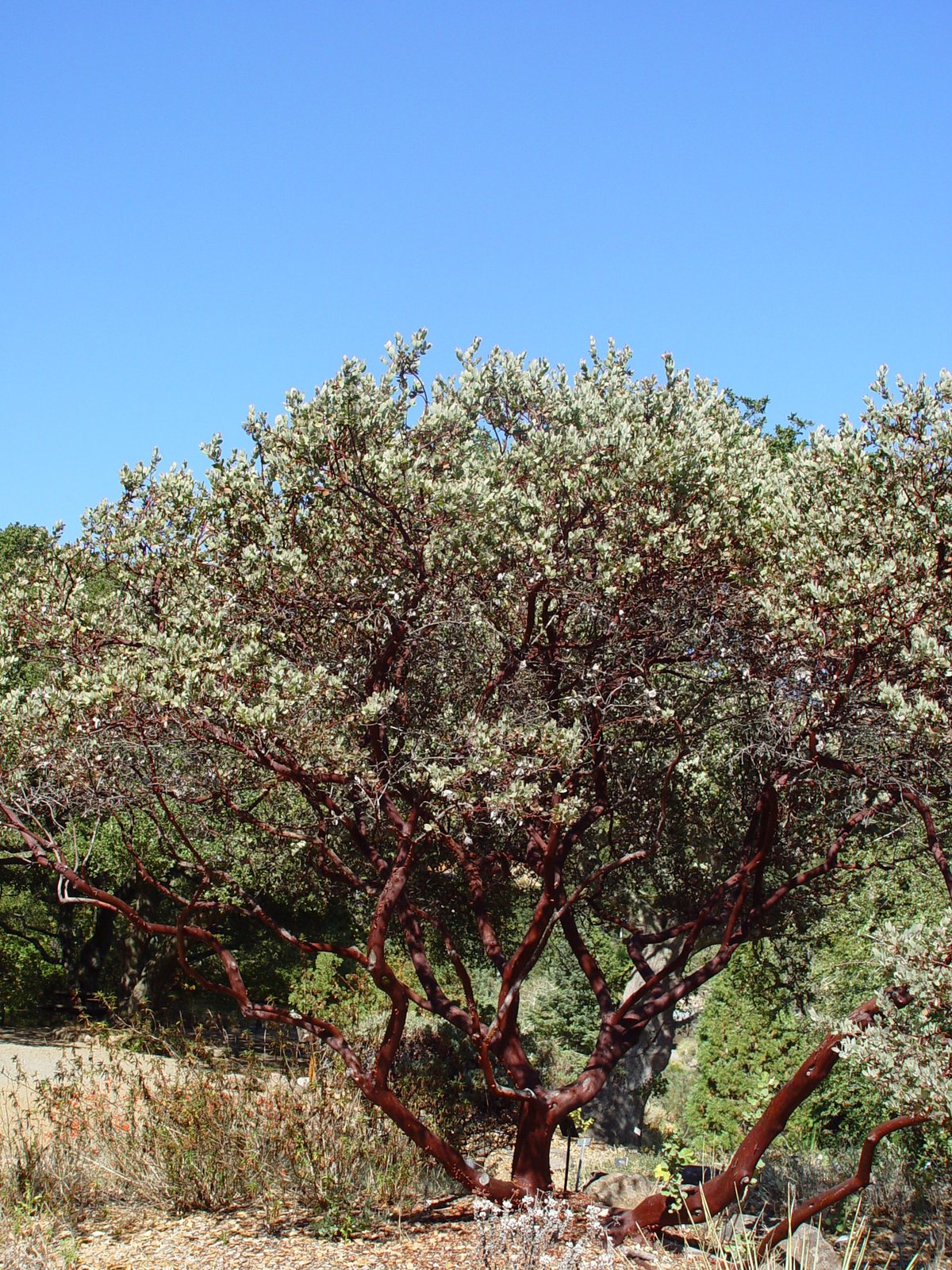
Common manzanita is a large evergreen shrub or small tree native to California, grown for its smooth reddish-brown bark, twisting branches and winter flowers. It suits dry, sunny gardens with excellent drainage, but is difficult to keep healthy in waterlogged soil or regularly irrigated borders.
At a glance
- Sun
- Full sun; tolerates light shade, though growth becomes more open and flowering may decrease.
- Water
- Low once established. Water young plants deeply but infrequently, allowing the soil to dry between waterings; established plants generally need little or no summer irrigation in suitable climates.
- Soil
- Well-drained sandy, gravelly or rocky soil, preferably acidic to neutral. Avoid waterlogged ground and heavily enriched planting holes.
- Height
- 10-20 ft (3-6 m)
- Spread
- 10-15 ft (3-4.6 m)
- Flowers
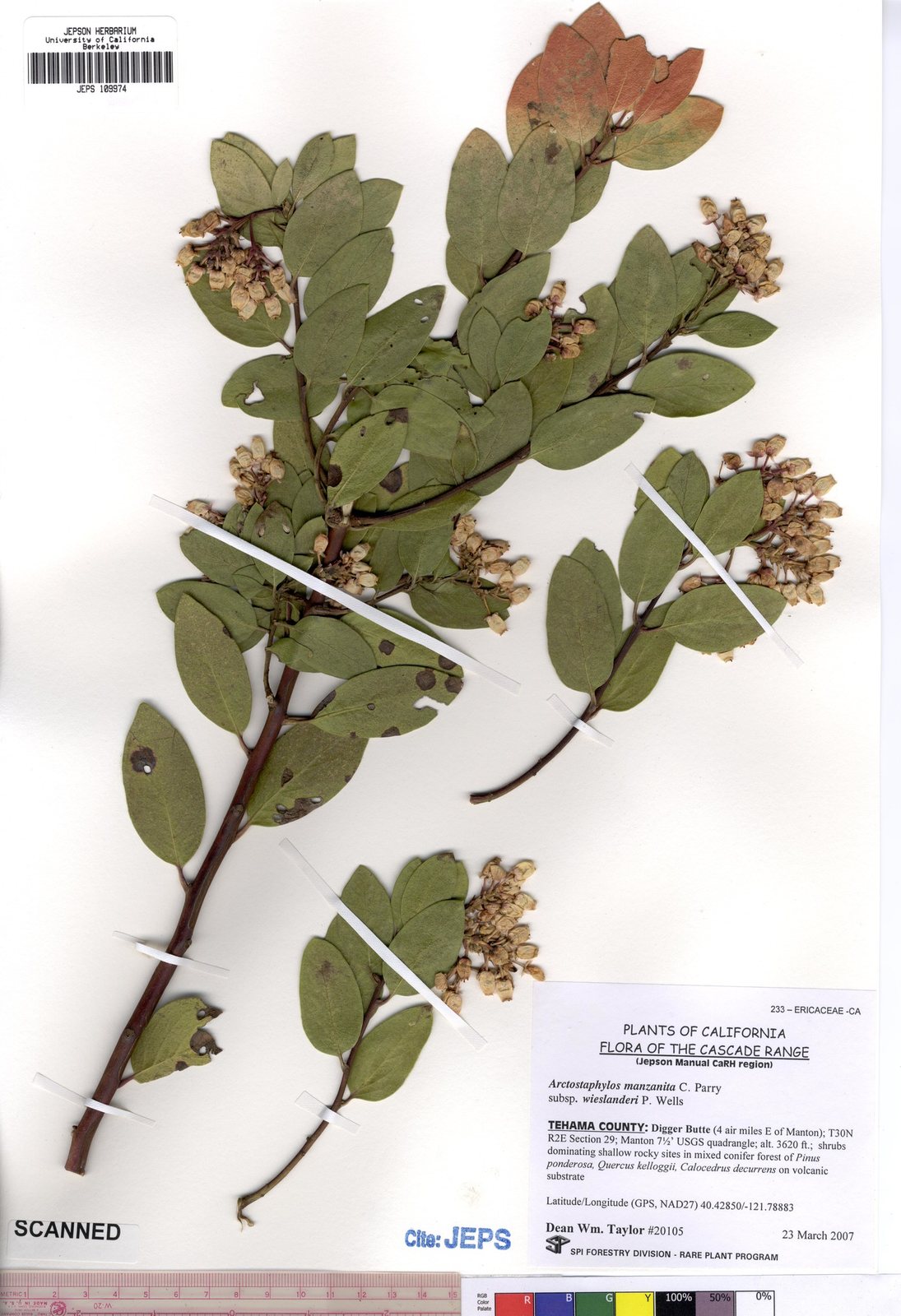
- Winter to early spring; clusters of small, urn-shaped white to pale pink flowers.
- Foliage
- Evergreen. Leathery, oval, pale grey-green leaves held on reddish stems; older branches develop smooth, peeling mahogany-red bark.
- Growth
- Slow to moderate, depending on soil, climate and establishment.
- Care needed
- Low
The year at a glance
- Pollinators
- Drought tolerant
- Heat tolerant
- Wildlife
- Low allergen
| J | F | M | A | M | J | J | A | S | O | N | D | |
|---|---|---|---|---|---|---|---|---|---|---|---|---|
| Flowers | ||||||||||||
| Fruit | ||||||||||||
| Plant |
Northern hemisphere months. In Australia, shift them by six.
- Difficulty
- Hard
- Toughness
- Needs looking after
Will it suit your garden?
Pick your zone, country, light and whether you have pets.
Full sun is 6 or more hours of direct sun a day, part shade 3 to 6 hours, shade under 3.
How it grows
Planting day
1.8 ft (0.54 m)
After 1 year
4 ft (1.1 m)
After 2 years
6 ft (1.8 m)
After 3 years
8 ft (2.4 m)
After 5 years
12 ft (3.6 m)
About 7 years to full size.
From a typical nursery size, at an average rate for this kind of plant. A rule of thumb, not a forecast.
Good to know
- Cats and dogs
- Safe
- Native to
- the US
- Growth rate
- Slow
Care
Jobs through the year
- WaterApr–May, Sep–Oct, every 28 days
- Water established plants only in unusually dry soil; young plants need closer moisture checks.
- WaterJun–Aug, every 28 days
- Water established plants only during exceptional drought with stress; otherwise keep summer irrigation off.
- PruneJul–Aug
- In dry weather, remove dead wood and make only small shaping cuts; retain leafy growth.
- ProtectJan–Apr, Oct–Dec
- Unsuitable for reliable outdoor survival in zones 6–7; overwinter a container plant in bright, frost-free shelter.
- ProtectNov
- Clear leaves and mulch from the trunk base and prevent winter waterlogging.
- Plant in autumn where winters are mild, or in spring where winter cold makes establishment difficult.
- Keep the root flare at soil level and leave the trunk clear of mulch.
- Water deeply during establishment, then let the root zone dry before watering again.
- Keep lawn sprinklers and frequent summer irrigation away from established plants.
- Do not routinely fertilise; avoid rich compost and manure around the roots.
Pruning. Prune lightly during dry summer weather to remove dead wood or gradually expose selected lower branches. Avoid cutting back into old, leafless wood or removing large limbs; common manzanita does not reliably recover from hard pruning.
Through the year
- Winter
- Enjoy the flowers and check that rainwater drains freely away from the roots.
- Spring
- Plant in colder suitable regions and water new plants thoroughly after planting.
- Late spring
- Check young plants for dry soil; water deeply only when needed.
- Summer
- Remove dead branches in dry weather and make only light shaping cuts.
- Autumn
- Plant in mild-winter regions, allowing plenty of space for the mature canopy.
- Late autumn
- Clear accumulated mulch from the trunk base and redirect any irrigation spraying the bark.
In the garden
- Use as a specimen beside a path or seating area where its bark and branching can be seen closely.
- Plant on a sunny, well-drained slope with other California natives for a low-water planting.
- Set against gravel and boulders to emphasise its sculptural trunk and pale foliage.
- Combine with low, drought-tolerant shrubs and perennials, leaving open space around its trunk.
Garden styles it suits: California native, Mediterranean, Desert / xeriscape, Dry gravel garden, Architectural minimal and Winter interest.
Plant it with: California buckwheat, Cleveland sage, Deer grass, California fuchsia, Toyon and California poppy.
Wildlife: Winter and early-spring flowers provide nectar and pollen for bees and other insects. Birds and mammals eat the fruits, and the evergreen canopy offers shelter.
Problems to watch for
- Root and crown rot: prevent with excellent drainage, a clear trunk base and minimal summer irrigation; severely affected plants usually need replacing.
- Fungal leaf spots: avoid overhead watering and remove fallen diseased leaves; minor spotting is usually cosmetic.
- Branch dieback and cankers: prune affected branches back to healthy wood during dry weather, disinfect tools between cuts and avoid unnecessary bark wounds.
- Poor recovery after hard pruning or transplanting: plant young nursery stock in its permanent position and restrict later pruning to small cuts.
Safety
Not known to be toxic to people, cats, dogs or horses, although animal-specific safety information is limited. The fruits have a history of human food use; leaves and bark should not be eaten or used for home remedies.
Easily confused with
Bigberry manzanita (Arctostaphylos glauca)
Also has pale foliage and red bark, but its mature fruits are noticeably larger, commonly about 0.5 in (1.3 cm) across; common manzanita fruits are usually smaller.
Pacific madrone (Arbutus menziesii)
Usually becomes a much larger tree, with larger, glossy green leaves and conspicuous clusters of orange-red berries rather than manzanita's smaller, duller fruits.
The name
Manzanita means 'little apple' in Spanish, referring to the fruits, while Arctostaphylos comes from Greek words meaning 'bear grape'.
Propagation. Take semi-ripe cuttings in late summer, using rooting hormone and a very free-draining medium; rooting can be slow and unreliable. Seed has complex dormancy and usually needs specialist pretreatment, so nursery-grown plants are the simplest option.
Checked against open data
- Accepted botanical name
- Arctostaphylos manzanita
- In the US and Canada
- Native in the lower 48 states.
- Native range
- California.
- Measured
- Soil pH 5.5 to 7.3. Average height 213 cm.
Sources: GBIF (CC BY 4.0), USDA PLANTS and Trefle (CC BY 4.0). The care and design notes are LandscapeGPT's own.
See it in your own yard.
Upload a photo of your yard and see it redesigned with plants that suit your climate, each checked against your zone.