Fishhook barrel cactus
Ferocactus wislizeni. Family Cactaceae. Succulent.
Also called Arizona barrel cactus, Candy barrel cactus, Compass barrel cactus.
This slow-growing desert cactus forms a deeply ribbed barrel with stout, hooked spines and a crown of summer flowers. Gardeners grow it for its sculptural shape, colourful spines and drought tolerance, but it needs excellent drainage and protection from prolonged cold and winter wet.
At a glance
- Sun
- Full sun; gradually acclimatise nursery-grown plants to strong sunlight. Young plants may benefit from light afternoon shade in very hot climates.
- Water
- Very low once established. Water deeply but infrequently during warm growth, allowing the soil to dry completely between waterings; keep nearly dry in winter.
- Soil
- Sharply drained, sandy or gravelly soil. For containers, use a gritty cactus mix and a pot with unobstructed drainage holes.
- Height
- 3-6 ft (0.9-1.8 m), occasionally taller with great age
- Spread
- 2-3 ft (0.6-0.9 m)
- Flowers
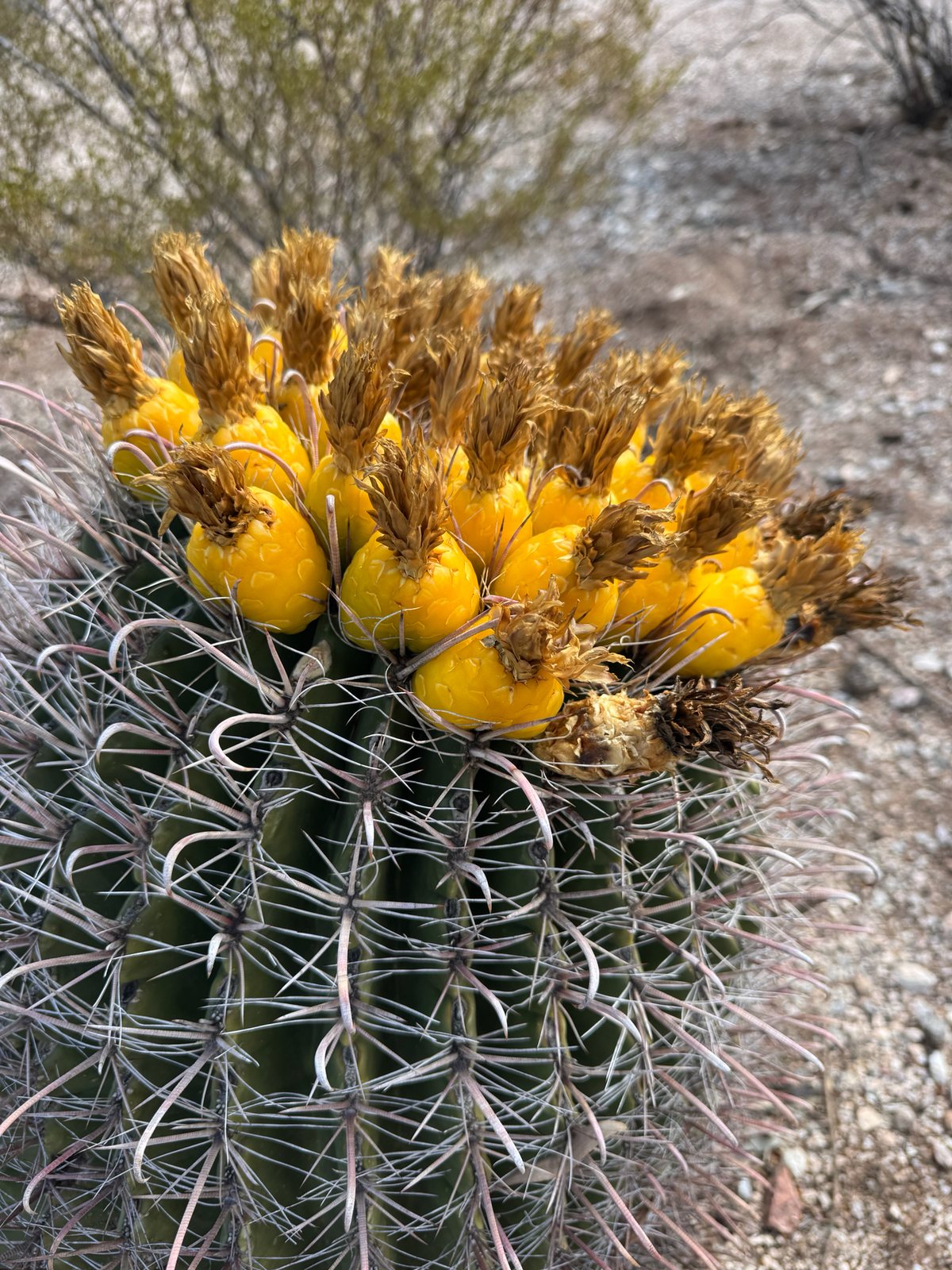
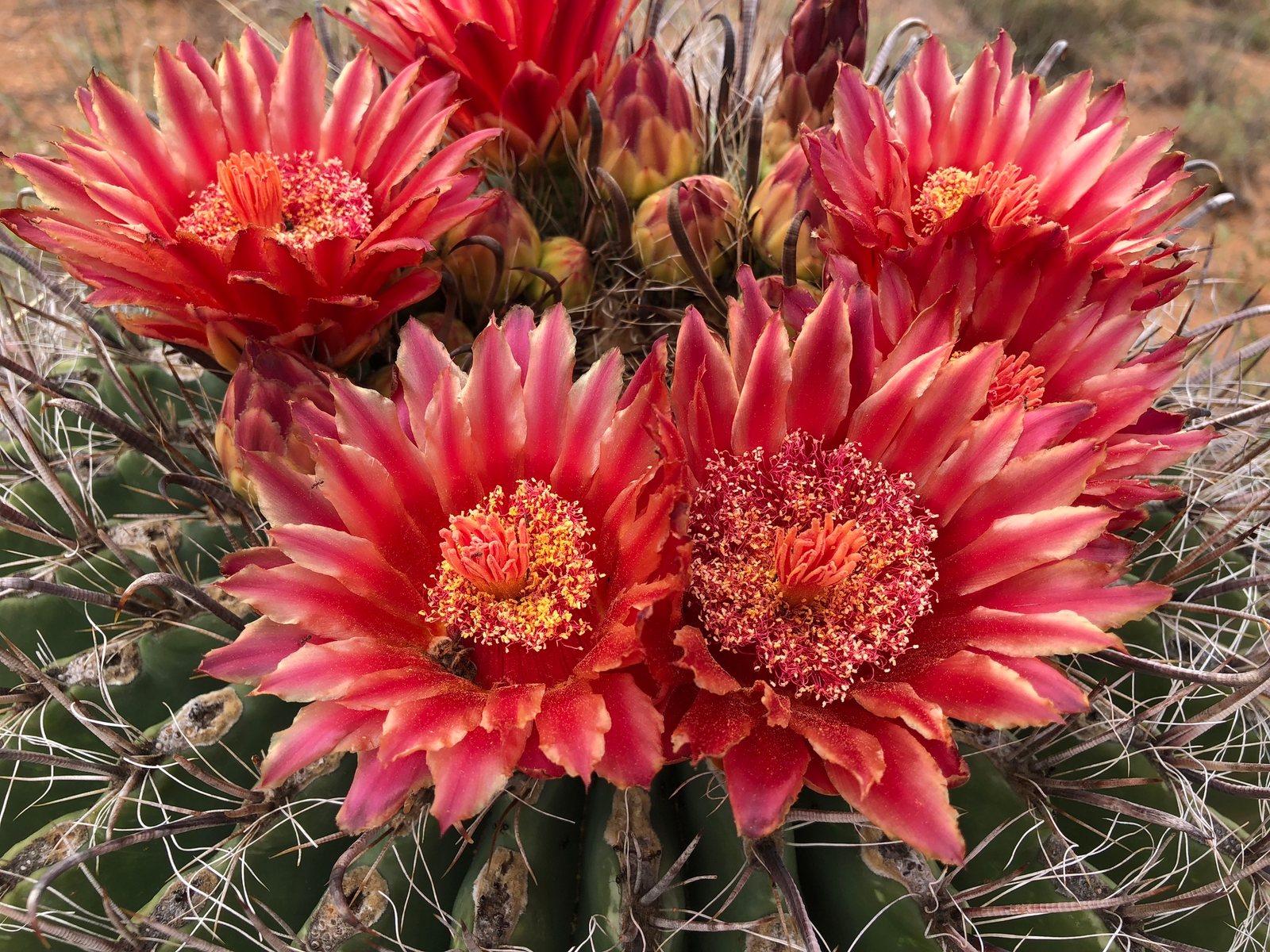
- Yellow, orange or red flowers form a ring around the crown in summer to early autumn on mature plants.
- Foliage
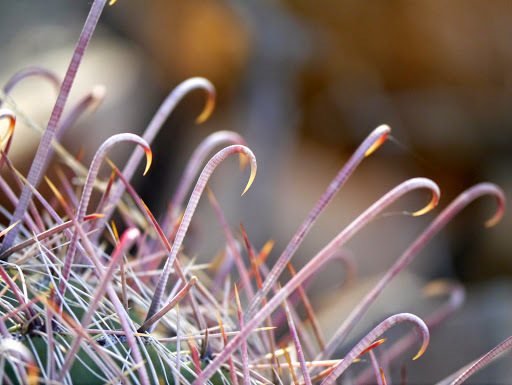
- Evergreen. No visible leaves; the green, water-storing stem has prominent ribs, woolly growing points and clusters of stout spines, including a strongly hooked central spine.
- Growth
- Slow
- Care needed
- Low
The year at a glance
- Pollinators
- Deer resistant
- Drought tolerant
- Heat tolerant
- Wildlife
- Low allergen
| J | F | M | A | M | J | J | A | S | O | N | D | |
|---|---|---|---|---|---|---|---|---|---|---|---|---|
| Flowers | ||||||||||||
| Fruit | ||||||||||||
| Plant |
Northern hemisphere months. In Australia, shift them by six.
- Difficulty
- Moderate
- Toughness
- Needs looking after
Will it suit your garden?
Pick your zone, country, light and whether you have pets.
Full sun is 6 or more hours of direct sun a day, part shade 3 to 6 hours, shade under 3.
How it grows
Planting day
0.8 ft (0.25 m)
After 1 year
1.2 ft (0.36 m)
After 2 years
1.6 ft (0.48 m)
After 3 years
1.9 ft (0.59 m)
After 5 years
2.7 ft (0.82 m)
About 10 years to full size.
From a typical nursery size, at an average rate for this kind of plant. A rule of thumb, not a forecast.
Good to know
- Cats and dogs
- Safe
- Native to
- the US
- Growth rate
- Slow
Care
Jobs through the year
- WaterApr–May, Sep, every 30 days
- Water only when warm and completely dry; in zones 6–7 use a movable, sharply drained pot.
- WaterJun–Aug, every 21 days
- Water deeply only after the root zone dries completely; skip watering in cool or wet weather.
- FeedMay
- Give container plants one dilute cactus feed; established plants in the ground need none.
- ProtectMay–Jun
- Acclimatise gradually to outdoor sun after frost; handle hooked spines with padding and tools.
- ProtectSep–Oct
- Move indoors before frost to a bright, dry, frost-free position.
- ProtectJan–Mar, Nov–Dec
- Keep nearly dry under bright, frost-free cover with good ventilation.
- Plant on a raised mound or slope if drainage is doubtful; do not bury the base deeper than it grew previously.
- Water only after the root zone has dried; do not run it on the same irrigation schedule as lawns or leafy borders.
- Keep organic mulch away from the stem; use a shallow gravel dressing instead.
- Feed container plants once in spring with a dilute cactus fertiliser; established plants in the ground usually need none.
- In cold or wet-winter regions, grow in a movable container and overwinter in a bright, dry, frost-free place.
- Keep hooked spines well away from paths, play areas and pets; use thick padding and suitable handling tools when moving it.
Pruning. No routine pruning is needed. Do not cut the crown or trim healthy spines; remove loose debris with long-handled tongs rather than reaching between the spines.
Through the year
- Spring
- Check drainage and inspect the base for soft spots before gradually resuming watering as temperatures rise.
- Late spring
- Plant or repot when warm weather is settled, using a sharply drained mix and handling the cactus with padding.
- Summer
- Water deeply only when the soil is dry, and check container plants for mealybugs.
- Late summer
- Watch for the crown of flowers on mature plants; avoid overhead watering into the crown.
- Autumn
- Reduce watering as growth slows and move containers under bright, dry cover before frost.
- Winter
- Keep sheltered plants nearly dry and maintain ventilation; protect outdoor plants from prolonged rain and freezing conditions.
In the garden
- Use as a sculptural focal point in a sunny gravel garden, with open space around its ribbed silhouette.
- Repeat several plants among boulders and low desert groundcovers for a restrained dryland planting.
- Grow in a broad, stable container on a sunny terrace where winter shelter is available.
- Pair with fine-textured grasses and upright desert succulents for contrasting shapes, set well back from circulation routes.
Garden styles it suits: Desert modern, Architectural minimal, Desert / xeriscape, Southwestern, Dry gravel garden and Mexican hacienda.
Plant it with: Red yucca, Banana yucca, Desert marigold, Blackfoot daisy, Brittlebush and Blue grama.
Wildlife: Flowers provide pollen and nectar for native bees. Fruits and seeds are eaten by some desert birds and mammals.
Problems to watch for
- Root or basal rot in wet soil: stop watering, improve drainage and shelter from winter rain; a plant with extensive soft, collapsing tissue may not recover.
- Mealybugs or scale: inspect between ribs and around the base, isolate affected pots and use a cactus-safe treatment according to its label.
- Sunburn after a sudden move into strong sun: acclimatise gradually and provide temporary light shade; existing bleached or corky scars will remain.
- Cold damage: protect from freezing, especially when wet, and overwinter containers in a bright, frost-free location.
Safety
Not known to be toxic to people, cats, dogs or horses, though species-specific safety information for pets and livestock is limited. The main hazard is physical: the hooked spines can cause deep punctures, become embedded and injure eyes or mouths. Keep children and animals from handling or chewing it.
Easily confused with
California barrel cactus (Ferocactus cylindraceus)
Usually has a denser covering of colourful spines, with central spines generally straighter or less strongly fishhook-shaped; mature plants often become more columnar.
Golden barrel cactus (Echinocactus grusonii)
Has closely spaced ribs and dense, mostly straight golden spines rather than the prominent hooked central spines of fishhook barrel cactus.
The name
Ferocactus means 'fierce cactus', wislizeni honours physician and plant collector Friedrich Wislizenus, and 'fishhook' describes the strongly curved central spines.
Propagation. Usually grown from seed sown in spring or early summer in a fine, freely draining cactus mix. Keep warm and lightly moist during germination, then gradually reduce moisture as seedlings establish. It usually grows as a solitary stem, so offsets are not a dependable propagation method.
Checked against open data
- Accepted botanical name
- Ferocactus wislizeni
- In the US and Canada
- Native in the lower 48 states.
- Native range
- Arizona, Mexico Northeast, Mexico Northwest, New Mexico and Texas.
- Measured
- Average height 135 cm.
Sources: GBIF (CC BY 4.0), USDA PLANTS and Trefle (CC BY 4.0). The care and design notes are LandscapeGPT's own.
See it in your own yard.
Upload a photo of your yard and see it redesigned with plants that suit your climate, each checked against your zone.